Timothée Chalamet Becomes Bob Dylan: Inside His 60 Minutes Journey and the Making of A Complete Unknown

When Timothée Chalamet first got the offer to play Bob Dylan in A Complete Unknown, he was only 23 years old—and admittedly, not much of a Dylan aficionado. Most people around him advised against it. Dylan, after all, is one of the most studied and guarded figures in music history. But Chalamet, who thrives on pushing boundaries, decided to take the leap. Now 29, he’s reaping the rewards of that decision with an Academy Award nomination for Best Actor and wide critical acclaim for his performance.
Chalamet’s journey into Dylan’s world wasn’t rushed. A combination of pandemic delays, industry strikes, and other commitments gave him five years to prepare—time he used to study Dylan’s mannerisms, voice, and soul. Unlike some biopics that lean on mimicry, Chalamet’s approach was to find his own truth within Dylan’s mystique. He immersed himself completely, refusing to use his phone during filming and avoiding distractions on set. The result is a portrayal not just of a music legend, but of a young man at a pivotal moment of change, mirrored by Chalamet’s own trajectory in Hollywood.
- 60 Minutes Interviews “Timothée Chalamet”, “Jamie Lee Curtis” & “Kate Winslet” January 25 2026
- Jamie Lee Curtis: 60 Minutes on Addiction, Motherhood, and True Lies
- Kate Winslet on “Lee”: 60 Minutes Reveals a Passion Project Seven Years in the Making
Living Dylan: From Greenwich Village to Gut-Wrenching Performances
The film, set in the early 1960s, tracks Bob Dylan’s transformation from obscure folk singer to cultural icon. It begins with Dylan arriving in New York City at 19, playing gigs at Cafe Wha? in Greenwich Village, and quickly ascending to national prominence. Chalamet retraced many of these steps, even visiting the now-changed Cafe Wha? during filming. He remarked how the venue’s musical energy had shifted—gone were the acoustic ballads of Dylan’s era, replaced by Aerosmith and AC/DC covers. Still, it was a physical anchor to a time that Chalamet worked tirelessly to understand.
Learning to play the harmonica and guitar was just the beginning. Chalamet absorbed over 40 Dylan songs, well beyond what the script required. Rather than lip-syncing to polished studio tracks, he insisted on performing live, knowing that Dylan’s grit—his cigarettes, his wine, his pain—couldn’t be captured in a clean playback. Director James Mangold supported the move and captured a now-iconic scene of Dylan (Chalamet) performing for his ailing idol, Woody Guthrie. The raw emotion and unscripted musical choices in that take became one of the most memorable moments in the film.
Acting Without a Mask to Portray a Master of Disguise
Bob Dylan has always been famously difficult to define. A poet, prophet, icon, and contradiction all at once, his identity was often deliberately obscured. For Chalamet, this presented a unique challenge—how do you portray someone who spent his life hiding behind personas? In interviews, he admitted wrestling with that question throughout filming. He didn’t want to copy Dylan, nor did he want to insert too much of himself. The answer, it seems, lay in finding emotional honesty, even when portraying someone who famously withheld it.
This tension culminated in Chalamet’s performance of “It Ain’t Me, Babe” alongside Monica Barbaro’s Joan Baez. The real-life video of Dylan and Baez informed his choices, especially the subtle discomfort Dylan showed in avoiding eye contact with Baez. Chalamet slowed the YouTube footage down to analyze Dylan’s body language, trying to understand not just what Dylan said, but what he didn’t. That subtle dissection of behavior added layers of complexity to Chalamet’s performance, giving audiences a version of Dylan that feels at once personal and unreachable—just as the real man has always been.
Timmy From the Block: Humble Beginnings and Artistic Grit
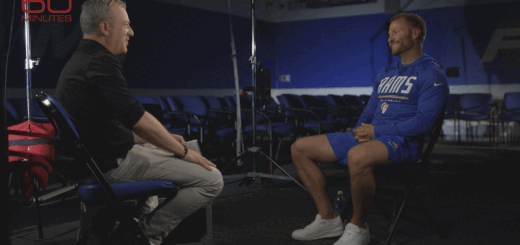
The 60 Minutes segment, led by Anderson Cooper, also pulled back the curtain on Chalamet’s upbringing. Born and raised in Manhattan’s Hell’s Kitchen, he grew up in a rent-controlled building filled with artists. His mother, Nicole Flender, was a dancer and union worker; his father, Marc Chalamet, a French journalist; and his sister Pauline, now an actress herself. Despite acting in Law & Order at age 12, young Timmy didn’t romanticize the industry. Surrounded by struggling creatives, he initially feared a life in acting.
It was his acceptance into LaGuardia High School, the famed performing arts school, that shifted his focus. He became intensely driven, known for leading school musicals and developing comedic rap routines as “Lil’ Timmy Tim.” Though he briefly attended Columbia and NYU, he left college to pursue acting full-time, a decision validated when Call Me by Your Name catapulted him to global fame. In that role, like Dylan, he portrayed a young man on the edge of transformation—vulnerable, magnetic, and unforgettable.
In Dylan, a Mirror—But Not a Blueprint
What makes Chalamet’s Dylan so riveting is not a perfect impersonation but a spiritual likeness. Both men were young artists who shouldered immense expectations early in their careers. Both navigated fame while resisting easy definitions. Chalamet, who has played everyone from a drug-addicted teen to King Henry V, understands the weight of shifting personas. But Dylan’s particular brand of mystique—equal parts revelation and retreat—offered a new level of complexity.
In the interview, Chalamet joked about never having met Dylan and how, if he did, he might not even bring up the film. Instead, he said he might just talk about the weather. That instinct, to preserve a respectful distance from the myth while still channeling its power, may explain why Chalamet succeeded in the role when others might not have dared to try.
A Complete Unknown, But Not Anymore
The film’s release in December 2025 stunned critics and fans alike, earning eight Academy Award nominations and marking a major artistic milestone for Chalamet. His portrayal helped bridge generational divides, introducing Dylan’s legacy to new audiences while honoring its depth for lifelong fans.
Ultimately, Chalamet’s portrayal reminds us why Dylan still matters. It isn’t just about protest songs or harmonicas—it’s about the defiance of being misunderstood, the courage to be different, and the delicate resilience of chasing your own fragile version of destiny. For Chalamet, embodying Dylan wasn’t about performance alone—it was a personal evolution that fused talent with reverence, leaving behind something raw and unforgettable.
As Dylan once told 60 Minutes, destiny is a private feeling best kept close. In A Complete Unknown, Chalamet shows just how powerful it can be when someone dares to make that feeling known.
More 60 Minutes January 25 2026
- 60 Minutes Interviews “Timothée Chalamet”, “Jamie Lee Curtis” & “Kate Winslet” January 25 2026
- Timothée Chalamet Becomes Bob Dylan: Inside His 60 Minutes Journey and the Making of A Complete Unknown
- Jamie Lee Curtis: 60 Minutes on Addiction, Motherhood, and True Lies
- Kate Winslet on “Lee”: 60 Minutes Reveals a Passion Project Seven Years in the Making