Saint Francis in the Cloud: 60 Minutes Reports on the AI Mission to Save an 800-Year-Old Basilica
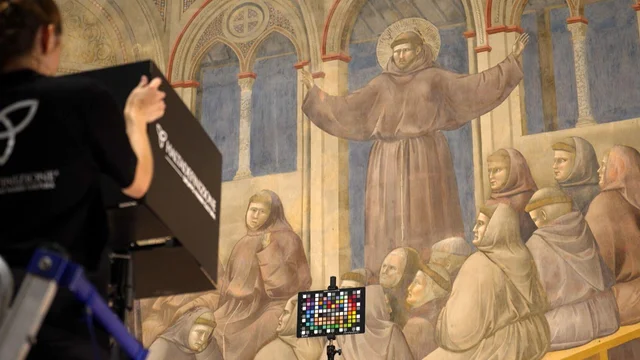
More than 800 years after the death of Saint Francis of Assisi, the basilica built in his honor remains one of the most important religious and artistic landmarks in Europe.
It is also fragile.
The Basilica of Saint Francis of Assisi has survived centuries of earthquakes, war, fire and weather, but the devastation caused by two powerful earthquakes in 1997 left scars that restorers are still attempting to repair nearly three decades later.
Now the people responsible for protecting the basilica are turning to some of the newest technology available — artificial intelligence, gigapixel photography, drones, lasers and 3D imaging.
Correspondent Bill Whitaker explores that unusual collision between the medieval and digital worlds in the 60 Minutes report “Saint Francis in the Cloud.”
- 60 Minutes Reports on “Who Needs Humans?”, “The Thom Tillis Tightrope” & “Saint Francis in the Cloud” on October 4 2026
- Who Needs Humans? 60 Minutes Reports on the AI Revolution Reshaping the Future of Work
- The Thom Tillis Tightrope: 60 Minutes Reports on the Republican Senator’s Break With Trump
A Church Built Around the Legacy of Saint Francis
The basilica stands in Assisi, the Umbrian hill town forever associated with Saint Francis, one of the most influential figures in Christian history.
Francis was born in Assisi around 1182 and came from a prosperous merchant family. He ultimately rejected that wealth and embraced a life centered on poverty, humility and service to others.
The religious movement he inspired became the Franciscan Order, and Francis was canonized shortly after his death in 1226.
Construction of the basilica began soon afterward.
Over the centuries, the church became both a major destination for Christian pilgrims and an extraordinary repository of medieval art.
UNESCO describes Assisi and its Franciscan sites as a fundamental reference point in the development of Italian and European art and architecture.
Some of Medieval Italy’s Greatest Artists Worked There
Part of the basilica’s significance comes from the remarkable concentration of artworks inside it.
Its walls and vaults feature works associated with masters including Cimabue, Pietro Lorenzetti, Simone Martini and Giotto.
Their paintings helped define the transition toward a more naturalistic style of European art.
Rather than simply creating decorative images, the artists used the enormous interior of the basilica to tell stories.
Scenes from the life of Saint Francis and other biblical narratives surround visitors as they move through the church.
That artistic legacy is part of the reason damage to the basilica is so consequential.
A destroyed section of plaster may represent far more than part of a wall. It can mean the disappearance of a unique piece of a medieval masterpiece.
The Earthquakes of 1997
On September 26, 1997, powerful earthquakes struck central Italy.
Assisi was among the communities affected.
The basilica initially survived one major shock, but another powerful quake followed while experts and friars were inspecting damage inside the church.
Part of the vaulted ceiling collapsed.
Four people were killed by falling rubble, while priceless frescoes and decorative elements were shattered.
The collapse also produced an enormous cloud of dust and debris that swept through the interior.
For people who were there, the experience remains difficult to forget.
Friar Giulio Cesareo, who was a student at the basilica at the time, tells 60 Minutes that he remembers seeing one of its huge stone arches moving during the earthquake.
Decades later, even small vibrations can bring those memories back.
An Extraordinary Restoration Began
The earthquake triggered a massive rescue and restoration operation.
Experts gathered fallen fragments from the floor and attempted to reconstruct shattered frescoes piece by piece.
The challenge was extraordinary.
Imagine taking a centuries-old painting, smashing portions of it into tens of thousands of irregular fragments and then trying to determine exactly where each tiny piece originally belonged.
Restorers succeeded in recovering and rebuilding substantial sections of the damaged artwork.
But they could not solve everything.
Some frescoes still contain visible gaps.
And beneath the basilica sits evidence of how difficult the task became.
More Than 80,000 Pieces Still Have No Home
Chief restorer Sergio Fusetti takes Whitaker into storage areas beneath the church where an astonishing collection remains.
There are more than 80,000 fragments from the 1997 earthquake that restorers have not been able to return to their original locations.
Some are recognizable pieces of painted plaster.
Others are tiny fragments containing only a small area of color, a line or part of a brushstroke.
For decades, restorers have attempted to match them manually.
Fusetti compares the challenge to an enormous jigsaw puzzle — except there is no complete picture printed on the box and many of the pieces have been damaged.
Sometimes a full day of work might result in finding the correct location for only a single fragment.
After years of painstaking effort, Fusetti has reached a sobering conclusion.
Human beings may have gone as far as they reasonably can.
“Only Artificial Intelligence Can Help Us”
That is where AI enters the story.
The friars and restorers are now working with technology specialists who hope artificial intelligence can analyze the fragments in ways that would be overwhelmingly time-consuming for a person.
An AI system can compare shapes, colors, textures, brushstrokes and other visual details across vast quantities of imagery.
A fragment that looks almost meaningless to the human eye might contain patterns that a computer can compare with millions of pixels elsewhere in the frescoes.
The hope is that AI can identify potential matches and narrow down the possibilities for restorers.
It does not necessarily mean allowing a machine to independently alter an irreplaceable medieval painting.
Instead, the technology can become an extraordinarily powerful assistant.
The final judgment remains with human experts.
Building a Digital Twin of the Basilica
The AI restoration work forms only one part of a much larger project.
Technology company Haltadefinizione is creating an extraordinarily detailed digital twin of the Basilica of Saint Francis.
Chief Technology Officer Giovanni Borelli is leading the effort.
His team is using robotic cameras, drones and laser scanners to record the church in extreme detail.
Hundreds of thousands of photographs are being collected and stitched together.
The objective is not merely to produce an attractive virtual tour.
The result is intended to be an extraordinarily precise three-dimensional record of the building.
What Exactly Is Gigapixel Photography?
One of the project’s most important tools is gigapixel photography.
A conventional digital photograph contains millions of pixels.
A gigapixel image contains billions.
That enormous increase in resolution allows specialists to zoom deep into a painting while retaining extraordinary detail.
Individual brushstrokes can become visible.
Tiny cracks, lifting paint, discoloration and other changes that might be difficult to notice from the floor of the basilica can be examined remotely.
Borelli tells 60 Minutes that the technology can reveal details beyond what visitors could ordinarily perceive with the naked eye.
For art conservators, that level of detail is particularly valuable because restoration often depends on identifying very small changes before they become serious damage.
A Digital Insurance Policy Against Another Earthquake
The basilica exists in an earthquake-prone region.
That means another damaging quake is not an abstract possibility.
A highly accurate digital model could therefore function almost like an architectural insurance policy.
If part of the basilica were damaged again, future restorers could consult a detailed record showing exactly what existed beforehand.
Every surface, fresco and architectural detail could potentially be compared with its pre-disaster condition.
The technology cannot prevent an earthquake.
But it could dramatically improve humanity’s ability to reconstruct what the earthquake destroys.
The team hopes the finished model will represent one of the highest-resolution 3D records ever produced of a building.
AI Could Monitor Damage in Minutes Instead of Years
The digital twin also opens the door to a different kind of preservation.
Maintaining a huge medieval church traditionally requires specialists to physically inspect large areas of painted and architectural surfaces.
That can be painstakingly slow.
AI could instead compare new scans with earlier ones.
Algorithms could flag emerging cracks, discoloration, paint lifting or other abnormalities.
Borelli says performing that analysis manually across the whole building could take years.
With AI, the initial analysis could potentially be performed in minutes.
The important word is analysis.
Human conservators would still decide what the findings mean and whether intervention is necessary.
AI simply makes it possible to examine vastly more information far more quickly.
The Project Goes Beyond Restoration
There is another ambition behind the technology.
The project is also about access.
Millions of people visit Assisi, but billions never will.
A sufficiently detailed digital recreation could allow someone on the other side of the world to explore the basilica in ways that would previously have been impossible.
Students could zoom into frescoes.
Researchers could inspect paintings remotely.
Virtual visitors might eventually move through spaces in immersive environments rather than simply viewing photographs on a screen.
That raises an interesting question: can technology reproduce the experience of standing inside an extraordinary historic building?
Can a Digital Copy Ever Replace the Original?
Borelli does not claim that it can.
Standing physically beneath a 13th-century fresco inside the building for which it was created carries an emotional and historical weight that a headset cannot completely reproduce.
But the purpose of a digital twin does not necessarily have to be replacement.
It can offer something different.
A visitor inside the basilica cannot fly up to the ceiling to inspect a fresco from inches away.
A virtual visitor potentially can.
A tourist cannot enter a fragile section closed to the public.
A digital visitor might.
And somebody thousands of kilometres away who would otherwise never experience Assisi at all could suddenly have access to its treasures.
Technology Is Also Revealing Forgotten History
The 60 Minutes report demonstrates that the same digital tools are already being used elsewhere in Italy.
Whitaker visits remains of ancient Roman baths beneath Rome, where laser scanners and high-resolution cameras have been used to capture spaces that are difficult to access.
The technology has helped document chambers, passageways and architectural details that had been largely forgotten.
The principle is the same as at Assisi.
Digitization preserves not merely an image of a historical site but information about its physical structure.
That information can later be studied in ways researchers may not yet have imagined.
Virtual Reality Could Bring Ancient Worlds Back to Life
The report pushes the concept even further through virtual reality.
Whitaker experiences a digital reconstruction of ancient Pompeii, entering an environment populated with people, music and activity.
Instead of looking at ruins and imagining what daily life once looked like, VR attempts to reconstruct the lost environment around them.
Borelli imagines eventually applying similar ideas to paintings.
A viewer might not simply look at a scene painted on a wall.
They could effectively enter it.
That possibility moves cultural preservation into a very different realm.
A digital archive records the past.
An immersive digital environment attempts to recreate the experience of it.
There Is a Philosophical Question Behind the Technology
Borelli began as a software engineer rather than an art historian.
His work ultimately led him toward a surprisingly philosophical question:
How good can a digital representation of a physical object become?
The closer digital copies move toward perfect visual reproduction, the harder it becomes to define precisely what remains unique about the original.
Texture?
Scale?
Location?
Historical continuity?
The knowledge that the physical object in front of you was touched by an artist hundreds of years ago?
Technology may reproduce an image to astonishing precision.
It cannot reproduce history itself.
That distinction may become increasingly important as museums and cultural institutions create digital twins of physical treasures.
The Friars Do Not See Technology as the Point
For the Franciscan friars, however, the debate is less complicated.
Friar Cesareo tells Whitaker that technology itself is not the objective.
It is simply a tool.
The real goal is to share what he describes as a treasure of faith and beauty with more people.
That attitude is striking because Saint Francis is not generally associated with technological sophistication.
Francis deliberately rejected material wealth and lived according to ideals of simplicity.
Yet eight centuries later, some of the world’s most advanced imaging and computational technology is being used to preserve his legacy.
The Basilica Is More Than a Museum
It is also important to remember that the Basilica of Saint Francis is not simply an art gallery filled with famous paintings.
It remains a functioning religious site and major destination for pilgrimage.
Saint Francis’ tomb lies within the basilica.
For Franciscans and countless visitors, the significance of the building is therefore spiritual as well as artistic.
UNESCO recognizes the wider Assisi landscape because of both its extraordinary art and its connection to Francis and the development of the Franciscan movement.
Preserving the basilica means preserving several overlapping forms of heritage at once.
The 1997 Disaster Changed Conservation Forever
One of the lessons of the Assisi earthquake was that even the world’s most famous monuments are vulnerable.
Centuries of survival can create the illusion of permanence.
But an earthquake can destroy in seconds what generations preserved for hundreds of years.
The enormous restoration effort after 1997 demonstrated what human conservators could accomplish.
The unfinished fragments demonstrate the limits.
Today’s digital project represents the next stage.
Instead of waiting until another catastrophe occurs, conservationists are attempting to create a detailed record beforehand.
AI Is Being Asked to Recover the Past
Much of the current debate around artificial intelligence focuses on the future.
Will AI replace jobs?
Will it write our software?
Will it transform education?
Will it create new forms of art?
At Assisi, AI is being asked to do something very different.
It is being asked to help recover the past.
Those 80,000 fragments are not synthetic images waiting to be generated.
They are physical remnants of something created centuries before computers existed.
The challenge is to discover where they belong.
There is something almost poetic about using one of the newest technologies humanity has created to reconstruct some of its oldest surviving cultural treasures.
From the Heavens to the Cloud
The basilica’s digital twin is expected to be completed in 2027 and made available to the public.
When finished, the project could become both a restoration tool and a model for how other historic sites are preserved.
Ancient monuments around the world face earthquakes, floods, fires, war, climate-related damage and simple deterioration.
Detailed digital records cannot save a physical structure from every disaster.
But they can ensure that far more information survives.
That is what gives the title “Saint Francis in the Cloud” its double meaning.
Saint Francis has been associated with heaven for eight centuries.
Now his earthly home is being preserved in another kind of cloud — one built from data, billions of pixels and an extraordinarily detailed digital memory.
For a building created in the 13th century, it may prove to be one of the best protections the 21st century can offer.
More 60 Minutes October 4 2026
- 60 Minutes Reports on “Who Needs Humans?”, “The Thom Tillis Tightrope” & “Saint Francis in the Cloud” on October 4 2026
- Who Needs Humans? 60 Minutes Reports on the AI Revolution Reshaping the Future of Work
- The Thom Tillis Tightrope: 60 Minutes Reports on the Republican Senator’s Break With Trump
- Saint Francis in the Cloud: 60 Minutes Reports on the AI Mission to Save an 800-Year-Old Basilica
More Feature Articles
- “The Home Alone”: 20/20 Reports on Allison Feldman Homicide September 25 2026
- “Unmasking the Monster”: Dateline NBC Reports on Dana Beatty Case October 2 2026
- 48 Hours Pre-Empted October 3 2026 for UFC & College Football
- 60 Minutes Reports on “Who Needs Humans?”, “The Thom Tillis Tightrope” & “Saint Francis in the Cloud” on October 4 2026