


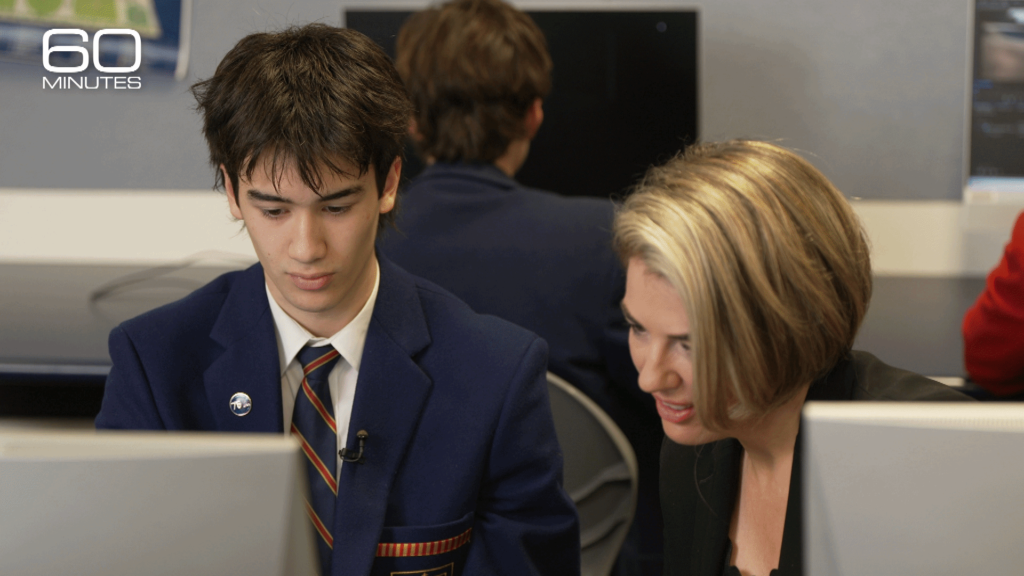
Australia’s unprecedented restrictions on social media accounts for children under 16 are the focus of a 60 Minutes investigation airing Sunday, October 25, 2026, as governments around the world consider whether the country’s approach could transform how young people interact with major technology platforms.
In a report titled “Australia’s Experiment,” correspondent Holly Williams travels to Australia to examine how the restrictions are working, why other countries are considering similar measures and what the world’s biggest social media companies stand to lose if the policy succeeds.
Australia became the first country to introduce a nationwide minimum age requirement covering accounts on many major social media platforms, shifting responsibility for enforcing the restrictions from parents and children to the technology companies themselves.
The policy represents one of the most significant government interventions in children’s social media use, affecting platforms including Instagram, Facebook, TikTok, Snapchat and YouTube.
For Australian families, the restrictions have changed the rules governing teenagers’ access to some of the world’s most popular online services. For technology companies, they have created a new regulatory challenge that could extend far beyond Australia’s borders.

- 60 Minutes Reports on “Destination: Nowhere”, “#FreeTinaPeters” & “Australia’s Experiment” October 25 2026
- Destination: Nowhere: 60 Minutes Investigates Trump’s Controversial Third-Country Deportations
- #FreeTinaPeters: 60 Minutes Investigates Trump’s Pressure Campaign and Colorado’s Disaster Funding
How Australia’s Under-16 Social Media Ban Works
Australia’s social media minimum age restrictions took effect on December 10, 2025, following the passage of the Online Safety Amendment (Social Media Minimum Age) Act 2024.
The legislation requires covered social media platforms to take reasonable steps to prevent Australians under 16 from creating or maintaining accounts.
Unlike traditional parental controls, the restrictions place the legal responsibility on technology companies rather than children or their parents.
Platforms that fail to comply with the requirements can face civil penalties of up to approximately A$49.5 million for serious or repeated breaches.
The rules apply to major services including Facebook, Instagram, TikTok, Snapchat, X, YouTube, Reddit, Threads and Twitch, among others.
Not every online service is covered. Certain messaging, educational and gaming services are excluded, reflecting the government’s effort to distinguish between social networking platforms and other forms of digital communication.
Children under 16 are not criminally punished for accessing restricted platforms, and parents do not face fines for allowing their children to use social media.
Instead, companies must demonstrate that they have taken reasonable measures to identify underage account holders and prevent them from maintaining accounts.
The Australian government has presented the legislation as a way to give children more time to develop without the pressures associated with social media.
Why Australia Introduced the Restrictions
The legislation emerged amid growing concern about the relationship between social media use and young people’s mental health, wellbeing and online safety.
Parents, educators and policymakers have raised concerns about cyberbullying, harmful content, excessive screen time and the effects of algorithm-driven feeds on developing teenagers.
Social media platforms can expose children to content involving self-harm, eating disorders, violence and other potentially distressing subjects.
The design of these services has also attracted scrutiny, particularly features such as endless scrolling, personalized recommendations, notifications and engagement-based algorithms.
Supporters of the restrictions argue that children should not be expected to navigate these environments without stronger protections.
The policy was championed by Prime Minister Anthony Albanese, whose government argued that technology companies needed to take greater responsibility for the experiences of younger users.
The legislation also reflected pressure from parents and community groups seeking stronger safeguards against harmful online interactions.
However, the relationship between social media and adolescent mental health remains complex. Researchers have found that the effects vary depending on the individual, the type of content encountered, the nature of online interactions and the amount of time spent using different services.
Some young people benefit from social media through friendships, creative expression, educational resources and access to supportive communities.
That complexity makes Australia’s experiment particularly important: it offers an opportunity to examine the consequences of restricting access on a national scale rather than relying entirely on theoretical predictions.
What Happened When the Ban Took Effect?
The introduction of the restrictions required major technology companies to change how they manage Australian users’ accounts.
Covered platforms were expected to identify users below the minimum age, prevent new underage registrations and restrict access to existing accounts belonging to children younger than 16.
Companies have used or explored different methods of assessing age, including information already associated with accounts, automated age estimation and additional verification processes.
The rules do not require every Australian to upload government identification documents to use social media. Platforms can adopt different approaches, provided they meet the regulatory requirements.
The implementation has also created practical challenges.
A teenager’s stated date of birth may not accurately reflect their age, while automated systems can incorrectly classify users. Companies must therefore balance enforcement with privacy, accuracy and accessibility.
Young people may also attempt to circumvent restrictions by providing false information or using alternative accounts.
These challenges are important because the legislation requires platforms to take reasonable steps to prevent underage access rather than guaranteeing that every attempt to bypass the rules will fail.
The Australian eSafety Commissioner is responsible for overseeing compliance and assessing how companies respond to their obligations.
Holly Williams’ 60 Minutes investigation examines how these changes are affecting Australians and whether the restrictions are delivering meaningful results.
Can Teenagers Still Use Social Media Without Accounts?
Australia’s restrictions focus on accounts rather than imposing a blanket prohibition on every form of access to online content.
Some platforms allow people to view publicly available material without signing in, although the features available to logged-out users can be more limited.
The distinction means that preventing children from holding accounts does not necessarily eliminate their exposure to social media content.
Teenagers may still encounter material through websites, search engines, shared links and services that fall outside the legislation.
The policy also does not prohibit all online communication among children.
Messaging and other excluded services remain available, allowing young people to maintain digital contact through channels not covered by the social media minimum age requirements.
This has prompted debate about whether restricting accounts will reduce harmful online experiences or shift some activity to alternative platforms.
The government has argued that the legislation addresses the risks associated with holding accounts on major social media services, particularly the personalized feeds and engagement features that can encourage prolonged use.
Critics question whether the restrictions could also remove positive online experiences or make it harder for vulnerable teenagers to find support.
The practical effects on children’s daily lives are among the issues attracting international attention.
Why YouTube, TikTok, Instagram and Other Platforms Have So Much at Stake
Australia’s restrictions have implications for some of the world’s largest technology companies.
Social media platforms depend heavily on active users, engagement and advertising revenue. Their business models often involve personalized recommendations that encourage users to return frequently and spend more time consuming content.
Younger audiences are particularly important because they can become long-term users as they grow older.
Although advertising and data protections already limit some commercial practices involving minors, access to younger users can still influence audience growth, platform popularity and future revenue opportunities.
Restrictions on accounts for children under 16 could therefore affect the ability of technology companies to develop relationships with the next generation of users.
The larger commercial concern is that Australia’s approach may be replicated internationally.
A single national market may represent a manageable regulatory challenge for a global technology company. Similar restrictions across numerous countries could have a much greater effect on audience growth and platform operations.
Companies may also face additional costs associated with age assurance systems, compliance monitoring, appeals processes and account management.
The 60 Minutes report examines what the technology industry stands to lose if Australia’s model is adopted more widely.
Other Countries Are Considering Australia’s Approach
Australia’s decision has become an international reference point for governments seeking stronger controls on children’s access to social media.
Countries including the United Kingdom, France, Denmark and others have debated or pursued measures intended to strengthen online protections for minors.
The European Union has also been examining age verification, platform accountability and the responsibilities of digital services under its broader regulatory framework.
In the United States, individual states have introduced or proposed legislation addressing minors’ social media use, parental consent and age verification, although several measures have faced legal challenges.
The Australian model differs from many earlier proposals because it establishes a nationwide minimum age requirement and places direct compliance obligations on covered platforms.
Its implementation is therefore being closely watched by policymakers who want to understand whether such restrictions can be enforced without creating excessive privacy risks or excluding legitimate users.
If Australia’s system proves workable, it could strengthen arguments for similar legislation elsewhere.
If major difficulties emerge, those experiences could influence how other governments design their own policies.
Williams’ report explores why Australia’s approach has attracted international interest and what its early implementation may reveal about the future of social media regulation.
The Debate Over Children’s Safety, Privacy and Digital Rights
Despite widespread concern about children’s online safety, Australia’s restrictions have generated disagreement among researchers, technology companies, privacy advocates and young people.
Supporters argue that setting a minimum age provides a clearer boundary for platforms and reduces the burden on parents who otherwise must negotiate social media access individually.
They also contend that stronger government intervention is justified when technology companies have commercial incentives to maximize engagement.
Opponents question whether excluding teenagers from major platforms is the most effective way to address harmful content and online behavior.
Some researchers have called for greater emphasis on platform design, algorithmic accountability, digital literacy and stronger safety features rather than age-based restrictions alone.
Privacy is another major consideration.
Effective age assurance requires companies to determine whether users meet the minimum age, potentially involving sensitive personal information or automated assessments.
The challenge is to establish reliable age checks without creating unnecessary databases of identity information or exposing users to additional security risks.
There are also questions about the rights and interests of young people who use online communities to maintain friendships, participate in public discussions or access information that may be difficult to obtain elsewhere.
These competing considerations help explain why Australia’s legislation has attracted such intense scrutiny internationally.
How Will Australia Measure Whether the Ban Is Successful?
The long-term significance of Australia’s social media restrictions will depend on evidence about their effectiveness.
A reduction in the number of underage accounts would demonstrate progress toward the legislation’s immediate objective, but account removals alone would not establish whether the policy improves children’s wellbeing.
Researchers and regulators will also need to examine whether young people spend less time on covered platforms, whether harmful online experiences decline and whether usage shifts to other services.
Other important measures include the accuracy of age assurance systems, the privacy consequences of verification methods and the effects on children’s social relationships.
The policy may also produce different outcomes for different age groups and communities.
For example, younger teenagers may respond differently from those approaching their 16th birthday, while children in rural or isolated areas may rely more heavily on online services for social connections.
Because the restrictions began in December 2025, the October 2026 broadcast comes less than a year into implementation.
That makes the programme an examination of the policy’s early operation rather than a definitive assessment of its long-term consequences.
The findings could nevertheless help inform the next phase of Australia’s regulatory approach and provide valuable evidence for governments considering comparable measures.
Holly Williams Reports From Australia for 60 Minutes
In “Australia’s Experiment,” Holly Williams examines a policy that has moved Australia to the forefront of the international debate over children’s social media use.
The investigation explores how the restrictions are operating, why other countries are following Australia’s lead and how major technology companies could be affected by the emergence of similar laws overseas.
For Australian families, the central question is whether the new rules are making online experiences safer for children.
For governments elsewhere, the issue is whether Australia’s approach offers a practical model that can be adapted to different legal and technological environments.
And for the technology industry, the report considers the consequences of a regulatory shift that could fundamentally change when young people are permitted to establish social media accounts.
Produced by Jacqueline Williams and Erin Lyall, the segment examines the early results of a national experiment whose implications extend well beyond Australia’s borders.
“Australia’s Experiment” airs on 60 Minutes Sunday, October 25, 2026, at 7:00 p.m. ET/PT on CBS, with streaming available on Paramount+.
More 60 Minutes October 25 2026
- 60 Minutes Reports on “Destination: Nowhere”, “#FreeTinaPeters” & “Australia’s Experiment” October 25 2026
- Destination: Nowhere: 60 Minutes Investigates Trump’s Controversial Third-Country Deportations
- #FreeTinaPeters: 60 Minutes Investigates Trump’s Pressure Campaign and Colorado’s Disaster Funding
- Australia’s Experiment: 60 Minutes Investigates Whether the Under-16 Social Media Ban Is Working
More Feature Articles
- “Help Dale Find Dee”: 20/20 Reports on Dee Warner Homicide October 23 2026
- “Blindsided”: Brandon Boudreaux Breaks His Silence on Lori Vallow Daybell Murder Plot on Dateline NBC October 23 2026 Episode
- “What the Cameras Saw”: 48 Hours Reports on Savannah Hancock Tolbert Homicide October 24 2026
- “The Mansion Above Dale Hollow Lake”: 48 Hours Reports on Michael Harding Homicide October 24 2026
- 60 Minutes Reports on “Destination: Nowhere”, “#FreeTinaPeters” & “Australia’s Experiment” October 25 2026