


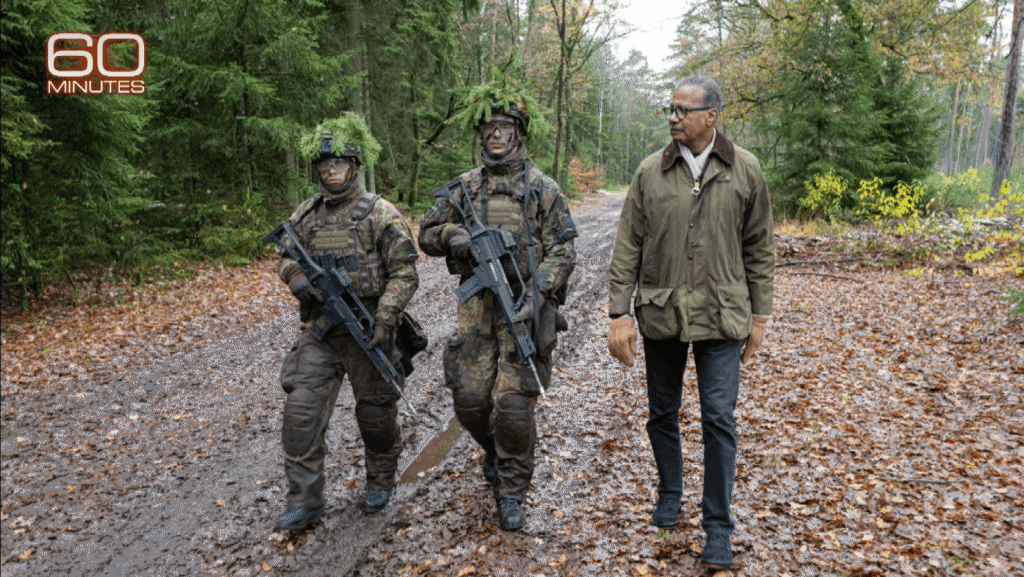
As war once again reshapes the map of Europe, Germany is confronting a defining moment in its modern history. In this Sunday’s episode of 60 Minutes, correspondent Bill Whitaker explores how the country is rapidly overhauling its defense posture in response to the Russian invasion of Ukraine. Titled Germany Rearms, the segment captures the urgency and complexity of a nation historically defined by postwar pacifism now moving to become Europe’s strongest military force.

- 60 Minutes Reports on “Germany Rearms”, “The Price of Life” & “Hoosier Hysteria” December 14 2025
- The Price of Life: 60 Minutes Explores the Cost of Medical Breakthroughs
- Hoosier Hysteria: 60 Minutes Chronicles Indiana’s Football Fairy Tale
A Historic Shift: From Postwar Restraint to Strategic Readiness
For decades after World War II, Germany adopted a defense strategy rooted in caution and cooperation, often reluctant to project military strength on the global stage. The nation’s postwar constitution and deep cultural unease about armed conflict led to a heavily constrained military presence. Defense spending was modest, and international deployments were limited to peacekeeping and humanitarian missions.
That foundational posture has shifted dramatically in the wake of Russia’s full-scale invasion of Ukraine. The war has reignited fears about territorial integrity and the durability of democratic institutions in Europe. In response, Chancellor Olaf Scholz declared a historic turning point—Zeitenwende—in German foreign and security policy. The country committed more than 100 billion euros to military modernization, marking the largest such investment since reunification.
Training the New Force: Inside Germany’s Military Rebuild
60 Minutes offers exclusive access to Germany’s Bundeswehr training grounds in the country’s northwest, where new recruits are preparing for a dramatically changed defense mission. Bill Whitaker observes military drills and firsthand efforts to modernize both equipment and personnel standards. This glimpse into the evolving force shows Germany moving away from its long-standing “citizen in uniform” philosophy and toward a more combat-ready and professional military structure.
German military leaders acknowledge the challenge of rebuilding trust in the armed forces while accelerating readiness. The Bundeswehr has long suffered from aging equipment, personnel shortages, and logistical bottlenecks. Now, officials are trying to reverse those trends in record time, facing both bureaucratic and cultural obstacles.
Political Commitment: The Voice of Defense Minister Boris Pistorius
In Berlin, Whitaker sits down with German Defense Minister Boris Pistorius, who has become the face of this renewed military vision. Pistorius outlines the government’s goal to build the most capable and well-equipped force in Europe. He points to fast-tracked procurement of advanced weaponry, from Leopard 2 tanks to F-35 fighter jets, and emphasizes Germany’s expanded role in NATO and European Union defense frameworks.
But the defense minister also addresses public skepticism. In a country still wrestling with the legacy of the Nazi era and the Cold War, any military expansion is politically sensitive. Pistorius insists the move is not about aggression, but about deterrence, sovereignty, and shared responsibility within NATO. He frames the rebuild as a necessary step to ensure peace in a more volatile world.
International Implications: A Stronger Germany in NATO
Germany’s pivot has significant implications not just at home but across Europe and the broader NATO alliance. For years, U.S. and NATO allies criticized Germany for falling short of its defense spending commitments. That perception is now changing. With increased troop commitments to Eastern Europe, weapons deliveries to Ukraine, and broader NATO integration, Germany is positioning itself as a reliable and powerful security partner.
Still, some observers warn that without structural reforms and cultural change within the Bundeswehr, funding alone may not yield the desired transformation. Experts note that rebuilding credibility and efficiency within Germany’s defense apparatus will take more than money—it will require sustained political will and institutional clarity.
Conclusion: A Nation at a Crossroads
60 Minutes captures Germany at a crossroads—caught between the burdens of its past and the demands of a changing world. As the country races to rearm, it must navigate internal tensions and external expectations. The Germany Rearms segment highlights how a modern democracy grapples with the reality that peace sometimes requires strength, and how rebuilding military power involves not just weapons, but trust, vision, and resolve.
Airing December 14, this segment is part of a powerful 60 Minutes episode that offers rare insight into the forces reshaping today’s global security landscape.