


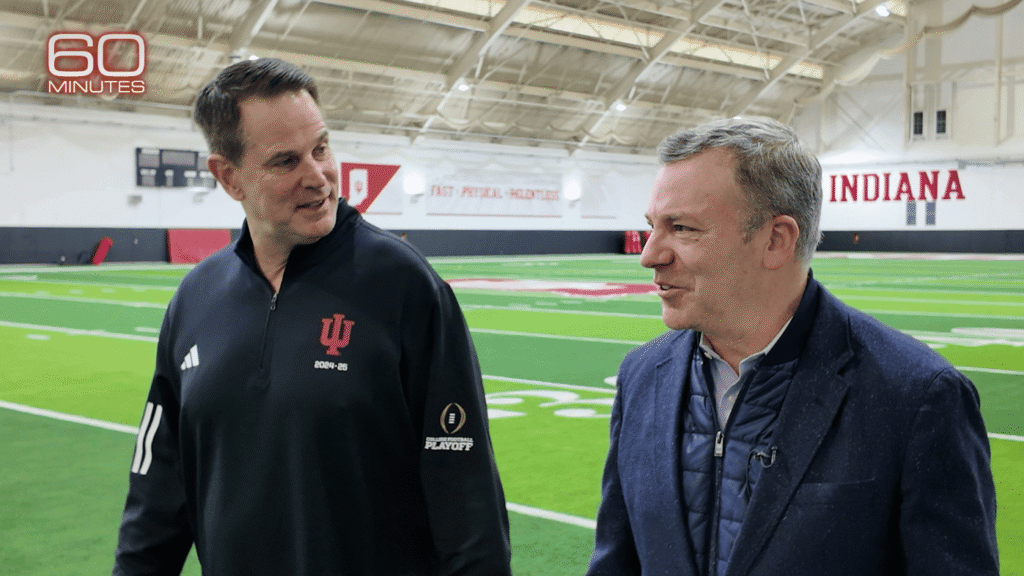
The August 9, 2026, edition of 60 Minutes revisits one of the most remarkable turnarounds in modern college football history with “Hoosier Hysteria,” correspondent Jon Wertheim’s report on the transformation of Indiana University football under head coach Curt Cignetti.
When the segment originally aired on December 14, 2025, Indiana was still in the middle of its extraordinary run. The Hoosiers had climbed to No. 1 in the College Football Playoff rankings, defeated powerhouse Ohio State for the Big Ten championship and entered the postseason with a legitimate opportunity to win the national title.
What happened afterward made the story even more extraordinary. Indiana completed a 16-0 season, defeated Alabama and Oregon in the College Football Playoff, then beat Miami 27-21 on January 19, 2026, to capture the first football national championship in school history.
The updated encore of “Hoosier Hysteria” therefore offers viewers a chance to look back at the moment when what had once seemed impossible was becoming real. The segment is reported by Wertheim and produced by David M. Levine.

- 60 Minutes Reports on “Generally Recognized as Safe”, “Growing Up Behind Walls” & “Hoosier Hysteria” on August 9 2026
- Generally Recognized as Safe: 60 Minutes Investigates the GRAS System Behind America’s Food Supply on August 9 2026
- Growing Up Behind Walls: 60 Minutes Reports From a Children’s Home in Gang-Controlled Port-au-Prince on August 9 2026′
Indiana Football Had Spent Decades in the Shadow of Basketball
Indiana is one of the most recognizable names in American college sports, but that reputation was traditionally built around basketball rather than football.
Indiana men’s basketball has produced national championships, legendary coaches and some of the most memorable moments in college basketball history. Football was another matter entirely.
For much of its history, Indiana struggled to compete consistently with the traditional powers of the Big Ten. Programs such as Ohio State, Michigan and Penn State regularly attracted greater national attention, larger recruiting classes and greater expectations.
When 60 Minutes introduced its original report, CBS described Indiana as having endured roughly a century in which losing had become an almost constant part of the football program’s identity. Before Cignetti’s arrival, expectations surrounding Indiana football were generally far more modest than those surrounding the nation’s elite programs.
That history is what makes the rapid transformation so striking. Indiana did not gradually build toward national contention over a decade. The Hoosiers went from being one of college football’s perennial underdogs to an undefeated national champion in only two seasons under Cignetti.
Curt Cignetti Arrived With No Interest in Accepting Indiana’s History
Cignetti took over the Indiana program ahead of the 2024 season.
His first impression was not particularly flattering.
In his interview with Wertheim, Cignetti recalled entering a program where the facilities appeared neglected, stadium banners looked old and the overall atmosphere reflected limited expectations. He sensed a widespread belief that winning at an elite level simply could not be done at Indiana.
Cignetti had little interest in accepting that assumption.
He had spent much of his coaching career in programs where winning was expected. Rather than adjusting his expectations downward to match Indiana’s history, he attempted to force the program upward to match his standards.
That attitude quickly became part of his public identity.
Shortly after taking the job, Cignetti appeared at an Indiana basketball game and declared that Purdue, Michigan and Ohio State all “suck.” The comments immediately drew attention because those were precisely the programs Indiana had struggled to compete with historically.
What might have sounded like bravado eventually became something closer to a statement of intent.
Cignetti Spent Decades Working His Way Toward the Big Ten
Cignetti’s own career adds another underdog element to the story.
He did not arrive at Indiana as a young coaching celebrity or a former NFL head coach. By the time he received his first major Power Four head coaching opportunity, he had already spent decades in the profession.
Cignetti began his coaching career as a graduate assistant at Pittsburgh in the early 1980s. He later worked at Davidson, Rice, Temple, Pittsburgh and North Carolina State before becoming part of Nick Saban’s staff at Alabama.
He eventually became a head coach at Indiana University of Pennsylvania, then moved to Elon and later James Madison. At each stop, winning followed.
His coaching background is also deeply rooted in football. His father, Frank Cignetti Sr., became a member of the College Football Hall of Fame after a lengthy and successful coaching career. Curt Cignetti himself played quarterback at West Virginia from 1979 through 1982.
By the time Indiana hired him, Cignetti was already an experienced head coach. What he had not previously received was an opportunity to lead a program in a conference with the resources and national profile of the Big Ten.
Indiana provided that opportunity.
The Transformation Started Immediately in 2024
There was almost no transition period.
In Cignetti’s first season, Indiana went 11-2 overall and 8-1 in Big Ten play, finishing second in the conference standings.
That alone would have qualified as one of the greatest seasons in program history.
The Hoosiers also reached the expanded College Football Playoff, changing expectations around a program that had previously been associated with trying merely to become bowl eligible.
Cignetti received widespread recognition for the turnaround, earning multiple national coach of the year honors.
But the 2024 season ultimately became only the beginning.
Instead of falling back toward the middle of the Big Ten after the surprise breakthrough, Indiana became even better in 2025.
Cignetti Used the Transfer Portal to Build a Different Kind of Powerhouse
One of the central elements of Indiana’s rise was roster construction.
College football changed dramatically after players were given greater freedom to transfer between schools, and Cignetti aggressively used that new environment to rebuild Indiana’s roster.
When he arrived from James Madison, several players followed him to Bloomington. Rather than relying exclusively on traditional recruiting and waiting several years for high school prospects to develop, Indiana assembled experienced college players capable of contributing immediately.
That strategy became one of the defining characteristics of the rebuild.
Indiana was not simply trying to collect the highest-rated recruits. Cignetti and his staff focused heavily on players they believed fit their system, culture and expectations.
The result challenged one of the traditional assumptions of college football: that a program needed years of elite recruiting classes before it could realistically compete with schools such as Ohio State.
By December 2025, Indiana was doing exactly that.
Fernando Mendoza Became the Face of the 2025 Team
No player better represented Indiana’s breakthrough than quarterback Fernando Mendoza.
Mendoza transferred to Indiana from California before the 2025 season. He quickly became the central figure in an offense capable of matching Indiana’s increasingly dominant defense.
During the regular season, Mendoza completed 226 of 316 passes for 2,980 yards and a national-best 33 touchdown passes. He also added six rushing touchdowns before the postseason.
His performance produced another first in Indiana history.
On December 13, 2025, Mendoza was announced as the winner of the Heisman Trophy, college football’s most famous individual award. He received 643 first-place votes and 2,362 total points, comfortably defeating Vanderbilt quarterback Diego Pavia.
Mendoza became the first Indiana player ever to win the Heisman.
Before him, the program’s highest finish had belonged to running back Anthony Thompson, who finished second in the 1989 voting.
His rise mirrored Indiana’s own. A player who was not originally viewed as one of the country’s biggest quarterback prospects became the best player in college football while leading a program few had expected to contend for a championship.
Indiana’s 2025 Regular Season Changed the Program Forever
The Hoosiers opened the 2025 season with a 27-14 victory over Old Dominion.
They never lost again.
Indiana defeated Kennesaw State 56-9 and Indiana State 73-0 before producing one of its first major statements of the season with a 63-10 victory over Illinois.
The Hoosiers then survived a difficult road game at Iowa, winning 20-15.
One of the biggest tests came on October 11 when Indiana traveled to Eugene to face Oregon. The Hoosiers won 30-20, establishing that their success was no longer simply the result of a favorable schedule.
Indiana continued winning through the remainder of the regular season, defeating Michigan State, UCLA, Maryland, Penn State and Wisconsin.
The regular season concluded with another emphatic result as Indiana defeated rival Purdue 56-3.
The Hoosiers were 12-0.
The Big Ten Championship Became Indiana’s Defining Test
Indiana’s next opponent was exactly the kind of program that historically represented everything the Hoosiers were not.
Ohio State entered the 2025 Big Ten Championship Game ranked No. 1 and undefeated at 12-0.
Indiana was No. 2 and also 12-0.
The matchup at Lucas Oil Stadium therefore became more than a conference championship game. It was an opportunity for Indiana to prove that its rise was not merely a compelling story but a genuine shift in college football’s competitive hierarchy.
The game was nothing like some of Indiana’s explosive victories earlier in the season.
It became a defensive struggle.
Ohio State led 10-6 at halftime before Indiana quarterback Mendoza connected with Elijah Sarratt for a 17-yard touchdown, giving the Hoosiers a 13-10 lead.
Indiana’s defense protected that advantage.
When the clock expired, the Hoosiers had defeated Ohio State 13-10.
Indiana Won Its First Outright Big Ten Championship Since 1945
The victory carried enormous historical significance.
Indiana had not won an outright Big Ten football championship since 1945.
The program had shared a conference championship in 1967, but the 2025 victory gave Indiana its first appearance and first victory in the modern Big Ten Championship Game.
The win also ended Ohio State’s 16-game winning streak.
For generations of Indiana fans, the idea of defeating an undefeated Ohio State team to win the Big Ten would have sounded improbable.
Cignetti had accomplished it in his second season.
The result also pushed Indiana to the top of the College Football Playoff rankings. The final CFP rankings released on December 7 placed the 13-0 Hoosiers at No. 1, ahead of Ohio State, Georgia and Texas Tech.
It was at roughly this moment that 60 Minutes entered the story.
60 Minutes Captured Indiana Before the Ending Was Known
The timing of “Hoosier Hysteria” is one of the most interesting aspects of the segment.
When CBS originally aired the report on December 14, 2025, Indiana had already completed its undefeated regular season and beaten Ohio State.
But the College Football Playoff had not yet been completed.
Wertheim and the 60 Minutes team were therefore documenting an underdog story without knowing whether it would end with a championship.
CBS framed Indiana as the unlikely darling of college football, noting that the Hoosiers were undefeated, had just defeated Ohio State and now had a realistic opportunity to win the national championship.
The postseason edition airing in August 2026 benefits from something the original report could not have known.
Indiana finished the story.
Alabama Was Waiting in the College Football Playoff
As the No. 1 seed, Indiana received a first-round bye in the 12-team College Football Playoff.
The Hoosiers’ first postseason opponent was Alabama in the Rose Bowl quarterfinal.
For decades, Alabama had represented the kind of national power Indiana could hardly have been more different from. The Crimson Tide had won multiple national championships and regularly produced NFL talent.
Yet Indiana did not merely beat Alabama.
The Hoosiers dominated them 38-3 on January 1, 2026.
A team that had once been considered one of major college football’s most reliable losers had eliminated one of the sport’s most successful programs by 35 points.
The victory moved Indiana to 14-0 and into the national semifinals.
Oregon Got a Rematch and the Result Was Even More Decisive
Next came Oregon.
Indiana had already defeated the Ducks 30-20 in Eugene during the regular season.
The College Football Playoff semifinal gave Oregon an opportunity for revenge.
Instead, Indiana produced one of its most dominant performances of the entire season.
The Hoosiers defeated Oregon 56-22 in the Peach Bowl on January 9, 2026. Mendoza threw five touchdown passes while Indiana’s defense forced turnovers that helped the Hoosiers build a commanding first-half lead.
Indiana was now 15-0.
Only one opponent remained between the Hoosiers and a perfect national championship season.
The Championship Game Brought Fernando Mendoza Home to Miami
Indiana faced Miami in the College Football Playoff National Championship on January 19, 2026.
The location provided an additional storyline for Mendoza, who grew up in Miami.
The game was played at Hard Rock Stadium in Miami Gardens, placing Indiana’s Heisman-winning quarterback in familiar surroundings for the biggest game of his career.
The Hoosiers built a 10-0 halftime lead, but Miami remained within striking distance throughout the second half.
The defining moment came with Indiana leading 17-14 in the fourth quarter.
Facing fourth-and-4, Mendoza ran for 12 yards and a touchdown, fighting through defenders before reaching the end zone. The score gave Indiana the cushion it needed to withstand Miami’s final challenge.
Indiana won 27-21.
Indiana Finished 16-0 and Won Its First Football National Championship
The victory completed one of the most extraordinary seasons in college football history.
Indiana finished 16-0 overall and 9-0 in Big Ten play. The Hoosiers won seven home games, five road games and four neutral-site contests.
They had beaten Oregon twice, defeated Penn State on the road, crushed rival Purdue, knocked off Ohio State for the Big Ten championship, routed Alabama in the Rose Bowl and defeated Miami for the national title.
The championship was the first football national championship in Indiana University history.
Only two seasons earlier, the idea would have sounded almost unimaginable.
Now Indiana had an undefeated national champion.
Mendoza Finished His Season With a Heisman and a Championship
Mendoza’s individual season became even more impressive after the Heisman ceremony.
Including the playoff, he finished the season completing 273 of 379 passes for 3,535 yards and 41 touchdowns, with only six interceptions.
He also scored seven rushing touchdowns.
Mendoza was named the College Football Playoff Championship Offensive Player of the Game, with his fourth-down touchdown run becoming the signature play of the title game.
His 2025 season placed him permanently in Indiana football history.
The Hoosiers had never previously produced a Heisman Trophy winner.
They had never previously won a football national championship.
Mendoza helped accomplish both in the same season.
Cignetti’s Confidence Became Easier to Understand
Cignetti’s personality is a major part of the 60 Minutes story.
His confidence could sometimes sound almost excessive, particularly when he first arrived at a program with Indiana’s history.
But his coaching record increasingly supported it.
At Indiana, Cignetti was named Big Ten Coach of the Year in both 2024 and 2025. He also collected numerous national honors, including AP, Walter Camp and AFCA coaching awards.
His approach centered on changing expectations.
When he arrived, he told Wertheim he immediately sensed an atmosphere suggesting that winning at Indiana was impossible.
His response was essentially to refuse to participate in that belief.
That may be one of the most important parts of the transformation. Indiana’s players did not only need new schemes and new teammates. They needed to stop viewing the program’s history as a prediction of its future.
The Transfer Portal Helped Rewrite the Rules of Rebuilding
Indiana’s rise also provides a case study in how dramatically college football has changed.
Historically, rebuilding a struggling program could take many years.
A new coach might need three or four recruiting cycles simply to replace the roster with players suited to his system.
The transfer portal has accelerated that process.
Experienced players can now change schools much more freely, allowing coaches to reshape rosters almost immediately. Indiana took advantage of that environment more effectively than nearly anyone.
Cignetti’s success also demonstrated that recruiting rankings do not tell the entire story.
Indiana did not enter the championship season with the same collection of highly rated high school recruits found at many traditional powers. Instead, the Hoosiers emphasized player evaluation, development, experience and fit.
By the end of the season, that roster had beaten many programs built with substantially more celebrated recruiting classes.
Indiana’s Rise Was About More Than One Magical Season
It would be easy to describe 2025 as a once-in-a-lifetime Cinderella story.
The results suggest something more substantial.
Cignetti’s first Indiana team went 11-2.
His second went 16-0 and won the national championship.
By August 2026, Indiana was no longer entering a season as an unknown underdog. The Hoosiers were preparing to defend a national championship and were again being discussed among the country’s leading teams. Contemporary preseason projections placed Indiana among the top contenders entering 2026.
That creates an entirely different challenge.
Winning when nobody expects success is difficult.
Winning when everyone expects it can be even harder.
Cignetti entered the 2026 season emphasizing the need to avoid complacency as Indiana attempted to prove that its championship was the beginning of sustained success rather than a single extraordinary year.
The 2026 Team Will Look Different
Indiana’s championship also brought inevitable roster changes.
Mendoza is no longer the quarterback around whom the offense is built.
For 2026, Indiana turned to Josh Hoover, a transfer from TCU, as part of its effort to reload rather than rebuild. Cignetti has publicly praised Hoover’s ability as Indiana prepares to defend its championship.
That transition will provide another test of the program Cignetti has created.
If Indiana can remain among the national elite despite losing central figures from the championship roster, it would provide further evidence that the transformation extends beyond one group of players.
The expectations have certainly changed.
Two years earlier, an Indiana appearance in the College Football Playoff seemed extraordinary.
Now anything less than competing for major championships risks feeling disappointing.
“Hoosier Hysteria” Became an Even Better Story After It Aired
The original 60 Minutes report presented Indiana as an unfinished underdog story.
Wertheim visited a program that had gone from generations of frustration to the top of the national rankings almost overnight.
The title “Hoosier Hysteria” deliberately borrowed a phrase traditionally associated with Indiana’s passion for basketball.
By December 2025, football had generated its own version.
But the postseason results gave the segment a conclusion even CBS could not guarantee when it originally aired.
Indiana did not stumble after reaching No. 1.
It did not simply celebrate making the playoff.
The Hoosiers defeated Alabama, crushed Oregon and held off Miami to finish undefeated.
The hypothetical national championship Wertheim discussed with Cignetti became reality.
Why Indiana’s Championship Resonated Beyond Bloomington
College football has historically been dominated by a relatively small group of powerful programs.
That concentration has sometimes contributed to the belief that schools outside the established elite have little realistic opportunity to reach the top.
Indiana’s championship challenged that assumption.
The Hoosiers did not possess the football history of Alabama, Ohio State or Michigan. They did not enter Cignetti’s tenure with decades of recent championship success.
They built a contender through coaching, transfers, player development and a dramatic change in expectations.
That does not mean every struggling program can reproduce Indiana’s transformation.
It does demonstrate that the modern structure of college football can allow change to happen much faster than it once did.
For athletic departments, coaches and fans of historically unsuccessful programs, Indiana suddenly became the example everyone could point toward.
If it could happen in Bloomington, perhaps traditional limitations were not as permanent as they seemed.
The August 2026 Encore Comes With an Entirely Different Perspective
Watching “Hoosier Hysteria” in August 2026 is fundamentally different from watching it when it first aired.
In December, viewers were watching a team hoping to complete a historic season.
Now they know the ending.
The No. 1 ranking was justified.
Mendoza’s Heisman season ended with a championship.
Cignetti’s confidence resulted in the first national football title in Indiana history.
And a program that had spent decades living behind the giants of the Big Ten finished the season standing above all of them.
That hindsight gives the updated 60 Minutes segment additional significance.
It captures the point at which one of college football’s most unlikely transformations was still unfolding, just before Indiana completed the final chapters of the story.
What to Watch for in “Hoosier Hysteria”
The most compelling part of Wertheim’s report is not simply Indiana’s win-loss record.
It is the speed at which the culture changed.
Cignetti arrived at a program where he sensed resignation and low expectations. Two seasons later, Indiana was undefeated, ranked No. 1, led by the eventual Heisman Trophy winner and preparing for a national championship run.
The contrast between those two versions of Indiana football explains why “Hoosier Hysteria” fits the classic underdog story so well.
Except this one was real.
The updated encore presentation of 60 Minutes airs Sunday, August 9, 2026, from 7:00 to 8:00 PM ET/PT on CBS and Paramount+. “Hoosier Hysteria” is reported by Jon Wertheim and produced by David M. Levine.
More 60 Minutes on August 9 2026
- 60 Minutes Reports on “Generally Recognized as Safe”, “Growing Up Behind Walls” & “Hoosier Hysteria” on August 9 2026
- Generally Recognized as Safe: 60 Minutes Investigates the GRAS System Behind America’s Food Supply on August 9 2026
- Growing Up Behind Walls: 60 Minutes Reports From a Children’s Home in Gang-Controlled Port-au-Prince on August 9 2026′
- Hoosier Hysteria: 60 Minutes Reports on Indiana Football’s Historic Rise to the Top on August 9 2026
Feature Articles
- “Broken Vows”: 20/20 Revisits the Pamela Smart Murder Case August 7 2026
- “Suspicion in Silver City”: Dateline NBC Revisits the Homicide of Cassy Farrington August 8 2026
- “The Secret in Black Rock Canyon”: Dateline NBC Reports on Cassie Jo Stoddart Homicide August 8 2026
- “My Uncle Joe’s Murder”: 48 Hours Investigates the Joe Shymanski Homicide on August 8 2026
- “Facing a Monster”: 48 Hours Revisits Shawn Doyle’s Violence and the Murder of Lori Leonard on August 8 2026
- 60 Minutes Reports on “Generally Recognized as Safe”, “Growing Up Behind Walls” & “Hoosier Hysteria” on August 9 2026