


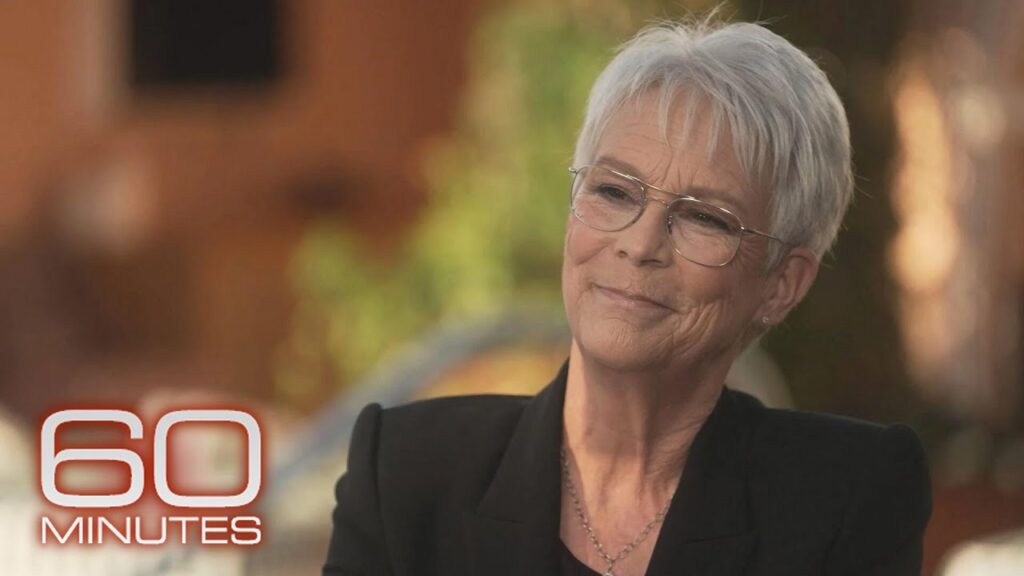
Jamie Lee Curtis grew up surrounded by movie history. Her father, Tony Curtis, was one of the defining leading men of classic Hollywood. Her mother, Janet Leigh, became immortal through Alfred Hitchcock’s Psycho. Yet despite that pedigree, Curtis never envisioned herself following the same path. In her own words, acting was not the plan. She imagined a very different future, even considering a career in law enforcement while attending college.
That sense of distance from Hollywood shaped much of Curtis’s early outlook. She understood firsthand how unforgiving the industry could be, particularly after watching her parents navigate fame, scrutiny, and repeated marriages. Rather than seeing stardom as glamorous, Curtis saw it as unstable. When opportunity finally arrived, it did so suddenly and without warning, setting off a chain reaction she never anticipated.
Her 60 Minutes interview captures this contrast clearly. Curtis describes her life as hinging on moments she never saw coming. One audition, one unexpected offer, and her future was rewritten almost overnight.

- 60 Minutes Interviews “Timothée Chalamet”, “Jamie Lee Curtis” & “Kate Winslet” January 25 2026
- Timothée Chalamet Becomes Bob Dylan: Inside His 60 Minutes Journey and the Making of A Complete Unknown
- Kate Winslet on “Lee”: 60 Minutes Reveals a Passion Project Seven Years in the Making
From College Student to Scream Queen
Curtis’s acting career began almost accidentally. While home from college, a friend encouraged her to audition for Universal Studios. She approached it casually, unaware that the outcome would change her life. Within a day, she was offered a seven-year studio contract. She quit college immediately, stepping into a world she had never planned to enter.
Her first major role came quickly. Cast as Laurie Strode in John Carpenter’s Halloween, Curtis found herself leading a low-budget horror film that few people expected to succeed. The movie’s modest budget contrasted sharply with its eventual impact. Halloween became a cultural phenomenon, launching a franchise and redefining the horror genre.
Despite its massive success, the film did not instantly grant Curtis the kind of career momentum many assume follows a breakout role. Instead, she became closely associated with horror, earning the label of a scream queen through films like The Fog, Prom Night, and Terror Train. While the work was steady, it was limiting, and Curtis knew she needed a shift to be taken seriously.
The Role That Changed Everything
That shift came with Trading Places. Directed by John Landis, the comedy allowed Curtis to reveal a new side of herself as Ophelia, a sharp, compassionate character who held her own alongside Eddie Murphy and Dan Aykroyd. Curtis has often described this role as the true beginning of her career rather than her horror films.
The importance of Trading Places went far beyond one successful movie. Curtis credits it as the foundation that led to future opportunities, including A Fish Called Wanda and True Lies. Each role expanded how she was perceived, moving her from genre typecasting into a versatile leading actor capable of comedy, action, and dramatic depth.
This period established Curtis as one of the most bankable stars of the 1980s and 1990s. Yet even at the height of her success, cracks were forming beneath the surface, shaped by industry pressures and personal insecurity.
Beauty Standards, Addiction, and Survival
One of the most revealing moments in Curtis’s 60 Minutes interview centers on her experience filming Perfect in the mid-1980s. At just 25 years old, she was criticized by a cinematographer for her appearance, specifically for having baggy eyes. The humiliation had lasting consequences. Curtis turned to cosmetic surgery immediately after the film wrapped.
That moment marked the beginning of a deeper struggle. Curtis became dependent on prescription painkillers, later acknowledging that she also used alcohol to cope. Her addiction remained private for years, hidden behind professional success and a carefully maintained public image.
Curtis has now been sober for more than 26 years. She speaks openly about that period with clarity rather than shame, emphasizing how quietly addiction can take hold. Her honesty stands in contrast to an industry that often rewards denial. In choosing transparency, Curtis reframed her past not as a failure, but as survival.
Family, Stability, and Redefining Success
While her professional life moved through peaks and valleys, Curtis built something far more stable at home. Married to actor and filmmaker Christopher Guest for over four decades, she created a family life that differed sharply from the instability she witnessed growing up. With two children, Curtis made deliberate choices to prioritize presence over prestige.
That philosophy influenced her career decisions. Commercial work, often dismissed by peers, allowed her to stay close to home during her children’s upbringing. Curtis has never framed those years as a sacrifice. Instead, she describes them as a necessary investment in her family and herself.
Her reflections on motherhood are grounded and unsentimental. Curtis openly rejects the idea of perfection, emphasizing that working parents simply do the best they can. That realism has become a defining trait of her public persona.
The Unlikely Comeback of a Lifetime
Once her children were grown, Curtis reclaimed her career with renewed focus. She launched her own production company, Comet Pictures, and expanded her creative reach into writing and philanthropy. Her children’s books became bestsellers, and her charitable foundation raised millions for pediatric healthcare and disaster relief.
Then came a creative resurgence few actors experience in their sixties. Curtis delivered raw, fearless performances in projects like The Last Showgirl and The Bear, culminating in her transformative role in Everything Everywhere All at Once. Unrecognizable and uncompromising, she won the Academy Award for Best Supporting Actress in 2022.
For Curtis, the Oscar symbolized more than professional validation. Neither of her parents had won the award, despite their success. Yet Curtis frames the achievement not as surpassing them, but as something deeper. She speaks of freedom. Freedom from image expectations. Freedom from silence. Freedom to show up exactly as she is.
A Career Built on Honesty, Not Illusion
The 60 Minutes profile presents Jamie Lee Curtis not as a Hollywood anomaly, but as a long-distance runner who refused to quit. Her career spans genres, generations, and identities, shaped as much by vulnerability as by talent. She did not chase relevance. She waited for truth.
Today, Curtis stands as a rare figure in entertainment. An actor who outlasted typecasting. A public figure who chose sobriety over secrecy. A performer who found her most meaningful roles later in life, when there was nothing left to prove.
In telling her story without polish or pretense, Curtis offers something far more enduring than nostalgia. She offers proof that reinvention is not only possible, but powerful when it arrives on one’s own terms.
More 60 Minutes January 25 2026
- 60 Minutes Interviews “Timothée Chalamet”, “Jamie Lee Curtis” & “Kate Winslet” January 25 2026
- Timothée Chalamet Becomes Bob Dylan: Inside His 60 Minutes Journey and the Making of A Complete Unknown
- Jamie Lee Curtis: 60 Minutes on Addiction, Motherhood, and True Lies
- Kate Winslet on “Lee”: 60 Minutes Reveals a Passion Project Seven Years in the Making