


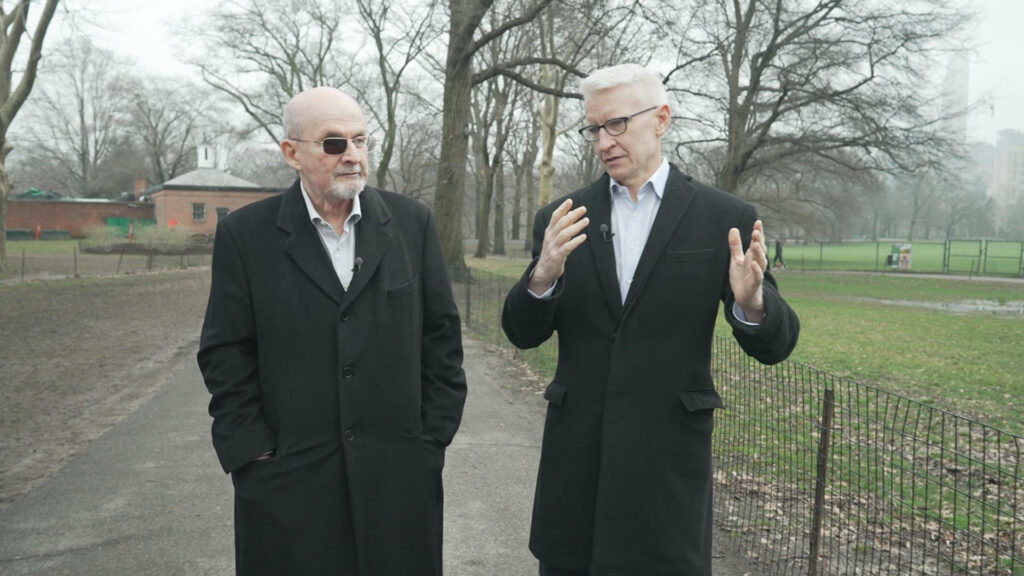
On 60 Minutes, author Salman Rushdie gave his first televised interview since surviving a near-fatal stabbing in 2022. Sitting down with Anderson Cooper, Rushdie opened up about the brutal attack, the decades-long fatwa that preceded it, and how he found a path forward through writing. His new book, Knife, is not just a memoir—it’s a reckoning with mortality, resilience, and the power of language.
- 60 Minutes Reports on “The Indomitable Margaret Atwood”, “Knife” & “Officially Amazing” on February 8 2026
- The Indomitable Margaret Atwood: 60 Minutes Explores the Life and Legacy of a Literary Icon
- Officially Amazing: 60 Minutes Dives Into Guinness World Records’ Wacky Process

A Life Marked by a Death Sentence
Rushdie has lived under threat since 1989, when Iran’s Ayatollah Khomeini issued a fatwa calling for his death over the publication of The Satanic Verses. The novel sparked international controversy for its portrayal of the Prophet Muhammad, igniting protests, book burnings, and violent attacks. The book’s translator in Japan was murdered. Rushdie himself was forced into hiding under constant British police protection for a decade.
Eventually, with diplomatic tensions easing, the Iranian government publicly distanced itself from the fatwa in 1998. Rushdie stepped back into the public eye, moving to New York, continuing to write, and becoming a prominent voice for free expression. For two decades, he believed the danger had passed.
The Attack at Chautauqua
In August 2022, Rushdie was invited to speak at a literary event in Chautauqua, New York, on the importance of protecting writers at risk. Ironically, it was there—on a public stage with minimal security—that a man rushed at him with a knife. In a harrowing 27-second attack, Rushdie was stabbed 15 times, including a puncture to the neck and a blow to his right eye, which he lost.
Rushdie described seeing the attacker from the corner of that very eye, the last image it would ever capture. His calm recollection—”So it’s you. Here you are.”—revealed a chilling acceptance. For someone who had long lived with the threat, the attack felt like a grim echo from the past. “It was like something trying to drag me back in time,” he said.
Recovery, Revelation, and Resilience
Rushdie’s survival was far from assured. He was airlifted to a hospital in Erie, Pennsylvania, where surgeons spent eight hours fighting to save his life. When he woke, unable to speak, he communicated with his wife, poet Eliza Griffiths, by wiggling his toes. She had no way of knowing if the damage to his eye had affected his brain. Slowly, he began to recover—18 days in hospital, three weeks in rehab—and started to reclaim control over his narrative.
Initially reluctant to write about the attack, Rushdie eventually realized that he couldn’t move forward without addressing it. In Knife, his 22nd book, he confronts the trauma head-on. “Language is my knife,” he told Cooper, using the written word to fight back in the only way he knows. The book does not name the attacker, a choice he made to avoid granting further power to the man who tried to silence him.
Confronting Violence with Clarity
The attacker, a 24-year-old New Jersey man who had read only a few pages of The Satanic Verses, was convicted of attempted murder and sentenced to 25 years in prison. Rushdie, who believes the man acted with minimal understanding of his work, sees the motive as a tragic example of how misinformation can spark violence. “If I had written a character who knew so little about his victim, my publisher would’ve said it’s under-motivated,” he remarked.
Rushdie remains an atheist. The attack did not change his views on death or the afterlife. “There was no revelation,” he said. “No heavenly choirs. No pearly gates.” But he did call his survival “a kind of miracle,” even if he can’t explain it.
Living With Shadows
Now 77, Rushdie continues adjusting to life with one eye and lingering physical trauma. But the deeper impact, he says, is the “presence of death” that shadows him. Some days, it’s darker than others. Yet through all of it, he has retained the wit, clarity, and bravery that have long defined his work.
Knife stands as a bold literary response to violence—not just the physical kind, but the ideological kind that seeks to erase, silence, or intimidate. For Rushdie, reclaiming the narrative was essential. With Knife, he reasserts that words can endure even the sharpest of blades.
More 60 Minutes February 8 2026
- 60 Minutes Reports on “The Indomitable Margaret Atwood”, “Knife” & “Officially Amazing” on February 8 2026
- The Indomitable Margaret Atwood: 60 Minutes Explores the Life and Legacy of a Literary Icon
- Knife: 60 Minutes Explores Salman Rushdie’s Fight for Survival and Free Speech
- Officially Amazing: 60 Minutes Dives Into Guinness World Records’ Wacky Process