


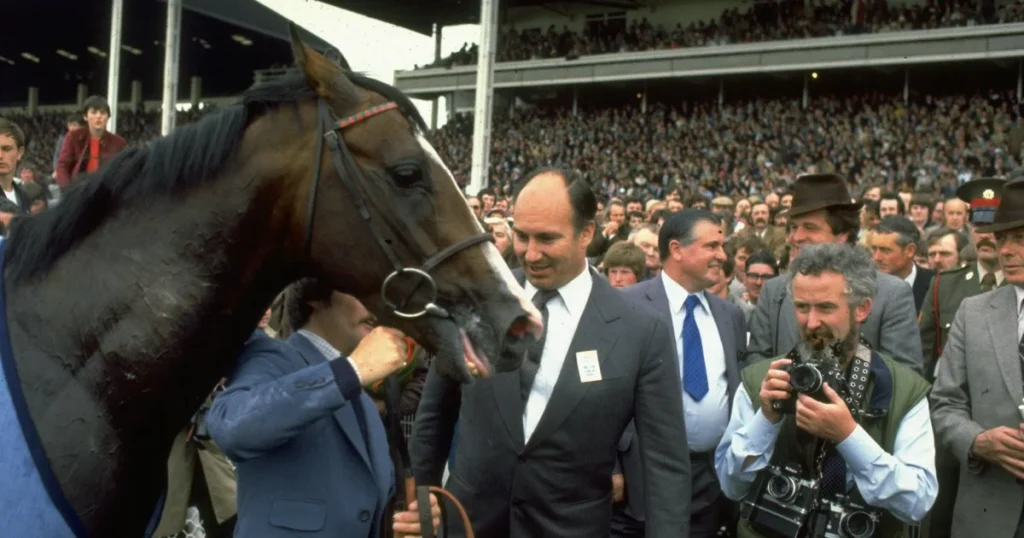
More than four decades after armed men arrived at an Irish stud farm and disappeared into the night with one of the world’s most valuable racehorses, nobody has ever found Shergar.
There has been no confirmed grave, no recovery of his remains and no official admission identifying everyone responsible for one of the strangest crimes in sporting history.
Yet there are now accounts that offer a likely explanation of what happened to the brilliant Derby winner after his kidnapping on February 8, 1983.
In a 60 Minutes report titled “Shergar, Where Are You?”, correspondent Jon Wertheim travels to Ireland to revisit the extraordinary case, speaking with people connected to the mystery and examining the evidence and theories that have accumulated over more than 40 years.
The story begins not with the kidnapping, however, but with a horse whose extraordinary performances had made him a sporting phenomenon.

- 60 Minutes Reports on “Patrick Clancy”, “AI Data Centers” & “Shergar, Where Are You?” on September 20 2026
- Patrick Clancy Gives First TV Interview After Lindsay Clancy Mistrial
- AI Data Centers: 60 Minutes Investigates the Backlash Against America’s AI Boom
Shergar Was One of the Greatest Racehorses of His Generation
Before Shergar became synonymous with an unsolved mystery, he was famous for an entirely different reason.
Owned by the Aga Khan IV, the distinctive bay colt with a white blaze was trained by Michael Stoute and emerged as an exceptional three-year-old during the 1981 racing season.
His defining performance came in the 1981 Epsom Derby.
With 19-year-old jockey Walter Swinburn aboard, Shergar demolished the field by 10 lengths, a record winning margin for the Derby that still stands.
And that was not his only major victory.
Shergar subsequently won the Irish Derby by four lengths with Lester Piggott riding before Swinburn returned to partner him to another four-length victory against older horses in the King George VI and Queen Elizabeth Stakes at Ascot.
By the end of 1981, Shergar wasn’t simply a successful racehorse. He was one of the most recognisable horses in the world.
Shergar Retired to Become an Extremely Valuable Stallion
Shergar’s racing career was brief.
After his three-year-old season, he was retired to stud, where his value potentially became even greater.
The Aga Khan syndicated Shergar into 40 shares, retaining six himself and selling 34 for £250,000 each. That structure would later become critically important when the kidnappers attempted to negotiate a ransom.
Shergar stood at Ballymany Stud near the Curragh in County Kildare, at the heart of Ireland’s thoroughbred industry.
By early 1983, his new career as a breeding stallion was beginning.
He was expected to cover around 55 mares during the 1983 breeding season, and his first foal had already arrived.
Then, on a foggy February night, everything changed.
Armed Men Arrived at Ballymany Stud
On the evening of February 8, 1983, armed men entered Ballymany Stud.
Their first target was not Shergar himself but Jim Fitzgerald, the horse’s head groom.
Fitzgerald was at home with his family when the intruders arrived. Armed men held members of the family at gunpoint while Fitzgerald was forced to take other members of the gang to Shergar.
The champion stallion was then loaded into a horsebox and driven away.
Fitzgerald was also abducted.
He was eventually released on an isolated road more than 30 miles away and warned against immediately contacting police.
By the time authorities were alerted, Shergar had vanished.
He would never be seen again.
The Kidnappers Wanted £2 Million
The crime was apparently intended to produce an enormous ransom.
The kidnappers demanded approximately £2 million for Shergar’s return.
But there was a fundamental problem with their plan.
Shergar did not belong solely to the Aga Khan.
Because the stallion had been syndicated, ownership was divided among numerous shareholders. The Aga Khan could not simply make a unilateral decision involving the horse.
The kidnappers appear to have badly misunderstood that ownership structure.
There was another concern as well.
If the kidnapping was connected to a paramilitary organisation, paying millions of pounds could potentially finance further violence.
Princess Zahra Aga Khan has said her father believed he could not hand over money if it might subsequently be used against people.
The ransom was never paid.
A Sports Commentator Became an Unlikely Hostage Negotiator
One of the most extraordinary parts of the 60 Minutes report concerns British racing broadcaster Derek Thompson.
Thompson had previously stood beside Shergar in the winner’s circle.
Then came a phone call that placed him in the middle of an international kidnapping investigation.
CBS reports that Thompson travelled from London to Belfast and then to a farmhouse roughly 30 miles away, where he spent around 12 hours taking calls connected to the kidnapping.
The kidnappers made various ransom demands.
Then came a chilling message.
Thompson recalls being told that the horse had suffered an accident and was dead.
The call ended.
There was still no Shergar.
The Search Became a Media Spectacle
The disappearance immediately became international news.
Police checkpoints appeared across Ireland. Journalists descended on County Kildare. Reports of possible sightings poured in.
Leading the Garda investigation was Chief Superintendent James “Jazzer” Murphy, whose frequent media appearances made him almost as recognisable as some of the other figures in the case.
The investigation also attracted an extraordinary number of supposed tips.
At one point, Murphy said around 50 clairvoyants, diviners and psychics were attempting to assist with the search.
Yet the enormous attention produced remarkably little hard evidence.
Shergar had seemingly disappeared without trace.
Why the IRA Became the Leading Suspect
No organisation has ever officially accepted responsibility for Shergar’s kidnapping.
However, suspicion has long centred on the Provisional Irish Republican Army.
Over subsequent decades, journalists, documentary makers and former republican figures produced accounts attributing the operation to IRA members seeking money.
The theory is that Shergar was selected because his extraordinary value made him appear to be an attractive ransom target.
But those accounts also suggest the operation was badly conceived.
The kidnappers apparently understood neither Shergar’s complicated ownership structure nor the difficulty of secretly transporting and controlling an elite thoroughbred stallion.
The distinction between evidence and inference remains important: no one has ever been convicted over Shergar’s kidnapping, and the IRA never formally claimed responsibility.
The Kidnappers May Have Been Completely Unprepared for Shergar
A valuable racehorse might have appeared to be an easier hostage than a person.
In practice, stealing a thoroughbred stallion presented enormous problems.
Shergar was a powerful animal being removed from familiar surroundings at night and handled by strangers.
Later accounts attributed to republican sources suggest most of the kidnappers had little or no experience handling horses.
One version holds that Shergar became increasingly agitated during transportation and injured himself.
Other accounts differ about precisely how long he survived.
But many converge on the same grim conclusion: Shergar was probably killed very soon after he was kidnapped.
Was Shergar Killed Within Hours?
This is where certainty becomes difficult.
Over the decades, several accounts have emerged purporting to explain Shergar’s final hours.
One account from a former republican source claimed Shergar became uncontrollable and was killed within 45 minutes of leaving Ballymany.
Another version suggested he suffered a serious leg injury during transportation before being killed as the kidnappers realised their operation was collapsing.
There have also been graphic claims about how Shergar was shot.
But without his remains, forensic evidence or a definitive official account from those responsible, many details cannot be independently established.
What can be said with much greater confidence is that authorities and people close to the case have long believed Shergar did not remain alive in captivity for very long.
The Aga Khan’s Daughter Says Shergar Died Within Two Days
The mystery received a significant new development in June 2026, only months before the 60 Minutes report.
Princess Zahra Aga Khan, daughter of the late Aga Khan IV, publicly discussed what her family now believes happened.
She said the family now knows that Shergar was killed within two days of being taken and described his death as horrific.
Princess Zahra also explained the dilemma facing her father.
Shergar had not been insured against kidnapping — an eventuality that apparently seemed almost unimaginable before it happened — and the horse’s syndicated ownership complicated any response to the ransom demand.
More importantly, her father was unwilling to provide money that might finance violence.
Her comments strengthen the long-standing belief that Shergar died shortly after the kidnapping, although they still do not provide the crucial missing piece of the mystery.
His body has never been recovered.
Where Was Shergar Buried?
That question has generated theories for more than four decades.
Various locations around Ireland have been suggested as Shergar’s possible burial site.
One account placed his remains in a remote mountainous area near the Irish border. Another pointed toward the Iron Mountain area of County Cavan.
None has produced a confirmed discovery.
Occasionally, apparent breakthroughs have generated headlines.
In 2000, for example, a horse’s skull containing bullet holes was discovered near Tralee in southwest Ireland, prompting renewed speculation that Shergar might finally have been found.
But the mystery survived.
More than 43 years after Shergar disappeared, there is still no confirmed grave.
Why Shergar’s Disappearance Became Bigger Than Horse Racing
Shergar’s kidnapping has endured partly because the story contains an extraordinary combination of elements.
There was a famous victim worth millions.
There were masked gunmen, a terrified family, ransom negotiations, alleged paramilitary involvement and an enormous police operation.
And at the centre of everything was a horse who simply disappeared.
The timing also placed the crime against the backdrop of the Troubles, when political violence associated with Northern Ireland regularly extended beyond the region itself.
That context makes the suspected motive more consequential than ordinary theft.
If the widely reported IRA explanation is correct, the kidnappers weren’t primarily interested in owning or selling Shergar. The horse was valuable because they believed someone would pay millions to get him back.
Instead, the plan apparently became a disaster.
Shergar Also Became Part of Irish Folklore
The absence of a definitive answer allowed the case to take on a life of its own.
For decades there have been supposed sightings, burial locations, deathbed stories and claims from people professing knowledge of what happened.
Shergar consequently occupies a strange position in Irish cultural history.
He was simultaneously a genuine sporting champion, the victim of a violent crime and the subject of an enduring national mystery.
As Wertheim observes in the 60 Minutes report, Ireland has a deep tradition of legends and stories passed from one generation to another.
Shergar has effectively joined them.
The Human Cost of the Shergar Kidnapping Can Be Forgotten
The more colourful elements of the mystery can obscure something important.
This was not simply a clever horse theft.
Armed men invaded the Fitzgerald family home and held a family, including children, at gunpoint. Jim Fitzgerald was forced to surrender the animal he cared for before being kidnapped himself.
The crime has sometimes acquired an almost mythical quality because of the unusual victim and the failures of the investigation.
But for the people at Ballymany Stud that night, it was an armed kidnapping.
That distinction is an important part of understanding why the case has remained painful for some of those closest to it.
Shergar’s Racing Legacy Survived His Disappearance
It would be easy for the kidnapping to completely overwhelm Shergar’s sporting achievements.
His 1981 season deserves to stand independently.
Shergar won five of his six races that year and captured the Epsom Derby, Irish Derby and King George VI and Queen Elizabeth Stakes.
Above all stands that extraordinary 10-length Derby victory.
More than four decades later, the margin remains a record.
Shergar therefore occupies two very different places in history.
One is as an exceptional racehorse.
The other is as the central figure in perhaps horse racing’s greatest unsolved mystery.
Will the Shergar Mystery Ever Be Solved?
There is now a reasonably coherent account of what probably happened.
An armed gang kidnapped Shergar in an attempt to obtain a huge ransom. The operation went wrong. The horse was killed soon afterwards, and his body was secretly buried somewhere in Ireland.
The IRA has long been identified as the likely organisation behind the operation, and numerous later accounts have supported that explanation.
But the crucial qualification remains.
Shergar’s remains have never been found, nobody has been convicted of kidnapping him and there has never been a definitive official account from those responsible.
That gap between what is widely believed and what can actually be proved is precisely why the story remains compelling.
The disappearance began as a ransom plot in February 1983.
More than 43 years later, it remains a mystery.
The “Shergar, Where Are You?” report aired on 60 Minutes on Sunday, September 20, 2026, on CBS, with Jon Wertheim reporting and Nathalie Sommer and Kaylee Tully producing.
More 60 Minutes September 20 2026
- 60 Minutes Reports on “Patrick Clancy”, “AI Data Centers” & “Shergar, Where Are You?” on September 20 2026
- Patrick Clancy Gives First TV Interview After Lindsay Clancy Mistrial
- AI Data Centers: 60 Minutes Investigates the Backlash Against America’s AI Boom
- Shergar, Where Are You?: 60 Minutes Investigates Horse Racing’s Greatest Unsolved Mystery
More Feature Articles
- “The Man Who Loved Christmas”: Dateline NBC Reports on Harold Allen Homicide September 18 2026
- “Mr & Mrs Murder”: 20/20 Reports on Mike Williams Homicide September 18 2026
- 48 Hours Pre-Empted September 19 2026 for College Football
- 60 Minutes Reports on “Patrick Clancy”, “AI Data Centers” & “Shergar, Where Are You?” on September 20 2026