


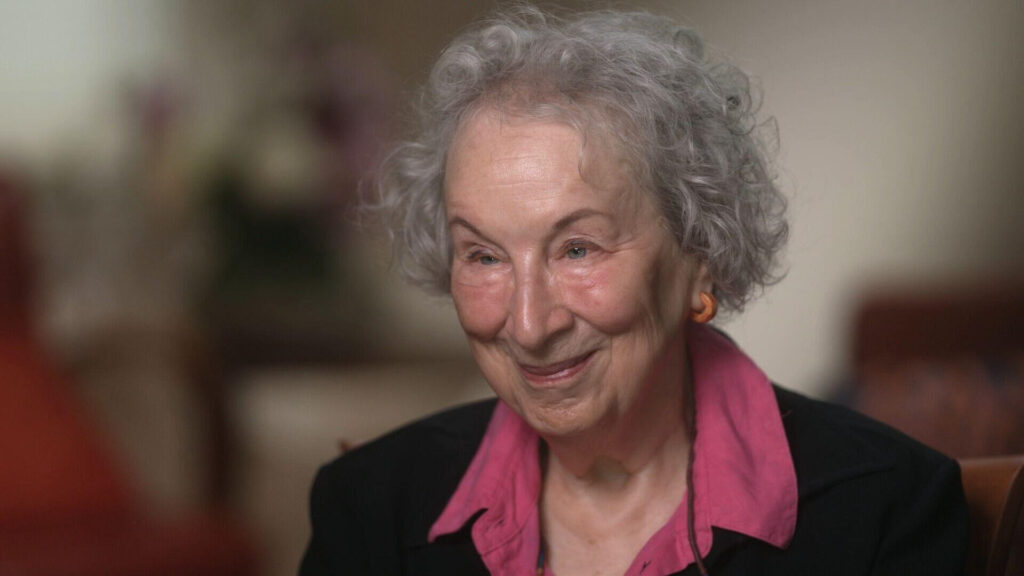
The August 16, 2026, edition of 60 Minutes revisits correspondent Jon Wertheim’s profile of Margaret Atwood, one of the most influential living writers and the author of the dystopian classic The Handmaid’s Tale. At 86, Atwood has spent more than half a century writing novels, poetry, short stories, essays and other works that repeatedly examine power, freedom, gender, environmental destruction and the ways societies can change.
“The Indomitable Margaret Atwood” also arrives at an appropriate moment in Atwood’s career. Her memoir, Book of Lives: A Memoir of Sorts, has given her an opportunity to turn her attention toward her own remarkable life after decades of creating fictional ones.
But the 60 Minutes profile is not simply a retrospective. Atwood’s books remain at the center of contemporary arguments about censorship and what students should be permitted to read. The Handmaid’s Tale and several of her other works have faced restrictions in American schools, giving new relevance to questions she has explored in her fiction for decades. CBS reported in its updated February 2026 version of the story that Atwood’s work had been removed from access in 135 American school districts.

- 60 Minutes Reports on “A Psychedelic Journey”, “The Mardi Gras Indians” & “The Indomitable Margaret Atwood” on August 16 2026
- A Psychedelic Journey: 60 Minutes Follows Veterans Searching for Relief From PTSD on August 16 2026
- The Mardi Gras Indians: 60 Minutes Explores the History, Art and Resilience of a New Orleans Tradition on August 16 2026
Margaret Atwood Looks Back at Her Own Life
Atwood has spent much of her career inventing characters, societies and possible futures. Book of Lives reverses that process by making the author herself the central character.
The memoir allows Atwood to look back at the experiences that shaped her writing and the unusual path that eventually turned her into Canada’s most internationally recognizable literary figure. Wertheim’s interview examines that personal history while also exploring the distinctive personality behind some of modern literature’s darkest imagined worlds.
Atwood’s enormous output is an important part of the story. CBS describes her as Canada’s best-known author and notes that she has produced 64 books. Her body of work stretches far beyond The Handmaid’s Tale and includes fiction, poetry, children’s literature and nonfiction.
The sheer variety of that career also helps explain why reducing Atwood to the author of one famous dystopian novel gives only a partial picture. The Handmaid’s Tale transformed her international reputation, but it represents one part of a writing career that was already well established before the novel appeared.
An Unusual Childhood Helped Shape the Future Author
Atwood’s childhood was considerably different from the conventional urban upbringing experienced by many Canadian children of her generation.
She was born in Ottawa in 1939, just months before the beginning of the Second World War. Her father was an entomologist, and his work meant the family spent considerable periods in the Canadian wilderness.
That environment exposed Atwood to nature from an early age. It also meant that books and imagination could assume an especially important role during periods spent away from large communities.
Those experiences would echo throughout her later writing. Nature, survival and the relationship between human beings and their environments became recurring concerns in her work.
Atwood’s interest in environmental issues is therefore not a late addition to her public identity. It can be traced through much of her writing and back to a childhood in which forests, insects, lakes and the natural world were part of everyday life.
From Poetry to a Major Literary Career
Atwood began writing seriously while still young and emerged as a significant Canadian literary voice during the 1960s and 1970s.
Her early reputation was built partly through poetry. She subsequently expanded into novels and other forms, establishing herself during a period when Canadian literature itself was developing a stronger international identity.
Her early novels included The Edible Woman, published in 1969, a work that examined gender, consumer culture and identity. Surfacing followed in 1972, while Lady Oracle appeared in 1976.
Those books demonstrated themes that would continue throughout her career. Atwood was interested in who holds power, how people construct identities and the social expectations placed on women.
By the time The Handmaid’s Tale appeared in 1985, Atwood was therefore far from an unknown writer. The novel instead took an already successful literary career to another level.
The Handmaid’s Tale Imagined the Republic of Gilead
The Handmaid’s Tale is set in Gilead, a fictional authoritarian state that has replaced the United States after the overthrow of the existing government.
In Atwood’s imagined society, women’s rights have been drastically restricted. The central character, Offred, belongs to a class of women known as Handmaids who are forced into reproductive servitude because declining fertility has made fertile women particularly valuable to the regime.
Women in Gilead are separated into rigid social categories and denied many basic freedoms. Handmaids cannot control their reproductive lives, while women generally face severe restrictions on reading, employment, property and personal autonomy.
Atwood’s creation of Gilead turned the novel into much more than a story about one fictional character.
It became a warning about how quickly rights can disappear when authoritarian institutions take control and when ideology is used to justify the removal of individual freedoms.
Atwood Did Not Want to Invent Gilead’s Atrocities From Nothing
One of the most important pieces of context surrounding The Handmaid’s Tale is Atwood’s approach to creating Gilead.
Rather than imagining completely unprecedented forms of repression, she has repeatedly explained that she drew from things human societies had already done.
That principle made the novel’s dystopia deliberately historical as well as speculative. Religious authoritarianism, forced reproduction, restrictions on women’s education, executions, political repression and systems that control women’s clothing and behavior all had precedents.
The approach helps explain why readers continue finding parallels between Gilead and real events.
Atwood did not need to predict the precise future. She was examining patterns from the past and asking how they could return under different circumstances.
That distinction is central to understanding why she is sometimes described as a prophet. Her work frequently feels predictive because the forces she writes about are not necessarily new.
Why Atwood Has Been Called a “Prophet of Doom”
The 60 Minutes profile examines Atwood’s unusual reputation for apparently anticipating catastrophes.
Over the years, readers have noticed similarities between events in her fiction and later developments in the real world. The comparison extends beyond The Handmaid’s Tale.
Atwood’s MaddAddam trilogy, beginning with Oryx and Crake, imagines a world shaped by genetic engineering, corporate power, environmental destruction and a devastating pandemic. Those themes acquired additional resonance as biotechnology advanced and the COVID-19 pandemic transformed daily life around the world.
Her fiction has also examined ecological instability and the consequences of allowing powerful institutions to operate with inadequate restraint.
Calling Atwood a prophet, however, risks misunderstanding her method. Many of the dangers appearing in her books originate in trends already visible when she wrote them.
Rather than claiming supernatural foresight, her work frequently takes an existing possibility and asks what could happen if society allowed it to develop further.
The Handmaid’s Tale Became Bigger Than the Novel
Few novels published in the 1980s have remained as culturally visible as The Handmaid’s Tale.
The book has been adapted repeatedly, including for film, stage and television. The television adaptation introduced Gilead to another generation and helped transform the distinctive red clothing associated with the Handmaids into an internationally recognizable symbol.
The imagery subsequently moved beyond fiction.
People dressed as Handmaids began appearing at demonstrations involving reproductive rights and women’s rights. A fictional uniform created for an authoritarian society became a form of real-world political symbolism.
Whatever readers’ political views, that transformation demonstrates the unusual cultural reach of Atwood’s creation.
Characters and images from novels sometimes become famous. Far fewer become a visual language used by people participating in real political debates.
Atwood’s Work Has Faced Book Bans and Restrictions
The irony surrounding The Handmaid’s Tale has become increasingly difficult to miss.
Atwood wrote a novel about a society in which women are forbidden from reading. Decades later, the novel itself continues to face attempts to remove or restrict it in schools.
PEN America’s data listed The Handmaid’s Tale among the most frequently banned books during the 2023-2024 school year, recording 67 bans for the novel.
The restrictions have not disappeared. PEN America’s figures for the 2024-2025 school year again included The Handmaid’s Tale among books banned in at least 12 school districts. The organization recorded 6,870 instances of school book bans affecting nearly 4,000 unique titles nationally during that school year.
Atwood is also not dealing with challenges to only one book. CBS noted that The Testaments and The Blind Assassin have faced censorship as well.
Why The Handmaid’s Tale Is Challenged
Challenges to The Handmaid’s Tale have centered on issues including sexual content, violence, reproductive coercion and other mature themes.
The novel contains disturbing material because Gilead itself is supposed to be disturbing. Sexual violence and forced reproduction are fundamental parts of the authoritarian system Atwood depicts.
That creates a larger debate about whether depicting disturbing behavior is equivalent to endorsing it.
Supporters of keeping books such as The Handmaid’s Tale available argue that removing difficult literature can prevent students from examining the very subjects the books are criticizing. Those seeking restrictions may argue that certain material is inappropriate for particular age groups or school environments.
PEN America has argued that the recent wave of school book restrictions has disproportionately affected works dealing with subjects including gender, sexuality, racism and sexual violence. The organization specifically identified The Handmaid’s Tale as one of the books affected by that trend.
For Atwood, the controversy has created an extraordinary case of life echoing literature.
Atwood Responded With an “Unburnable” Handmaid’s Tale
Atwood has not responded quietly to attempts to restrict her work.
One of her most memorable protests came in 2022, when she collaborated with Penguin Random House and the creative agency Rethink on a special fire-resistant edition of The Handmaid’s Tale.
Known as the “Unburnable Book,” the one-of-a-kind edition was constructed using fire-resistant materials. A promotional video showed Atwood attempting to burn it with a flamethrower.
The symbolism was unmistakable.
A book about authoritarian suppression had itself become the subject of censorship debates, so Atwood transformed a copy into something physically resistant to destruction.
The project was designed to raise awareness about book bans and support PEN America’s work defending freedom of expression.
The Fireproof Book Sold for $130,000
The Unburnable Book was not simply a publicity stunt.
The special copy was auctioned through Sotheby’s, with proceeds benefiting PEN America. It ultimately sold for $130,000.
The episode captured something characteristic about Atwood’s public persona.
She can address serious subjects without surrendering her sense of humor. Instead of responding to censorship solely through speeches and essays, she participated in an image that was almost absurd: an internationally acclaimed author pointing a flamethrower at her own novel.
Yet the joke carried a serious message.
Books can be challenged, prohibited or physically destroyed, but eliminating the ideas contained within them is considerably more difficult.
The Testaments Returned to Gilead Decades Later
Atwood surprised readers when she eventually returned to the world of The Handmaid’s Tale.
The Testaments, published in 2019, arrived more than three decades after the original novel. Rather than simply repeating Offred’s story, it expanded the fictional world and examined Gilead through different perspectives.
The novel demonstrated how dramatically the cultural position of The Handmaid’s Tale had changed.
When Atwood first created Gilead, she could not have known that her fictional society would still occupy such a prominent place in public conversation more than 30 years later.
The Testaments went on to share the 2019 Booker Prize with Bernardine Evaristo’s Girl, Woman, Other.
It was Atwood’s second Booker Prize victory, confirming that the later stages of her career were producing major literary achievements rather than simply celebrating earlier ones.
The Blind Assassin Brought Atwood Her First Booker Prize
Atwood’s first Booker Prize came for The Blind Assassin in 2000.
The novel is an intricate story involving memory, family history and stories within stories. Its structure is very different from the direct dystopian framework that made The Handmaid’s Tale famous.
That difference is useful when considering Atwood’s wider career.
Readers who know her primarily through Gilead can easily assume that dystopian fiction defines her work. In reality, her novels have ranged widely in setting, structure and genre.
The Blind Assassin also demonstrates the literary recognition Atwood achieved independently of The Handmaid’s Tale’s later cultural prominence.
CBS noted another striking connection between Atwood’s celebrated books and contemporary censorship: both The Blind Assassin and The Testaments, despite winning the Booker Prize, have also been among her works facing restrictions.
Alias Grace Explored a Real 19th-Century Mystery
Another important work in Atwood’s career is Alias Grace, published in 1996.
The novel was inspired by the real case of Grace Marks, an Irish-born domestic servant convicted in Canada in connection with the 1843 murders of Thomas Kinnear and Nancy Montgomery.
Atwood used the historical case to explore memory, class, gender, crime and the difficulty of determining truth.
Rather than offering readers an uncomplicated answer about Grace’s guilt or innocence, the novel leaves uncertainty at its center.
Alias Grace was later adapted into a television miniseries, giving another Atwood novel a significant life beyond the printed page.
Its historical foundation also shows that Atwood’s interest in power and women’s lives does not depend on futuristic dystopias. She has explored similar questions through history, realism, mythology and speculative fiction.
Atwood Has Consistently Written About Power
Across Atwood’s enormous body of work, one theme appears repeatedly: power.
Who possesses it?
How do people acquire it?
What happens to people who have none?
And what are people willing to do when they believe their status is threatened?
Those questions appear in relationships between men and women, governments and citizens, corporations and consumers, humans and the natural environment.
Atwood’s fiction rarely depends on simple divisions between completely virtuous victims and completely evil villains. She is often interested in how people adapt to systems, compromise with them or discover ways to benefit from them.
That complexity helps explain the durability of her books.
A novel such as The Handmaid’s Tale can be read as a warning about authoritarianism, but it is also an examination of the smaller accommodations and compromises that allow authoritarian systems to function.
Environmental Concerns Run Throughout Her Work
Atwood’s environmental interests are another major part of her career.
Long before climate change became one of the dominant subjects of international politics, her fiction was exploring ecological damage and humanity’s complicated relationship with nature.
Those concerns became particularly prominent in the MaddAddam trilogy: Oryx and Crake, The Year of the Flood and MaddAddam.
The books imagine a world in which corporate power, genetic experimentation and environmental destruction contribute to catastrophic consequences.
Once again, Atwood’s method is less about predicting a specific event than taking existing scientific and social trends and pushing them further.
Her childhood in Canada’s wilderness gives this aspect of her work additional context. Nature was not an abstract concept she discovered late in life. It had been part of her world since childhood.
Atwood’s Personal Life Also Shaped Her Memoir
Book of Lives gives Atwood an opportunity to discuss the people behind the public literary career.
One of the most important was novelist Graeme Gibson, her longtime partner, with whom she shared decades of her life. Gibson died in 2019.
Writing a memoir after such a long life inevitably means writing about absence as well as achievement.
Atwood has lived through the deaths of family members, friends and contemporaries while continuing to publish into her 80s.
That makes the memoir different from a conventional chronological account of professional milestones.
The title Book of Lives itself suggests something broader. Atwood’s story is inseparable from the many other lives that intersected with hers.
Humor Is a Major Part of the Atwood 60 Minutes Meets
Anyone familiar only with the grim world of Gilead might expect its creator to be equally solemn.
Atwood’s public personality is considerably more playful.
Wertheim’s 60 Minutes profile captures an author known for dry humor, quick observations and an ability to discuss frightening subjects without presenting herself as a permanently gloomy oracle.
That contrast is important.
Atwood’s books can contain executions, environmental collapse, sexual violence, authoritarian governments and human extinction, but their creator has frequently approached public life with considerable wit.
Even the Unburnable Book demonstrates that quality. Facing censorship, Atwood’s response included taking a flamethrower to her own novel.
The humor does not make the underlying issue less serious. Instead, it is one of the tools she uses to confront it.
Why Atwood Rejects the Idea That She Simply Predicts the Future
The description “prophet of doom” makes for an irresistible nickname, particularly when events seem to resemble scenarios from Atwood’s fiction.
But the more revealing question is why those similarities keep appearing.
Atwood has spent decades observing history, science, politics, environmental change and human behavior. Her speculative fiction often takes existing tendencies and extends them logically.
The result can look like prediction when reality later travels down a similar path.
The Handmaid’s Tale is perhaps the clearest example. Its power does not depend on readers believing that the precise Republic of Gilead will someday exist.
Its warning is that freedoms can disappear, institutions can fail and people can normalize circumstances that once seemed impossible.
That is a broader lesson than any single political prediction.
Book Bans Give Her Work Another Layer of Relevance
The continuing controversy surrounding Atwood’s books gives the 2026 60 Minutes encore an additional dimension.
PEN America’s figures show that The Handmaid’s Tale remained among books facing school bans during the 2024-2025 academic year.
This means Atwood is not simply discussing censorship as a historical concept or something that happens to other writers.
She is experiencing it directly.
That produces one of the striking contradictions at the center of her late career. The more frequently The Handmaid’s Tale is challenged, the more closely the debate itself can seem to resemble the novel’s concerns about controlling information and deciding who is permitted to read.
Atwood has consequently become not only a novelist associated with freedom of expression but an active participant in the debate surrounding it.
A Literary Career That Continues at 86
At 86, Atwood could easily treat her career as complete.
Instead, the picture presented by 60 Minutes is of a writer who remains engaged with literature and public debate.
Her longevity also gives Wertheim an unusual opportunity. He is not interviewing an author looking back on a handful of famous works but someone whose writing career stretches across profound social and technological changes.
Atwood was born before television became commonplace in North American homes. She began publishing before personal computers, the internet and social media. She then lived long enough to see The Handmaid’s Tale become a global streaming television phenomenon and images from the story circulate instantly around the world.
Through all those changes, the basic technology at the center of her career has remained remarkably simple: words arranged into stories.
Why Margaret Atwood Remains So Relevant
“The Indomitable Margaret Atwood” ultimately examines a question that extends beyond one famous author: why do certain writers remain culturally important decades after their breakthrough work?
For Atwood, part of the answer is that the questions in her books have never gone away.
Societies still debate reproductive freedom, censorship, authoritarianism, environmental destruction, biotechnology and the concentration of political and corporate power.
Atwood did not create those conflicts.
She recognized their possibilities and transformed them into stories.
The fact that readers continue seeing their own world reflected in those stories is why her work can sometimes feel unsettlingly prophetic.
More Than the Author of The Handmaid’s Tale
The Handmaid’s Tale will almost certainly remain the book most closely associated with Margaret Atwood.
But the 60 Minutes profile provides an opportunity to look beyond Gilead.
Atwood is a poet, novelist, essayist, environmental advocate and public defender of literary freedom whose career stretches across more than six decades. She has won the Booker Prize twice, created works ranging from historical fiction to speculative dystopias and continued publishing well into her 80s.
Her career also demonstrates the unpredictable life a book can have after publication.
The Handmaid’s Tale began as a novel published in 1985. It became a film, a television phenomenon, a source of protest imagery, a frequent target of school book restrictions and eventually the inspiration for a fireproof edition deliberately designed to resist destruction.
Few writers ever see one of their creations become so thoroughly embedded in public culture.
An Author Who Refuses to Be Silenced
There is a fitting quality to the title “The Indomitable Margaret Atwood.”
Atwood has spent much of her career imagining characters living under systems designed to control what they can say, read, know and do. Now, in the later stages of her own career, she finds herself defending her books against efforts to restrict access to them.
She has responded by continuing to write, speaking publicly about censorship and sometimes using humor to make her point.
The 60 Minutes profile therefore becomes more than a celebration of literary longevity.
It is a portrait of an 86-year-old writer whose most famous fictional warnings continue colliding with the real world, sometimes in ways even their author could not have anticipated.
“The Indomitable Margaret Atwood,” reported by Jon Wertheim and produced by Nathalie Sommer, airs as part of the 60 Minutes encore presentation on Sunday, August 16, 2026, from 7:00 to 8:00 PM ET/PT on CBS and Paramount+.
More 60 Minutes on August 16 2026
- 60 Minutes Reports on “A Psychedelic Journey”, “The Mardi Gras Indians” & “The Indomitable Margaret Atwood” on August 16 2026
- A Psychedelic Journey: 60 Minutes Follows Veterans Searching for Relief From PTSD on August 16 2026
- The Mardi Gras Indians: 60 Minutes Explores the History, Art and Resilience of a New Orleans Tradition on August 16 2026
- The Indomitable Margaret Atwood: 60 Minutes Profiles the Author Who Refuses to Be Silenced on August 16 2026
Feature Articles
- “Noises in the Night”: Dateline NBC Revisits the Homicide of Cassy Farrington August 14 2026
- “I’m Going to Get You”: 20/20 Reports on Debbie Dorian Homicide August 14 2026
- “Murder in the Parking Garage”: 48 Hours Investigates the Kenny Fandrich Homicide on August 15 2026
- 60 Minutes Reports on “A Psychedelic Journey”, “The Mardi Gras Indians” & “The Indomitable Margaret Atwood” on August 16 2026