


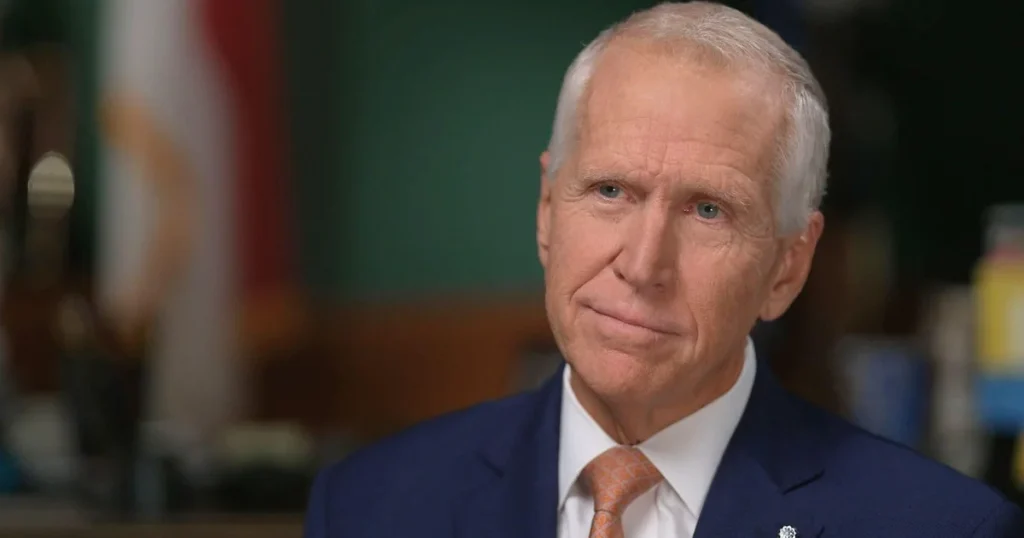
For much of Donald Trump’s political era, Republican lawmakers have faced a difficult calculation: how far can they disagree with the president without finding themselves on the outside of their own party?
Senator Thom Tillis of North Carolina has spent years attempting to walk that line.
Tillis has remained a Republican, supported much of Trump’s agenda and voted for the president’s Cabinet nominees. At the same time, he has repeatedly challenged the White House, criticized members of Trump’s inner circle and argued that Congress has surrendered too much of its constitutional authority to presidents of both parties.
Now, with his Senate career nearing its conclusion, Tillis is becoming considerably less restrained.
Correspondent Ross Douthat sits down with Tillis for 60 Minutes in “The Thom Tillis Tightrope,” an unusually candid interview about Donald Trump, the Republican Party, the Senate and Tillis’ decision to leave Washington rather than seek another term.
The conversation comes just before the publication of Tillis’ new book, How to Lose Friends and Antagonize Presidents: The Trouble with Sycophants, Courage Outsourcing, and Partisan Groupthink, in which the North Carolina Republican offers an even more unfiltered assessment of modern Washington.

- 60 Minutes Reports on “Who Needs Humans?”, “The Thom Tillis Tightrope” & “Saint Francis in the Cloud” on October 4 2026
- Who Needs Humans? 60 Minutes Reports on the AI Revolution Reshaping the Future of Work
- Saint Francis in the Cloud: 60 Minutes Reports on the AI Mission to Save an 800-Year-Old Basilica
Thom Tillis Is Leaving the Senate
Tillis arrived in the U.S. Senate after winning election in 2014, following a rise through North Carolina politics that included serving as speaker of the state House of Representatives.
He developed a reputation as a generally reliable conservative who was nevertheless willing to negotiate across party lines and occasionally challenge his own leadership.
That approach became considerably more difficult after Donald Trump transformed the Republican Party.
Tillis continued supporting much of the Republican agenda, but his relationship with Trump increasingly became a balancing act. He could vote with the president on one issue and publicly criticize the administration on another.
Those disagreements eventually became impossible to contain.
Tillis announced that he would not seek another Senate term after one particularly significant clash with Trump, turning what might otherwise have been another Republican reelection campaign into the final chapter of his congressional career.
His departure has also created one of the most consequential Senate contests of the 2026 midterm elections, with Republicans attempting to hold his North Carolina seat.
The Fight That Helped End Tillis’ Senate Career
One of the decisive confrontations involved Trump’s signature domestic legislation, widely known as the One Big Beautiful Bill.
Tillis opposed the legislation, arguing that its Medicaid provisions could cause too many low-income North Carolinians to lose health coverage.
Trump responded publicly.
The president attacked Tillis as a “talker and complainer” and threatened to support a Republican primary challenger against him.
Soon afterward, Tillis announced that he would retire rather than run for another term.
But retirement did not make him quieter.
It did the opposite.
Without another Republican primary to worry about, Tillis gained something increasingly rare for a sitting politician: the freedom to criticize powerful figures in his own party without worrying about how those comments would affect his next campaign.
Tillis Says He Still Wants Trump to Succeed
One of the contradictions explored by Douthat is that Tillis does not present himself as a Republican who has abandoned Trump.
He insists that he wants the president to succeed.
Tillis describes their relationship as unusual, acknowledging that he has clearly angered Trump while also pointing out that it took years before the president publicly attacked him.
The senator says his confrontational response is not unique to Trump. If someone presents information that Tillis believes is unfair or inaccurate, he says he will push back regardless of who that person is.
That philosophy helps explain the “tightrope” in the segment’s title.
Tillis wants to remain a conservative Republican while arguing that loyalty to a Republican president should not require silence when the president or his administration makes mistakes.
His New Book Takes Aim at Trump’s Inner Circle
Tillis’ impending retirement has also given him the opportunity to tell his version of the story in unusually colorful fashion.
His new book is titled How to Lose Friends and Antagonize Presidents, an obvious play on Dale Carnegie’s famous How to Win Friends and Influence People.
But Tillis jokes that Trump is not the only president he has antagonized.
He tells Douthat that the “more recent” president is certainly relevant, while noting that he also managed to antagonize Joe Biden and, earlier in his political career, Barack Obama.
The book’s broader target is not simply Trump. Tillis argues that one of the administration’s biggest problems is the collection of advisers and officials surrounding the president.
His central accusation is that too many people in positions of power tell Trump what he wants to hear rather than warning him when a policy could go badly.
In Tillis’ view, that is not loyalty.
It is dangerous.
Tillis Blames the Sycophants Around Trump
Tillis reserves some of his strongest criticism for what he regards as sycophancy inside the administration.
He argues that a good presidential adviser should be willing to deliver bad news, anticipate unintended consequences and tell a president when an idea is unlikely to work.
Instead, Tillis believes some members of Trump’s team are failing to “look around corners” for him.
That distinction is important to Tillis’ argument.
He contends that some of the administration’s problems arise less from the objectives Trump wants to achieve than from the way those objectives are pursued.
It allows Tillis to make an unusual case: that criticizing the people around Trump can actually be an expression of wanting Trump to succeed.
His book is considerably less diplomatic. Its full subtitle — The Trouble with Sycophants, Courage Outsourcing, and Partisan Groupthink — leaves little ambiguity about what Tillis believes has gone wrong.
Pete Hegseth Is Tillis’ “Biggest Regret”
The interview also forces Tillis to confront his own responsibility for putting administration officials into powerful positions.
After all, senators do not merely comment on Cabinet appointments. They vote to confirm them.
Tillis voted to confirm Trump’s Cabinet nominees, including Defense Secretary Pete Hegseth.
He now describes his vote for Hegseth as his “biggest regret.”
That admission highlights a central tension in Tillis’ criticism of the Trump administration.
He may now object to officials he believes should never have received so much authority, but as a senator he helped confirm them.
Tillis is particularly critical of Hegseth and Homeland Security Secretary Kristi Noem, arguing that both were elevated into positions carrying enormous responsibilities despite his current belief that they were poorly suited to wield that authority.
The criticism is especially striking because Tillis is not evaluating decisions made by a Democratic administration. He is discussing appointments made by a president of his own party that he personally voted to approve.
Trump and Tillis Have Had an Extraordinary Private Relationship
Their public clashes tell only part of the story.
Tillis’ book also reveals unusually blunt private communications between the senator and president.
Messages disclosed ahead of the book’s release show Tillis directly confronting Trump when he believed the president had unfairly attacked him.
In one message, Tillis told Trump that he would not accept what he described, profanely, as unfair treatment from anyone — including the president — while simultaneously insisting that he wanted Trump to succeed.
That combination captures their relationship remarkably well.
Tillis could be furious with Trump and still regard himself as someone attempting to help the president.
The senator has portrayed that willingness to disagree as a virtue rather than an act of disloyalty.
January 6 Remains an Important Contradiction
Douthat also presses Tillis on one of the most difficult episodes in his relationship with Trump: January 6, 2021.
Tillis offers an unequivocally negative assessment of the attack on the Capitol.
He describes the failure to achieve a completely peaceful transfer of power that day as disgraceful and says those who led the attack and assaulted police officers deserved severe punishment.
Yet Tillis subsequently voted to acquit Trump during his second impeachment trial.
Douthat challenges him on the apparent contradiction.
If Tillis believes senators must exercise leverage over presidents and defend the constitutional role of Congress, the impeachment trial represented an extraordinary opportunity for Republican senators to do precisely that.
Tillis argues that the impeachment process itself was rushed and that using a flawed process to prevent Trump from running for office again would have degraded impeachment as an institution.
It is perhaps the clearest example of the political tightrope Tillis has spent years walking: sharply criticizing Trump’s conduct without taking the final step of breaking with him.
Tillis Says Congress Has Given Presidents Too Much Power
The most significant part of Tillis’ argument extends beyond Donald Trump.
He believes Congress itself has become too weak.
The Constitution established Congress, the presidency and the judiciary as separate branches of government, each capable of checking the others.
Tillis argues that senators increasingly fail to behave as though Congress is genuinely co-equal with the executive branch.
And he does not regard this as exclusively a Republican problem.
When Democrats control Congress and the White House, he argues, Democratic lawmakers have incentives to give a Democratic president greater freedom.
When Republicans control them, Republicans face the same temptation.
The short-term political logic is obvious: lawmakers want their own president to succeed.
The long-term institutional consequence, Tillis argues, is an executive branch that accumulates more power regardless of which party occupies the White House.
“Our Guy” Is the Problem
Tillis identifies a recurring cycle in modern American politics.
When the opposing party controls the presidency, lawmakers suddenly rediscover the importance of congressional authority.
When “our guy” becomes president, those concerns frequently disappear.
Congress then allows the White House to exercise powers that legislators might have considered outrageous under the previous administration.
Eventually control of the presidency changes hands.
The powers remain.
The next president inherits them.
Tillis argues that this pattern has accelerated across multiple administrations and that Congress must reassert itself before the imbalance becomes permanent.
It is one of the areas where his criticism goes well beyond Trump.
His argument is fundamentally institutional: presidents naturally seek power, so Congress has to be willing to say no — including when the president belongs to the same political party as the congressional majority.
Tillis Issues a Stark Warning About Checks and Balances
That concern leads to the most serious warning in the 60 Minutes interview.
Tillis argues that Americans may underestimate how quickly democratic safeguards can weaken because the country’s constitutional system has survived for so long.
The continued survival of those institutions can itself create complacency.
His concern is that if Congress repeatedly declines to exercise its constitutional authority, presidents will inevitably fill the vacuum.
Without meaningful checks on executive power, Tillis warns, the United States risks moving toward what he describes as a “dictator king.”
For a sitting Republican senator discussing a Republican president, it is extraordinary language.
But Tillis frames the warning as applying to presidents generally rather than solely to Trump.
His fear is about the precedent each administration leaves for the next one.
His Background Helps Explain His Political Style
The 60 Minutes profile also looks beyond Tillis’ fights with the White House to the experiences that shaped him.
Born in Jacksonville, Florida, in 1960, Tillis was one of six children and spent his childhood moving frequently around the South.
His family lived in different circumstances, including rented homes and mobile homes.
His path to the Senate was also unconventional.
Before becoming a full-time politician, Tillis built a lengthy career in business and management consulting and became an executive before completing his college degree.
He eventually entered local politics in North Carolina, rose through the Republican Party and became speaker of the North Carolina House before defeating Democratic Senator Kay Hagan in 2014.
That business background helps explain his preference for negotiation, management and practical outcomes — qualities that can sit awkwardly within an increasingly confrontational political environment.
A Republican Who Still Believes in Compromise
Tillis belongs to a tradition of senators who view dealmaking as part of the institution rather than evidence of ideological weakness.
That philosophy has become increasingly difficult to maintain as American politics has polarized.
Primary elections can punish lawmakers for compromising with the opposition. Social media rewards confrontation. Political fundraising can benefit from outrage. And presidents increasingly expect members of their own party to demonstrate public loyalty.
The incentives frequently point away from compromise.
For Tillis, that creates a Senate fundamentally different from the institution he believes it should be.
His argument is not that senators should abandon their principles.
It is that governing a divided country requires lawmakers who can disagree intensely and still negotiate.
Retirement Has Made Tillis More Dangerous to His Critics
Tillis’ retirement changes his political position in another important way.
A senator seeking reelection has donors, activists, party officials and primary voters to consider.
A retiring senator does not face those same pressures.
That makes Tillis considerably harder for either Trump or Republican leaders to discipline.
He can criticize Cabinet members, challenge White House policy and vote against legislation without wondering whether those decisions will appear in attack advertisements during his next campaign.
His forthcoming book takes advantage of precisely that freedom.
Instead of attempting to repair his relationships in Washington, Tillis appears prepared to document exactly why many of them deteriorated.
His Departure Could Have Major Consequences for Republicans
There is another irony surrounding Tillis’ retirement.
The battle between Trump and Tillis did not simply affect one senator’s career. It helped create an open Senate seat in a politically competitive state.
North Carolina has subsequently become one of the most important races of the 2026 midterm elections.
Republicans are trying to defend the seat while Democrats see an opportunity to capture it, meaning Tillis’ departure could ultimately affect control of the Senate itself.
That makes his complaints about partisan strategy more than an academic debate.
The Republican Party now has to win an expensive and difficult contest for a seat that would otherwise have been occupied by an incumbent Republican senator.
The Thom Tillis Paradox
Tillis is difficult to fit neatly into either side of the Trump-era Republican divide.
He is not a Democrat.
He has not renounced conservatism.
He has not become an anti-Trump independent.
He supported much of Trump’s agenda, confirmed administration officials and voted to acquit Trump during his second impeachment trial.
Yet he is also willing to call out decisions he considers dangerous, criticize powerful figures inside the administration and warn that Congress is failing in its responsibility to restrain presidential power.
Those contradictions are exactly what make “The Thom Tillis Tightrope” more revealing than a straightforward interview with either a Trump loyalist or a Trump opponent.
What Happens to Republicans Who Say No?
Ultimately, Douthat’s interview raises a question larger than Thom Tillis himself.
Can a Republican senator meaningfully challenge a Republican president and remain politically viable inside the modern Republican Party?
Tillis tried.
Sometimes he supported Trump. Sometimes he negotiated. Sometimes he objected. Sometimes he backed down.
Eventually, after Trump threatened to support a primary challenger, Tillis decided not to seek another term.
Now he is leaving Washington with fewer political constraints and considerably more to say.
His final message is not simply that Donald Trump possesses too much power. It is that senators have a responsibility to prevent any president from accumulating too much power — and that Congress cannot fulfill that responsibility when lawmakers are afraid to challenge a president from their own party.
After years spent walking the political tightrope, Thom Tillis is finally stepping off it.
And on his way out, he is warning his colleagues about what could happen if nobody else is willing to walk it.
More 60 Minutes October 4 2026
- 60 Minutes Reports on “Who Needs Humans?”, “The Thom Tillis Tightrope” & “Saint Francis in the Cloud” on October 4 2026
- Who Needs Humans? 60 Minutes Reports on the AI Revolution Reshaping the Future of Work
- The Thom Tillis Tightrope: 60 Minutes Reports on the Republican Senator’s Break With Trump
- Saint Francis in the Cloud: 60 Minutes Reports on the AI Mission to Save an 800-Year-Old Basilica
More Feature Articles
- “The Home Alone”: 20/20 Reports on Allison Feldman Homicide September 25 2026
- “Unmasking the Monster”: Dateline NBC Reports on Dana Beatty Case October 2 2026
- 48 Hours Pre-Empted October 3 2026 for UFC & College Football
- 60 Minutes Reports on “Who Needs Humans?”, “The Thom Tillis Tightrope” & “Saint Francis in the Cloud” on October 4 2026