


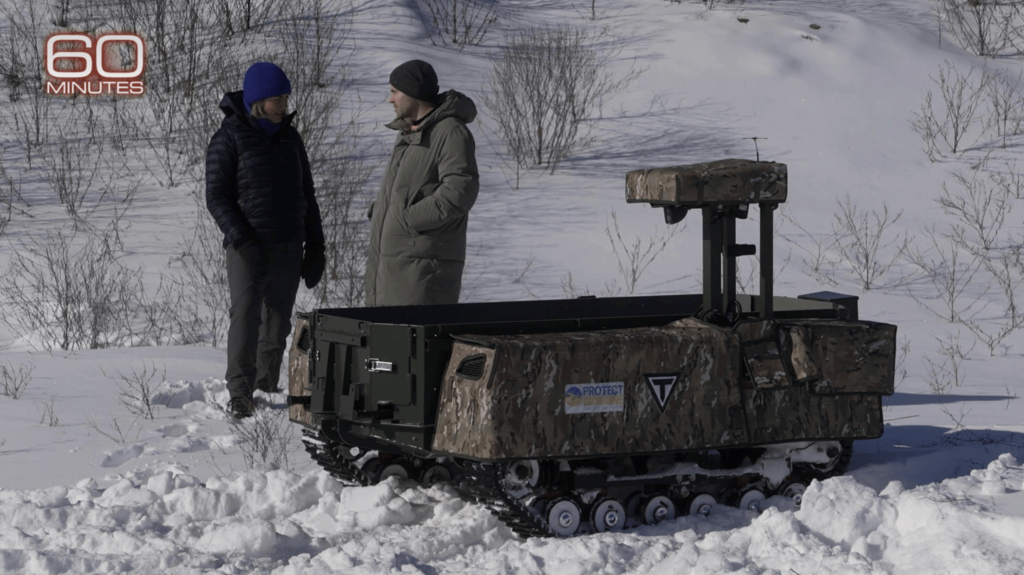
The second major segment in this week’s 60 Minutes broadcast turns to one of the defining military stories of the war in Ukraine: the use of remotely controlled and unmanned drones to challenge a larger invading force. In Unmanned, CBS News correspondent Holly Williams reports on how Ukraine has used drone technology on land and at sea to reshape the battlefield and force militaries around the world to reconsider long-held assumptions about combat.
The segment also points to a larger development beyond the war itself. According to the preview, the U.S. military is now studying Ukraine’s battlefield experience and learning from the country’s practical, tested drone expertise. That gives the report significance beyond daily war coverage, because it is not only about how Ukraine has fought, but about how warfare itself is changing in front of the world.

- 60 Minutes Reports on “Inside the Tower”, “Unmanned” & Wonder of the World” on March 29 2026
- Inside the Tower: 60 Minutes Examines the Strain on America’s Air Traffic System
- Wonder of the World: 60 Minutes Explores the Vast Hidden Realm of Hang Son Doong
How Ukraine Turned Drones Into A Strategic Advantage
One of the most striking features of the war in Ukraine has been the speed with which drone warfare moved from a useful support tool to a central part of military operations. Drones have been used for reconnaissance, targeting, surveillance, direct attack, and disruption. In many cases, they have allowed Ukrainian forces to strike targets, monitor enemy movement, and adapt quickly without depending entirely on more traditional systems.
That shift matters because Ukraine has often had to find ways to counter a larger military force with fewer resources. Drone technology has helped narrow that gap. Smaller, more flexible systems can gather intelligence and carry out attacks at lower cost, while also reducing some of the risks associated with sending personnel directly into danger. That does not remove the human cost of war, but it does change how force can be applied.
The title Unmanned suggests that the segment will focus not just on individual drone strikes, but on an entire way of thinking about combat. Instead of relying only on tanks, aircraft, artillery, and conventional naval systems, the war has shown how remote platforms can be used creatively in multiple environments. Ukraine’s approach has drawn attention precisely because it has been adaptive rather than rigid.
A War That Has Become A Testing Ground For New Tactics
Wars often accelerate military innovation, and Ukraine has become a major example of that pattern. The conflict has forced rapid experimentation, with drones used not only in the air but also in maritime settings and other contested environments. That practical use under battlefield pressure has given outside observers a close look at what these technologies can actually do when lives, territory, and strategic positions are at stake.
What makes Ukraine’s experience especially significant is that it has not been a theoretical exercise. The techniques being developed and refined there have been shaped by real combat conditions, not training simulations. That gives them a kind of credibility that military planners elsewhere pay close attention to. When a tactic succeeds repeatedly in war, it tends to influence how others prepare for future conflict.
This helps explain why the segment’s reference to the U.S. military is so important. The lesson is not simply that drones matter, but that battlefield innovation can come from necessity, speed, and improvisation as much as from large defense budgets. That is one reason Ukraine’s methods have drawn such close attention from military institutions abroad.
Why The Story Matters Beyond Ukraine
At one level, Unmanned is clearly about the war against Russia and the way Ukraine has responded to a powerful invading force. But at another level, it is about the future of warfare more broadly. Military planners have long studied technological change, yet conflicts often reveal that the most important developments are not always the largest or most expensive systems. Sometimes the greatest change comes from how tools are used, combined, and adapted in real time.
That is why this segment has relevance even for viewers who do not follow every battlefield development. It raises larger questions about how countries prepare for conflict, how technology changes the balance between large and small forces, and how quickly old doctrines can become outdated. A report like this can help explain why militaries are paying so much attention to lessons emerging from Ukraine.
The story also highlights the increasing connection between civilian innovation and military application. Drone technology has developed rapidly in many sectors, and warfare has shown how quickly those advances can be applied to reconnaissance, attack, and defense. That overlap is one reason the subject feels so current and so consequential.
Holly Williams And The Human Side Of A Technological Story
Holly Williams has reported extensively on international conflict, and that experience matters in a story like this. A segment about unmanned systems could easily become overly technical, focused only on machines and tactics. Strong reporting, however, tends to place technology in its human setting, showing what these tools mean for the people using them and the conflict they are shaping.
That balance is likely to be one of the key strengths of the piece. The preview frames drone warfare as a battlefield equalizer, but the deeper story is about adaptation under pressure. Behind every drone program are soldiers, planners, engineers, and commanders trying to respond to immediate threats with the tools available to them. The effectiveness of those systems depends not only on machinery, but on training, creativity, and judgment.
This is also where 60 Minutes can add depth. Rather than presenting drone warfare as a futuristic concept, the program is likely to show it as something already reshaping conflict in the present. That can make the story feel less like speculation and more like a close study of transformation already underway.
What Viewers Can Expect From Unmanned
Unmanned appears set to be one of the most strategically significant segments in the March 29 broadcast. It takes a major international story and focuses on one of its most influential developments: the way drones have altered the battlefield and forced larger militaries to pay attention. By showing how Ukraine has used land- and sea-based unmanned systems against Russian forces, the report promises both frontline relevance and long-term importance.
The segment is also likely to stand out because it connects immediate wartime realities with future military thinking. That gives it a dual purpose. It explains what is happening now, while also asking what these innovations mean for the next generation of warfare. In that sense, the story is about far more than equipment. It is about how strategy evolves when technology becomes cheaper, faster, and easier to adapt.
Produced by Erin Lyall, this report looks positioned to deliver both context and urgency. For viewers interested in global affairs, military strategy, or the changing nature of conflict, Unmanned has the potential to be one of the most thought-provoking parts of the evening’s broadcast.
More 60 Minutes March 29 2026
- 60 Minutes Reports on “Inside the Tower”, “Unmanned” & Wonder of the World” on March 29 2026
- Inside the Tower: 60 Minutes Examines the Strain on America’s Air Traffic System
- Unmanned: 60 Minutes Explores How Ukraine Changed Modern Warfare
- Wonder of the World: 60 Minutes Explores the Vast Hidden Realm of Hang Son Doong
More Feature Articles
- “Savannah Speaks”: Dateline Reports on Nancy Guthrie Disappearance March 27 2026
- “Stranger in the House”: 20/20 Reports on Heidi Firkus Homicide March 27 2026
- “Denise and Aaron Quinn Get the Last Word”: 48 Hours Episode March 28 2026
- 60 Minutes Reports on “Inside the Tower”, “Unmanned” & Wonder of the World” on March 29 2026