Up in the Air: 60 Minutes Investigates How the Iran War Triggered a Global Helium Crisis
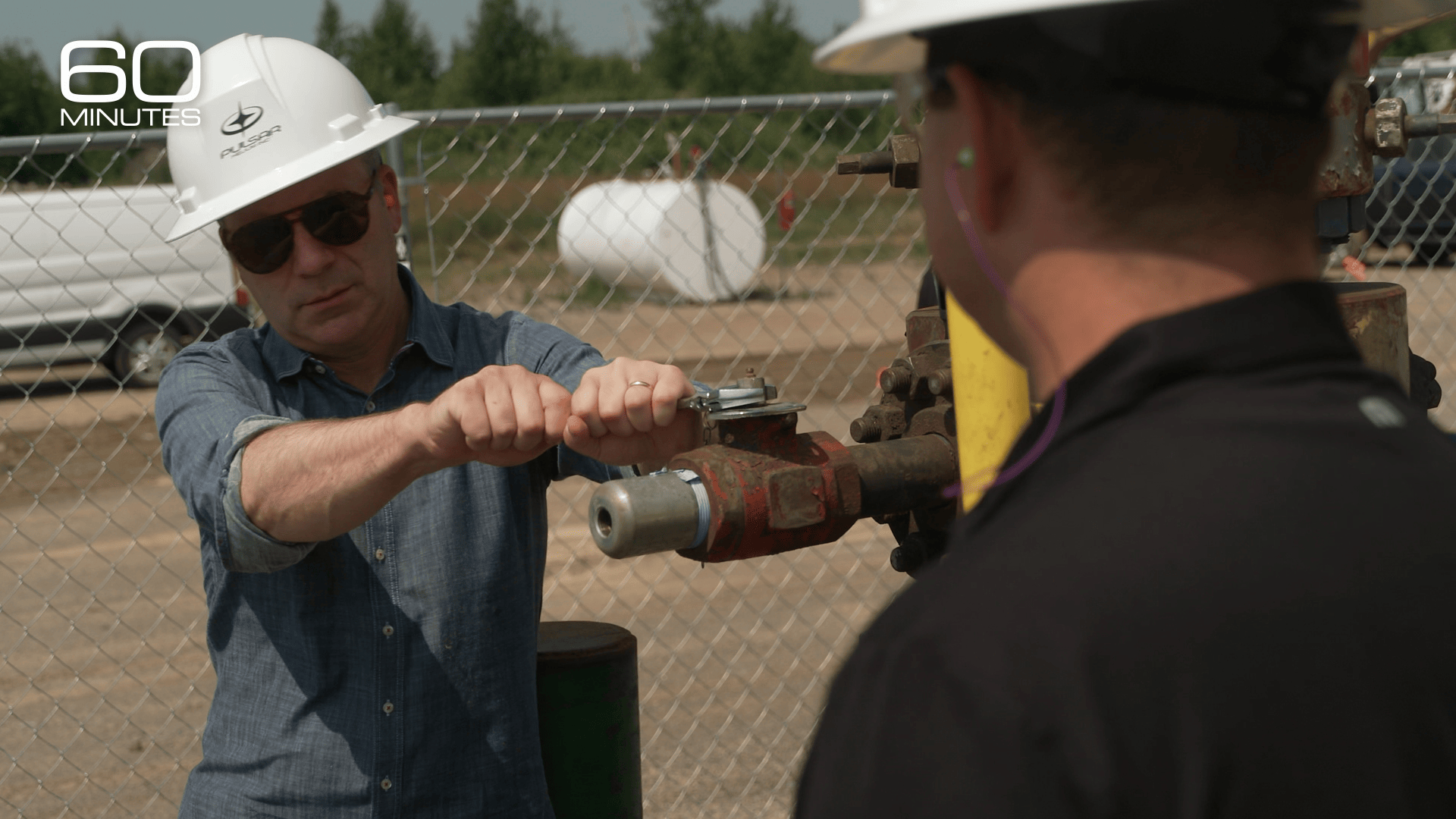
60 Minutes examines an unexpected consequence of the war with Iran on Sunday, October 18, 2026, revealing how disruptions to the global helium supply are creating serious concerns for American industries ranging from semiconductor manufacturing to scientific research.
In a report titled “Up in the Air,” correspondent Jon Wertheim investigates how the effective closure of the Strait of Hormuz and Iranian strikes on Qatar’s Ras Laffan industrial complex have disrupted the international supply of a gas essential to modern technology.
Although helium is commonly associated with balloons and party decorations, its industrial applications are far more important. The gas is used in semiconductor production, medical imaging, advanced scientific equipment and other technologies that depend on its unusual physical properties.
The 60 Minutes investigation explores how a conflict thousands of miles away is exposing vulnerabilities in American supply chains and raising questions about the security of materials essential to the modern economy.
How the Iran War Disrupted the World’s Helium Supply
The conflict with Iran has had consequences extending well beyond the oil and natural gas markets that typically dominate coverage of Middle Eastern instability.
When the Strait of Hormuz was effectively closed at the beginning of the war, shipments of several critical commodities were interrupted. Among them was helium, a gas whose importance to global manufacturing is often overlooked.
According to CBS, approximately one-third of the world’s helium supply became trapped as maritime traffic through the strategic waterway was disrupted.
The Strait of Hormuz connects the Persian Gulf with the Gulf of Oman and the wider international shipping network. It is one of the world’s most important maritime routes, particularly for energy exports from Gulf producers.
Because helium is frequently extracted and processed alongside natural gas, disruptions affecting major gas-producing countries can also threaten helium production and exports.
The situation worsened when Iranian strikes hit the Ras Laffan industrial complex in Qatar, a major global center for natural gas processing and helium production.
The combination of interrupted shipping routes and damage to critical infrastructure created additional uncertainty for businesses that rely on consistent deliveries of the gas.
For manufacturers and researchers in the United States, the disruption illustrates how quickly a regional conflict can create problems across seemingly unrelated sectors of the global economy.
Why Qatar’s Ras Laffan Facility Is So Important
Qatar occupies a particularly important position in the international helium market because of its enormous natural gas reserves and the infrastructure developed to process them.
The country’s Ras Laffan Industrial City is home to major liquefied natural gas operations and helium production facilities that serve customers around the world.
Helium occurs naturally in certain underground gas deposits. During processing, it can be separated from natural gas, purified and prepared for industrial distribution.
This relationship means that helium production is closely connected to the infrastructure used to extract and process natural gas.
Qatar has invested heavily in facilities capable of recovering helium from its natural gas resources, helping establish the country as one of the world’s most significant suppliers.
However, concentrating such a large share of production in a relatively small number of facilities creates vulnerabilities.
When a major processing complex is damaged or unable to operate normally, the effects can extend far beyond the country where the disruption occurs.
The attacks on Ras Laffan demonstrate the risks associated with relying on large industrial facilities located in geopolitically sensitive regions.
Even when production can continue, restrictions on shipping, storage and transportation can prevent supplies from reaching customers.
For American companies, the concern is not simply whether helium exists somewhere in the world, but whether sufficient quantities can be delivered reliably and at commercially manageable prices.
Why Helium Is Essential to Semiconductor Manufacturing
One of the industries particularly exposed to helium supply disruptions is semiconductor manufacturing.
Computer chips are essential components in smartphones, computers, vehicles, telecommunications equipment, industrial machinery and the data centers supporting artificial intelligence.
Manufacturing these chips requires extraordinarily precise conditions, with temperature control, contamination prevention and sophisticated processing equipment playing important roles.
Helium is used in certain semiconductor manufacturing processes because it is chemically inert, conducts heat effectively and can help maintain controlled production environments.
It can be used for cooling, leak detection and other specialized applications in chip fabrication.
Unlike more familiar industrial gases, helium cannot always be substituted easily without changing equipment or manufacturing procedures.
That makes interruptions to supply particularly concerning for semiconductor producers, whose factories operate with highly specialized machinery and carefully controlled processes.
The problem is especially relevant as governments and technology companies invest heavily in expanding semiconductor manufacturing capacity.
The United States has made domestic chip production a strategic priority, partly to reduce reliance on overseas manufacturing and strengthen the resilience of technology supply chains.
However, producing more chips domestically does not eliminate dependence on imported materials and specialized industrial gases.
The helium disruption highlights how even sophisticated domestic manufacturing operations can remain vulnerable to events occurring thousands of miles away.
How Helium Shortages Could Affect Scientific Research and Medical Technology
Semiconductor manufacturing is only one of the sectors that depend on helium.
The gas also plays an important role in scientific laboratories, medical equipment and advanced research facilities.
One of helium’s most valuable characteristics is its exceptionally low boiling point, which allows liquid helium to cool equipment to temperatures approaching absolute zero.
These extremely low temperatures are necessary for operating certain superconducting magnets and other specialized scientific instruments.
Magnetic resonance imaging, commonly known as MRI, is among the best-known applications.
Many MRI machines rely on superconducting magnets cooled using liquid helium. Modern systems vary in their helium requirements, and some newer designs use substantially less than traditional equipment.
Nevertheless, helium remains an important resource for maintaining and operating a significant amount of medical imaging infrastructure.
Scientific institutions also use liquid helium in particle physics, materials research, quantum computing and experiments requiring extremely low temperatures.
When supplies become difficult to obtain, laboratories may face higher operating costs, delivery delays or restrictions on experiments.
For facilities with limited storage capacity, interruptions can be particularly challenging because liquid helium gradually evaporates unless sophisticated recovery and refrigeration systems are available.
Researchers may therefore need to prioritize essential experiments, postpone activities or invest in equipment that reduces helium consumption.
The 60 Minutes report examines how a supply disruption originating in the Middle East can affect American scientists and manufacturers whose work depends on reliable access to the gas.
Why Helium Is Difficult to Replace or Stockpile
Helium presents unusual supply challenges because of its physical and chemical characteristics.
It is the second-lightest element in the universe and is chemically inert, meaning it does not readily react with other substances.
These properties make helium valuable for applications where other gases would be unsuitable.
However, they also make it difficult to manage.
Helium is generally recovered from particular natural gas deposits rather than manufactured economically on demand. Not all natural gas fields contain enough helium to justify commercial recovery.
Once extracted, it must be purified and transported using specialized equipment.
Liquid helium requires extremely low temperatures, creating additional storage and transportation challenges.
Another complication is that helium released into the atmosphere can eventually escape into space. Unlike many industrial materials, it cannot simply be recreated or replenished on a useful commercial timescale.
These factors make conservation, recycling and recovery increasingly important.
Some research institutions and industrial facilities have installed systems that capture helium after use, allowing it to be purified and reused.
Others have adopted technologies designed to reduce the amount of helium required for particular applications.
Such measures can help reduce vulnerability, but they do not eliminate the need for a reliable primary supply.
When a major exporting region experiences disruption, alternative producers may be unable to increase output quickly enough to replace the missing volumes.
Can the United States Produce More of Its Own Helium?
The United States has a long history of helium production and remains an important participant in the global market.
Significant helium-bearing natural gas deposits are found in parts of the country, and American companies operate facilities involved in extraction, purification and distribution.
Historically, the federal government also maintained a strategic helium reserve intended to support important national needs.
The Federal Helium Reserve, located near Amarillo, Texas, played a major role in the development of the American helium industry.
However, federal policy changed over time, with the government moving away from directly maintaining the reserve as a major commercial supply source. The remaining federal helium assets were sold in 2024.
That history has become increasingly relevant as policymakers and businesses consider how to protect critical supply chains against international disruptions.
Expanding domestic helium production is not necessarily straightforward.
New projects require suitable geological resources, processing infrastructure, investment and time. Helium production can also depend on the economics of recovering other gases from the same deposits.
Even where new reserves are identified, developing them into reliable commercial operations can take years.
The latest supply disruption raises questions about whether the United States and other major consumers should invest more heavily in domestic production, alternative suppliers and helium recycling.
The Wider Economic Consequences of the Helium Crisis
The disruption illustrates a broader challenge facing modern manufacturing: many advanced technologies depend on relatively obscure materials supplied through complex international networks.
A shortage of helium may not attract the same public attention as rising petrol prices or disruptions to oil shipments, but its effects can spread through industries central to economic growth.
Semiconductors support much of the digital economy, while scientific laboratories and medical technology providers depend on specialized equipment that cannot always operate without helium.
Companies facing shortages may be forced to pay more for supplies, negotiate alternative delivery arrangements or reduce consumption.
In some circumstances, businesses may have to delay production or prioritize the most essential uses.
The financial effects depend on the duration of the disruption, the availability of alternative suppliers and the inventories held by individual customers.
A temporary interruption may be manageable for companies with sufficient reserves or flexible supply contracts.
A prolonged shortage, however, could create more serious operational and financial challenges.
The situation also highlights the limitations of supply-chain strategies focused exclusively on finished products.
Even when countries invest in domestic factories, their ability to manufacture advanced technologies can remain dependent on raw materials and industrial gases sourced internationally.
What Happens If the Helium Shortage Continues?
The longer the disruption to Middle Eastern production and shipping persists, the greater the potential consequences for industries dependent on helium.
Restoring normal supply involves more than reopening shipping routes. Damaged processing facilities may require repairs, while transportation networks and commercial delivery schedules must also return to normal.
Even after production resumes, it can take time for inventories to be replenished throughout the international supply chain.
Industrial customers may respond by increasing conservation efforts, investing in helium recovery systems or seeking contracts with suppliers outside the affected region.
The crisis could also accelerate interest in technologies that use less helium, particularly in applications where alternatives are technically feasible.
However, some uses depend on physical properties that are extremely difficult to reproduce with other substances.
For those applications, maintaining a secure and diverse supply remains essential.
The 60 Minutes investigation examines the immediate disruption while drawing attention to a longer-term question: whether American industries are sufficiently prepared for interruptions involving materials that are indispensable but rarely discussed outside specialized sectors.
When to Watch Up in the Air on 60 Minutes
“Up in the Air” airs Sunday, October 18, 2026, as part of a new edition of 60 Minutes.
Correspondent Jon Wertheim reports on how the war with Iran, the effective closure of the Strait of Hormuz and attacks on Qatar’s Ras Laffan facility have disrupted helium supplies and affected American industries.
Lucy Hatcher is the producer.
The episode is scheduled to air 7:30-8:30 PM ET and 7:00-8:00 PM PT on CBS, following NFL football, and will also be available on Paramount+.
The broadcast also includes Lesley Stahl’s investigation into federal election oversight ahead of the midterms and Ariel Levy’s interview with actor and comedian Sacha Baron Cohen.
While helium rarely dominates international headlines, the report reveals why the gas has become a critical component of modern technology and how a disruption halfway around the world can threaten industries that depend on it.
More 60 Minutes October 18 2026
- 60 Minutes Reports on “The Vote”, “Up in the Air” & “Sacha Baron Cohen” October 18 2026
- The Vote: 60 Minutes Investigates Trump’s Election Demands as Republican Official Pushes Back
- Up in the Air: 60 Minutes Investigates How the Iran War Triggered a Global Helium Crisis
- Sacha Baron Cohen: 60 Minutes Explores the Secrets Behind Borat, Brüno and Ali G
More Feature Articles
- “The Suitcase Murders”: 20/20 Reports on Steven Zelich Case & Jenny Gamez and Laura Simonson Homicides October 16 2026
- “The Betrayal of Kirby Carpenter”: Dateline NBC Reports October 16 2026
- “The Corn Rake Witness”: 48 Hours Reports on Amy Mullis Homicide October 17 2026
- “The Detective & the Chewing Gum Sting”: 48 Hours Reports on How Mitchell Gaff Was Caught for the Homicides of Judy Weaver and Susan Vesey October 17 2026
- 60 Minutes Reports on “The Vote”, “Up in the Air” & “Sacha Baron Cohen” October 18 2026