Battering Ram: 60 Minutes Goes Inside the Los Angeles Rams’ Super Bowl Quest
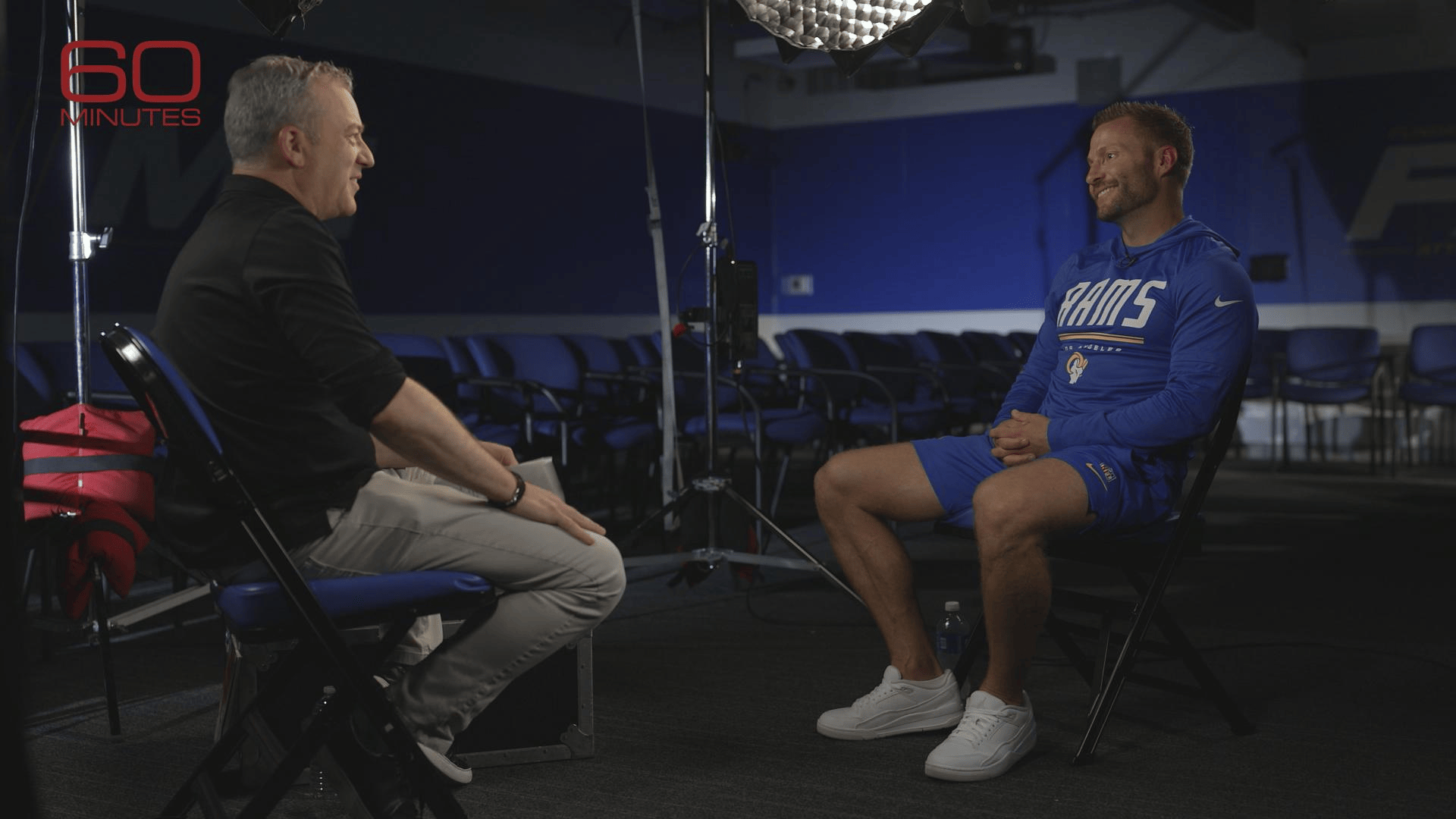
The Los Angeles Rams have spent much of the Sean McVay era challenging conventional wisdom about how an NFL team should be built. Now 60 Minutes is going inside the organization to examine the people, decisions and increasingly sophisticated technology behind one of football’s most ambitious franchises.
In “Battering Ram,” airing as part of the 60 Minutes Season 59 premiere on Sunday, September 13, correspondent Jon Wertheim reports from the sidelines of a Rams preseason practice and sits down with three of the organization’s most important figures: head coach Sean McVay, general manager Les Snead and quarterback Matthew Stafford.
CBS describes Los Angeles as a “superteam” and an early favorite to win the Super Bowl, but the story behind the current Rams stretches well beyond the team’s star players. It is also the story of an organization that has repeatedly been willing to trade convention for calculated risk.
- 60 Minutes Reports on “Shot Down Over Iran”, “The Pardon Economy” & “Battering Ram” on September 13 2026
- Shot Down Over Iran: 60 Minutes Reports on a Dramatic Rescue Behind Enemy Lines
- The Pardon Economy: 60 Minutes Goes Undercover Inside the Business of Seeking a Trump Pardon
Sean McVay Changed the Rams Almost Immediately
When the Rams hired Sean McVay in 2017, he was only 30 years old, making him the youngest head coach in modern NFL history at the time.
The turnaround was immediate.
Los Angeles had finished 4-12 in 2016, its first season back in Southern California after relocating from St. Louis. In McVay’s first season, the Rams went 11-5 and reached the playoffs.
Only a year later, McVay had them in the Super Bowl.
Although the Rams lost Super Bowl LIII to Bill Belichick and the New England Patriots, the rapid transformation established McVay as one of the NFL’s most influential young coaches.
His offensive concepts spread around the league, while teams increasingly began searching for young offensive-minded coaches who might become their own version of McVay.
But reaching another Super Bowl required something more.
Les Snead and the Rams Were Willing to Bet Big
If McVay became the public face of the Rams’ transformation, general manager Les Snead helped create the roster around him.
Snead has been Los Angeles’ general manager since 2012, predating both McVay’s arrival and the franchise’s move back to California.
Together, Snead and McVay became associated with one of the boldest roster-building philosophies in professional football.
Rather than treating high NFL Draft selections as assets that always had to be protected, the Rams repeatedly demonstrated a willingness to trade them for established stars.
That strategy produced a roster filled with recognizable names and eventually helped create the championship team Los Angeles wanted.
The approach was encapsulated by the famous “F them picks” slogan that became associated with Snead following the Rams’ Super Bowl victory.
It was an oversimplification — Los Angeles never stopped valuing the draft — but it captured the franchise’s willingness to sacrifice uncertain future assets when Snead believed a proven player could help the Rams win immediately.
Few moves demonstrated that philosophy better than the deal for Matthew Stafford.
The Matthew Stafford Gamble Changed Everything
By early 2021, the Rams had already reached a Super Bowl with quarterback Jared Goff.
They nevertheless decided that being good wasn’t enough.
Los Angeles agreed to trade Goff, two future first-round draft picks and a third-round selection to the Detroit Lions for Matthew Stafford, who had spent the first 12 seasons of his NFL career in Detroit.
Stafford’s individual ability had rarely been in doubt. He had accumulated enormous passing numbers with the Lions and developed a reputation for toughness, arm strength and late-game heroics.
What he didn’t have was postseason success.
Stafford had never won a playoff game before joining Los Angeles.
That changed almost immediately.
In his first season with McVay, Stafford helped take the Rams through the playoffs and into Super Bowl LVI, played at their own SoFi Stadium.
The Rams defeated the Cincinnati Bengals 23-20, giving Los Angeles its championship and Stafford the postseason breakthrough that had eluded him throughout his years in Detroit.
For Snead and McVay, it also provided powerful validation of their willingness to take enormous roster-building risks.
Stafford Remains Central to the Rams’ Super Bowl Hopes
Years later, Stafford remains one of the most important pieces of the Rams’ championship equation.
Quarterbacks are routinely playing deeper into their careers than previous generations, but succeeding at an advanced NFL age requires teams to manage a difficult balance between experience and physical decline.
Stafford’s value to the Rams goes beyond his passing statistics.
After years working with McVay, he has extensive command of the offense and the experience to diagnose defenses before the snap, manipulate coverage and make throws that many quarterbacks would avoid.
That relationship between coach and quarterback is one of the most interesting elements of the organization 60 Minutes is visiting.
McVay is known for his offensive preparation and ability to communicate complex concepts, while Stafford is a veteran capable of processing those ideas on the field almost instantaneously.
When both are operating at their best, Los Angeles can possess one of the NFL’s most sophisticated passing attacks.
The Rams Had to Reinvent Themselves After Winning the Super Bowl
The championship also created a problem.
The Rams had assembled an expensive, veteran-heavy roster designed to win immediately. Keeping that group together indefinitely was impossible.
Several prominent members of the championship team eventually departed or retired, and Los Angeles entered a period in which it needed to become younger while remaining competitive.
That forced Snead to demonstrate another side of his roster-building philosophy.
The general manager who became famous for trading away premium draft choices suddenly needed to find productive young players through the draft.
The Rams began replenishing their roster with younger, less expensive talent rather than relying exclusively on blockbuster acquisitions.
It amounted to something of a reset without committing to the traditional multi-year rebuild that often follows an NFL team’s championship window.
Puka Nacua Became the Perfect Example
Few players better illustrated that transition than Puka Nacua.
Los Angeles selected the BYU receiver in the fifth round of the 2023 NFL Draft, far from the portion of the draft normally expected to produce an immediate offensive star.
Instead, Nacua became one of the league’s biggest rookie revelations.
His emergence demonstrated why the Rams’ evolution after their Super Bowl victory mattered.
Los Angeles could no longer rely solely on trading high draft picks for established household names. It needed its scouting and development operation to identify undervalued players capable of contributing quickly.
Finding a player such as Nacua late in the draft gives a team an enormous competitive advantage because young players on rookie contracts cost dramatically less than established stars producing at a comparable level.
It is precisely the kind of advantage every NFL front office is searching for.
SoFi Stadium Is Part of a Much Bigger Rams Project
The modern Rams story also cannot be separated from owner Stan Kroenke and the franchise’s return to Los Angeles.
The Rams moved from St. Louis back to Los Angeles in 2016, returning to a market the franchise had left following the 1994 season.
The centerpiece of that return became SoFi Stadium in Inglewood, which opened in 2020.
The stadium is far more than simply the Rams’ home field. It anchors the enormous Hollywood Park development and has become one of America’s highest-profile sports and entertainment venues.
It has hosted a Super Bowl, major concerts and other enormous events, while Los Angeles will also play an important role in the 2028 Olympic and Paralympic Games.
For Kroenke, therefore, building a consistently successful Rams team is connected to a much larger investment in turning the franchise and its surroundings into a centerpiece of American sports.
The Rams Are Looking to Technology for Their Next Advantage
One of the more intriguing elements surrounding the 60 Minutes report is the Rams’ interest in technology and artificial intelligence.
Professional football has always been a sport of enormous amounts of information. Teams study thousands of plays, player movements, formations, tendencies, medical information and scouting reports while attempting to identify patterns that an opponent might overlook.
Modern computing has dramatically increased what organizations can do with that information.
AI potentially offers another step forward, helping teams process enormous datasets, identify tendencies and make information easier for coaches and football operations staff to use.
But football presents a particularly difficult challenge for technology.
A statistically optimal decision on paper may not account perfectly for a player’s health, weather, game situation, individual matchup or how an opponent is likely to react.
That means the competitive advantage may not come from allowing an algorithm to make football decisions. Instead, it can come from finding better ways to give human decision-makers useful information quickly.
For a franchise already known for questioning conventional NFL thinking, that makes the Rams a particularly interesting organization for 60 Minutes to examine.
Sean McVay Has Already Built an Influential Coaching Legacy
McVay’s influence extends well beyond Los Angeles.
Assistants who worked within his coaching network have gone on to receive prominent jobs elsewhere in the NFL, contributing to what has frequently been described as the Sean McVay coaching tree.
That is remarkable considering how young McVay was when his own head-coaching career began.
His success also influenced hiring trends throughout the league. NFL teams increasingly sought coaches who were young, offensively creative and capable of developing quarterbacks.
Not every coach subsequently labeled the “next Sean McVay” succeeded, but the trend demonstrated how quickly Los Angeles had changed perceptions of what an NFL head coach could look like.
McVay has now moved into a different stage of his career.
He is no longer simply football’s unusually young coaching prodigy. He is a Super Bowl-winning coach trying to sustain success across multiple versions of the same franchise.
Snead and McVay Have Survived the NFL’s Boom-and-Bust Cycle
One reason the Rams remain such an interesting organization is that their aggressive strategy could easily have produced a much different ending.
NFL teams that trade future draft capital, sign expensive veterans and push aggressively for a championship can find themselves facing painful consequences once that window closes.
Los Angeles experienced some of those pressures.
What makes the subsequent period noteworthy is that the Rams managed to replenish their roster rather than disappearing into a prolonged rebuild.
That doesn’t mean every decision worked.
But the partnership between Snead and McVay has endured through multiple stages: the rapid rise after 2017, the first Super Bowl appearance, the Stafford trade, the Super Bowl LVI championship and the subsequent transition toward a younger roster.
Continuity between a general manager and head coach for that length of time is increasingly unusual in an NFL where unsuccessful seasons can quickly cost both men their jobs.
Why the Rams Can Be Considered a Super Bowl Contender
Calling any NFL team a Super Bowl favorite before the season carries considerable uncertainty.
Injuries alone can completely transform a team’s prospects, particularly when its championship ambitions depend heavily on a veteran quarterback.
But the case for Los Angeles begins with a combination few teams can easily reproduce: an accomplished quarterback, a Super Bowl-winning head coach and a general manager with a demonstrated willingness to make aggressive moves when he believes the roster is close.
Stafford gives McVay the experienced quarterback required to run a sophisticated offense. McVay provides the offensive system and game planning. Snead controls the personnel operation and has shown little hesitation about changing the roster when an opportunity arises.
Los Angeles also has something less tangible but valuable: institutional experience.
The Rams’ leadership has already navigated a Super Bowl run, suffered a Super Bowl defeat, returned to win a championship and rebuilt significant parts of the roster afterward.
They know what a championship season requires because many of the people making the organization’s biggest decisions have already done it together.
The Clock Is Also Ticking
There is nevertheless an unavoidable tension surrounding this version of the Rams.
Stafford cannot play forever.
That makes every season with the veteran quarterback potentially precious. Los Angeles needs to compete in the present while also preparing for the point at which one of the most important players of the McVay era is no longer behind center.
Finding a long-term successor to a successful veteran quarterback is one of the hardest challenges in professional football.
The Rams’ ability to remain contenders after Stafford will ultimately become another major test of the McVay-Snead partnership.
For now, however, the objective is considerably simpler: maximize the opportunity while Stafford can still lead a championship-caliber team.
What to Expect From Battering Ram on 60 Minutes
That combination of ambition, urgency and experimentation gives “Battering Ram” a broader story to tell than a conventional NFL season preview.
Jon Wertheim’s access to Sean McVay, Les Snead and Matthew Stafford brings together the three figures who best represent the Rams’ modern identity: the coach who transformed the franchise, the executive willing to take extraordinary personnel risks and the quarterback acquired through perhaps their biggest gamble of all.
Viewers will also get a look inside a franchise that has invested heavily not only in players but in facilities, technology and new ways of finding competitive advantages.
The result is a revealing question for 60 Minutes to explore: after already proving that an unconventional strategy could produce a championship, what are the Los Angeles Rams willing to try next to win another one?
“Battering Ram” airs Sunday, September 13, 2026, as part of the 60 Minutes Season 59 premiere on CBS. Jon Wertheim is the correspondent, and Aaron Weisz and Ian Flickinger are the producers.