Shot Down Over Iran: 60 Minutes Reports on a Dramatic Rescue Behind Enemy Lines
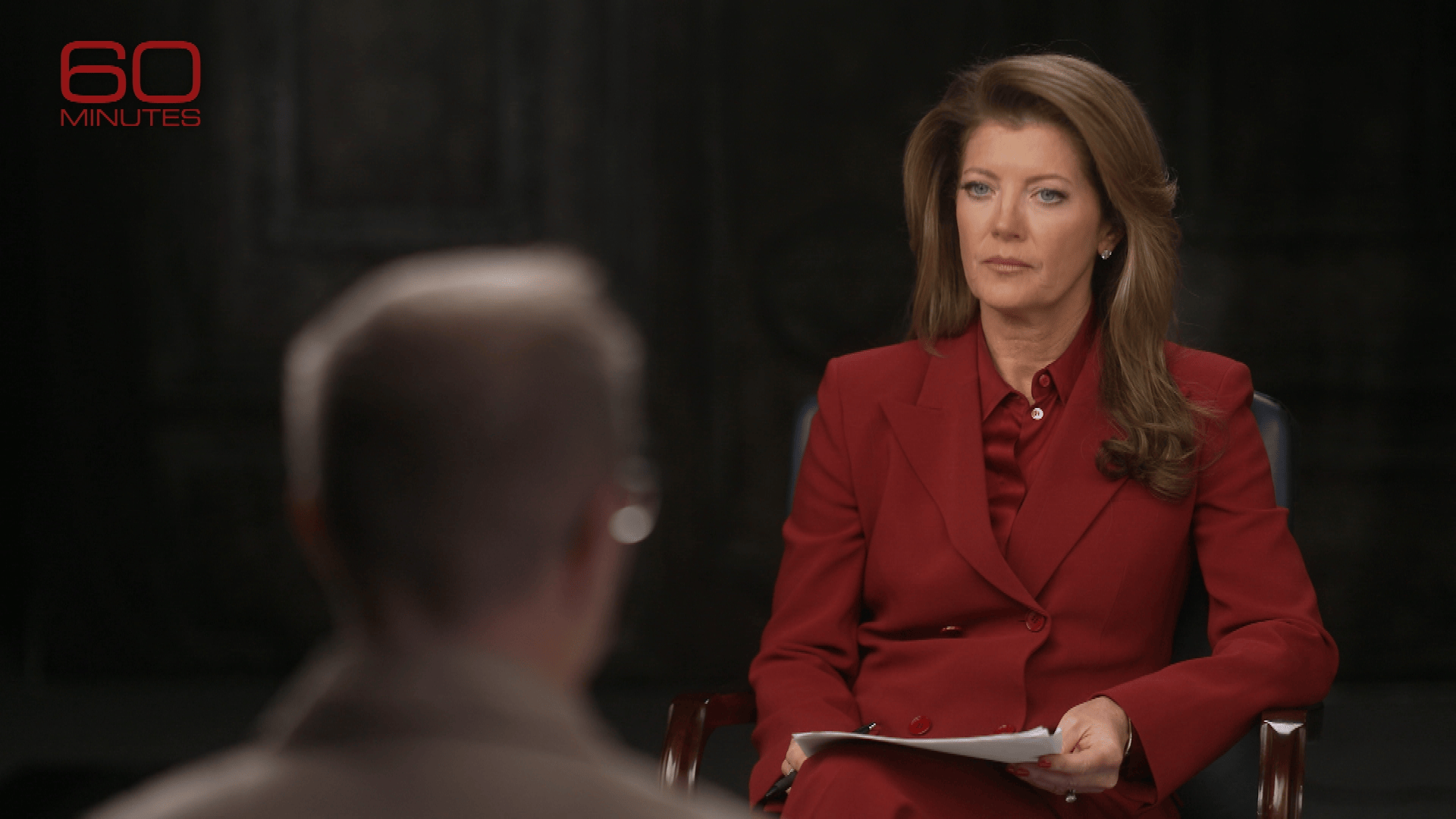
A U.S. Air Force officer who survived the destruction of his F-15E fighter and spent two days injured and alone inside Iran is telling his story publicly for the first time on the September 13, 2026 season premiere of 60 Minutes.
Correspondent Norah O’Donnell interviews the officer, identified by his mission call sign as Dude 44 Bravo, about ejecting from the aircraft, surviving behind enemy lines and trying to evade Iranian forces as the United States mounted an enormous effort to bring him home.
The incident developed into far more than the rescue of a downed aircrew. Dozens of aircraft and personnel were reportedly involved as U.S. forces searched deep inside hostile territory, while Iranian forces were simultaneously trying to locate the missing American.
CBS describes the mission as one of the riskiest and most complex rescue operations of its kind in U.S. military history. Five months later, 60 Minutes is returning to those two extraordinary days to tell the story from the perspective of the man at the center of the search.
- 60 Minutes Reports on “Shot Down Over Iran”, “The Pardon Economy” & “Battering Ram” on September 13 2026
- The Pardon Economy: 60 Minutes Goes Undercover Inside the Business of Seeking a Trump Pardon
- Battering Ram: 60 Minutes Goes Inside the Los Angeles Rams’ Super Bowl Quest
An F-15E Is Shot Down Over Iran
The ordeal began in early April when a U.S. Air Force F-15E Strike Eagle was brought down during a combat mission over Iran.
Unlike many fighter aircraft, the F-15E carries two aircrew. A pilot occupies the front cockpit while a weapon systems officer, or WSO, sits behind and plays a major role in operating the aircraft’s weapons and sensors and managing the complex workload of a combat mission.
Bravo was the weapon systems officer.
Both men managed to eject from the stricken aircraft, but they came down separately. That immediately transformed the incident into two different rescue problems.
The pilot was located and recovered within hours. Bravo was not.
For the next two days, the second airman remained somewhere inside Iran, injured and isolated while American forces attempted to find a way to reach him.
CBS says Bravo will describe to O’Donnell the harrowing ejection that began his ordeal, the injuries he suffered and what he did after finding himself alone on the ground.
Two Days Alone Behind Enemy Lines
Surviving the loss of the aircraft was only the beginning.
Bravo was now an American military officer stranded inside a country actively at war with the United States. He had to remain alive while avoiding the forces looking for him long enough for American rescuers to reach his position.
CBS says Iranian forces were closing in and a bounty had been placed on him.
The geography made the situation even more difficult. Contemporary accounts of the rescue described the missing officer as being in mountainous terrain, complicating both efforts to locate him and the challenge of extracting him.
Time was therefore critical.
Every additional hour increased the possibility that Iranian forces could find the officer before the Americans did. At the same time, attempting a rescue too quickly or without sufficient protection could expose helicopters, special operations personnel and other aircraft to Iranian forces.
Bravo’s survival therefore depended not just on his ability to evade capture but on a much larger American operation taking place around him.
Why Combat Search and Rescue Is So Dangerous
Recovering a downed airman from enemy territory is among the most difficult missions a military can attempt.
A rescue force has to locate the survivor, determine whether enemy forces are nearby, establish a viable route into the area and then get personnel or aircraft close enough to make the recovery.
Those rescuers can themselves become targets.
The problem becomes significantly harder when the survivor is deep inside an adversary’s territory rather than near friendly lines. Aircraft entering the area may have to contend with air defenses, enemy aircraft, ground fire and forces converging on the same location.
The rescue of Dude 44 Bravo consequently became a much larger military operation than simply dispatching a helicopter to collect him.
Reports published immediately after the mission described dozens of American aircraft participating in or supporting the effort, illustrating the resources required to recover a single stranded airman from hostile territory.
A Massive American Rescue Operation Takes Shape
While Bravo remained hidden, the United States began assembling the forces necessary to get him out.
The mission reportedly drew upon multiple elements of American air power and special operations capabilities.
American aircraft could perform very different roles during an operation of this scale: searching for and communicating with the survivor, watching Iranian movements, protecting the rescue force, suppressing threats and providing the transportation ultimately needed to extract the stranded officer.
The rescue was also taking place while the broader war continued.
That distinction is important. The United States was not conducting an isolated peacetime recovery mission. American forces were attempting to rescue a wounded officer inside the territory of an adversary with which they were actively fighting.
It meant commanders had to protect Bravo while simultaneously avoiding the possibility that an attempted rescue could produce additional American casualties or aircraft losses.
The First Crew Member Was Already Safe
There was at least one major piece of good news early in the operation.
The other member of the F-15E crew had been recovered.
The aircraft’s pilot was rescued within hours of the shootdown, confirming that at least one of the two men had survived the ejection.
But the successful first recovery also intensified attention on the missing weapon systems officer.
For roughly two days, the question remained whether American forces could reach Bravo before Iranian forces did.
The separation of the two crew members also helps explain why the rescue operation stretched over such a long period. Ejection from a fast-moving combat aircraft can leave crew members landing significant distances apart, and each survivor effectively becomes a separate search-and-rescue mission.
The Race to Find Bravo Before Iran Did
One of the most striking aspects of the story is that the United States was not alone in searching for the missing officer.
Iranian forces also wanted to find him.
Capturing an American colonel alive during an active war would potentially have had enormous military and political significance. It would also have transformed Bravo from a missing airman into a prisoner in Iranian custody.
American forces therefore faced a race.
Reports following the operation said the United States employed deception and misdirection as part of the rescue effort, seeking to confuse Iranian forces about American intentions while preparations were made to retrieve the officer.
At the same time, aircraft were reportedly monitoring threats approaching his position.
The result was an unusual combination of survival, intelligence, air power, deception and special operations—all centered on reaching one injured man before the enemy could.
American Air Power Protects the Downed Officer
Protecting Bravo while he remained on the ground was another crucial part of the operation.
Air & Space Forces Magazine subsequently reported that MQ-9 Reaper drones were among the aircraft protecting the stranded officer, with American aircraft taking action against people considered a threat as they approached his location.
Fighters and bombers were also reported to have participated in the wider mission.
That provides some sense of the extraordinary situation developing above and around Bravo. Although physically alone on the ground, he was effectively at the center of a large American air operation designed to prevent Iranian forces from reaching him first.
For the stranded officer, however, the experience would have looked very different.
He was injured, unable simply to leave Iran and dependent on rescuers whose arrival time he could not control.
It is that human perspective that 60 Minutes can add to a story previously known largely through official statements and reports from military and national-security sources.
The Final Rescue
The search eventually culminated in a nighttime operation to retrieve the missing officer.
American special operations forces reached Bravo in the early hours of Easter Sunday, April 5, ending approximately two days behind enemy lines.
Reports at the time described the final phase as an exceptionally complicated operation involving a substantial number of aircraft.
The rescue was successful: Bravo was recovered alive and returned to American control.
The moment ended one immediate crisis for the U.S. military. Both members of the downed F-15E crew had now survived and been recovered despite ejecting inside Iran.
It also meant the officer who had spent two days hiding from Iranian forces could finally receive treatment for the injuries he had suffered during the ejection and his time on the ground.
The Rescue Came at a Cost
Although the aircrew survived, contemporary reporting indicated the broader operation was not without losses.
Reports following the rescue described American aircraft being damaged or destroyed during the effort, demonstrating the level of risk commanders were prepared to accept to recover the stranded airman.
That willingness reflects a longstanding principle behind U.S. combat search-and-rescue operations: downed personnel should have reason to believe that an extraordinary effort will be made to bring them home.
It also highlights the difficult calculation commanders face.
Launching a rescue can place many more service members at risk than the number of people originally stranded. Yet abandoning an airman inside enemy territory carries its own military, moral and strategic consequences.
The Iran operation became an unusually dramatic demonstration of that trade-off.
What Dude 44 Bravo Says for the First Time
Until now, the story has largely been reconstructed from government announcements, military sources and reporting about the rescue operation.
Sunday’s 60 Minutes report changes that.
For the first time, viewers will hear extensively from the officer who actually spent those two days on the ground.
CBS says Bravo tells Norah O’Donnell about his ejection, his injuries, how he avoided Iranian forces and what happened while he waited for American forces to reach him.
He also reveals what he said to his rescuers when they finally arrived.
That firsthand account should fill in one of the largest gaps in the story: what those approximately two days looked and felt like from the perspective of the person everyone else was trying to find.
60 Minutes Also Interviews America’s Senior Military Leadership
O’Donnell’s report is not limited to Bravo’s account.
CBS says she has also interviewed Defense Secretary Pete Hegseth, Chairman of the Joint Chiefs of Staff Gen. Dan Caine and U.S. Central Command commander Adm. Brad Cooper.
Those interviews should allow 60 Minutes to reconstruct the rescue from both sides.
Bravo can explain what was happening on the ground while America’s senior military leadership can provide the broader operational picture: how commanders tracked the missing officer, assessed the danger and assembled the force needed to reach him.
That combination could provide the clearest public reconstruction yet of how the mission unfolded.
Why the Loss of the F-15E Was Significant
The shootdown itself was also an important moment in the war.
The F-15E Strike Eagle is one of the U.S. Air Force’s principal long-range strike fighters and has been used extensively in American combat operations.
Its two-person crew and ability to carry a large weapons load allow it to perform demanding missions against ground targets while retaining significant air-to-air capability.
Losing one to hostile fire demonstrated that American aircraft were still operating in a dangerous environment despite the scale of U.S. air operations over Iran.
The same period also saw the loss of an A-10 Thunderbolt II in the region, although its pilot was rescued.
Those incidents provided a reminder that claims of air superiority do not eliminate every threat to aircraft operating over hostile territory.
A Survival Story Inside a Much Larger War
The most compelling part of “Shot Down Over Iran” may ultimately be its contrast in scale.
At the strategic level, the incident was one small part of a much larger military campaign involving governments, commanders and large numbers of aircraft and personnel.
At ground level, the situation was extraordinarily simple.
One injured man was hiding inside enemy territory.
Iranian forces wanted to find him.
American forces had to reach him first.
For approximately two days, those two realities existed simultaneously—an enormous military operation unfolding around a single stranded officer trying to remain free long enough to be rescued.
Five months later, 60 Minutes is putting that officer at the center of the story.
When to Watch Shot Down Over Iran on 60 Minutes
“Shot Down Over Iran” airs as part of the 60 Minutes Season 59 premiere on Sunday, September 13, 2026.
The episode is scheduled for 7:30–8:30 p.m. ET on CBS following NFL football and 7:00–8:00 p.m. PT, with streaming available on Paramount+.
Norah O’Donnell reports the segment, with Keith Sharman serving as producer.
The premiere also includes Lesley Stahl’s investigation “The Pardon Economy” and Jon Wertheim’s Los Angeles Rams report “Battering Ram.”
But “Shot Down Over Iran” promises something that was missing from the dramatic reports that emerged in April: the story of the rescue told by the man who spent two days waiting for it to happen.
More 60 Minutes September 13 2026
- 60 Minutes Reports on “Shot Down Over Iran”, “The Pardon Economy” & “Battering Ram” on September 13 2026
- Shot Down Over Iran: 60 Minutes Reports on a Dramatic Rescue Behind Enemy Lines
- The Pardon Economy: 60 Minutes Goes Undercover Inside the Business of Seeking a Trump Pardon
- Battering Ram: 60 Minutes Goes Inside the Los Angeles Rams’ Super Bowl Quest