


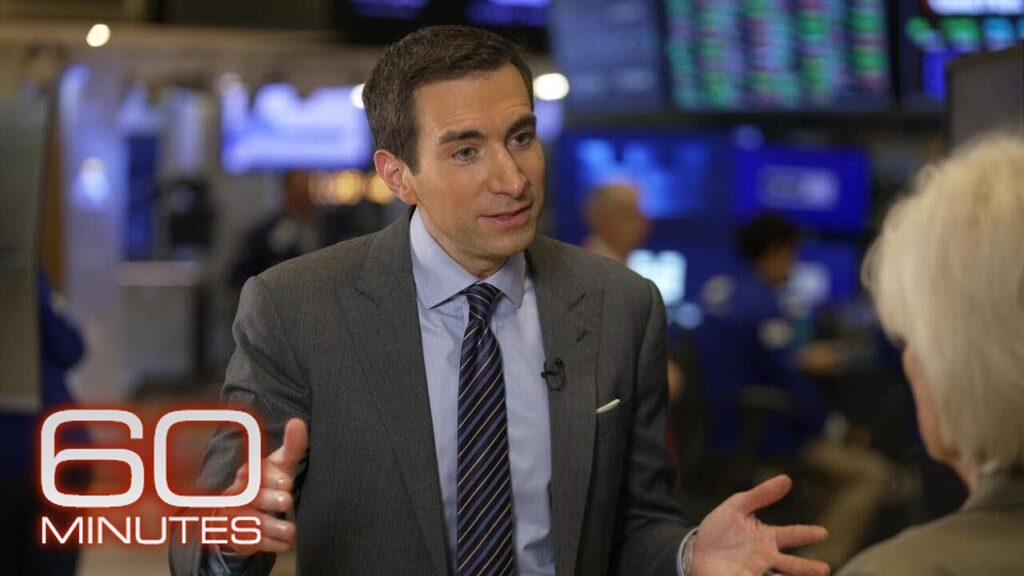
As investors continue pouring money into artificial intelligence companies and the stock market remains resilient despite global instability, “60 Minutes” is revisiting one of the darkest chapters in financial history to ask a troubling question: could another major crash be forming beneath the surface?
In the updated segment “Booms, Busts and Bubbles,” airing Sunday, May 24, 2026, correspondent Lesley Stahl speaks with veteran financial journalist Andrew Ross Sorkin about the lessons of the 1929 stock market collapse and how they may relate to today’s economy. The report comes at a time when concerns about market speculation, AI-driven hype and economic uncertainty are dominating Wall Street discussions.

- 60 Minutes Reports on “Booms, Busts and Bubbles”, “Sculpting Evolution” & The Payam Method” on May 24 2026
- Sculpting Evolution: 60 Minutes Reports on the Bold Plan to Stop Lyme Disease on May 24, 2026
- The Payam Method: 60 Minutes Reports on the Piano Teacher Changing Music Education on May 24, 2026
Why the 1929 Crash Still Matters Today
The stock market crash of 1929 remains one of the most important financial events in American history. It wiped out fortunes, devastated banks and triggered the Great Depression, leading to years of unemployment and economic hardship across the globe.
In the years leading up to the collapse, stock prices climbed rapidly as investors became convinced the market would continue rising indefinitely. Many Americans borrowed money to buy stocks, hoping to profit from what appeared to be unstoppable growth. Speculation reached dangerous levels, and confidence often outweighed caution.
Andrew Ross Sorkin’s book “1929” revisits that period in detail, examining how excitement, greed and fear combined to create one of the greatest economic disasters ever recorded. Through his conversation with Stahl, viewers are reminded that financial bubbles are often built on the belief that “this time is different.”
That phrase has echoed throughout history during periods of extreme optimism. From the dot-com bubble of the late 1990s to the housing market collapse in 2008, investors repeatedly convinced themselves that traditional warning signs no longer applied. The segment explores whether artificial intelligence and modern tech investing may now be creating a similar atmosphere.
The AI Boom and Today’s Market Anxiety
Artificial intelligence has become the driving force behind much of today’s stock market growth. Major technology companies have seen their valuations surge as investors bet heavily on AI transforming industries ranging from healthcare and finance to entertainment and transportation.
Companies connected to AI infrastructure, semiconductors and software development have experienced enormous gains over the past several years. Some analysts compare the excitement surrounding AI to the internet boom of the late 1990s, when investors rushed into technology stocks before the market eventually crashed in 2000.
Despite fears of inflation, international conflict and economic slowdowns, the market has continued climbing. That resilience has surprised many economists and added to concerns that stock prices may be increasingly disconnected from economic realities.
The “60 Minutes” segment examines how modern investing has also changed because of social media, instant information and retail trading apps that allow millions of people to buy and sell stocks within seconds. Unlike 1929, today’s market moves faster and is influenced by a nonstop cycle of online speculation and viral financial trends.
At the same time, supporters of AI investments argue that the technology is genuinely transformative and could justify the enormous valuations attached to leading companies. The debate over whether current prices reflect innovation or dangerous speculation sits at the center of the report.
Andrew Ross Sorkin’s Influence on Financial Journalism
Andrew Ross Sorkin has become one of the most recognizable voices covering business and finance in America. A longtime New York Times journalist and co-anchor of CNBC’s “Squawk Box,” Sorkin is known for breaking major Wall Street stories and explaining complex financial issues to mainstream audiences.
He gained widespread recognition for his bestselling book “Too Big to Fail,” which chronicled the 2008 financial crisis and was later adapted into an HBO film. His reporting during the collapse of Lehman Brothers and the banking crisis established him as one of the most trusted reporters covering modern finance.
Sorkin’s latest work, “1929,” reflects growing interest in historical financial patterns and whether markets are once again entering dangerous territory. His appearance on “60 Minutes” provides viewers with both historical perspective and contemporary analysis at a moment when many Americans are wondering how long the current bull market can continue.
The conversation also highlights how financial psychology often repeats itself across generations. Whether in the 1920s, the dot-com era or the AI age, investors frequently chase rapid gains while underestimating long-term risks.
Why Financial Bubbles Are Difficult to Predict
One of the challenges explored in the segment is the fact that financial bubbles are often only obvious after they burst. During boom periods, rising prices can reinforce confidence and encourage even more investment, creating a cycle that becomes difficult to stop.
Economists and analysts rarely agree on exactly when markets become overvalued. Some believe strong corporate earnings and technological advances support today’s stock prices, while others warn that excessive speculation could eventually trigger a major correction.
The Federal Reserve also plays a major role in market stability. Interest rate decisions, inflation control efforts and government policy can influence investor behavior and determine whether economic growth continues or slows sharply.
“Booms, Busts and Bubbles” examines how uncertainty itself has become part of the modern investing landscape. Many Americans now follow financial news daily through smartphones and social media, creating a culture where market swings can quickly spark both panic and euphoria.
The segment ultimately asks whether investors have truly learned from history or whether human nature continues to drive markets in predictable ways.
A Timely Look at Economic Uncertainty
The updated “60 Minutes” report arrives during a period of major transition in the global economy. Artificial intelligence is reshaping industries at extraordinary speed, geopolitical tensions continue affecting trade and energy markets, and investors remain divided over what comes next.
For viewers, the segment offers more than just financial analysis. It serves as a reminder that economic history is filled with periods of excitement followed by painful corrections, often when confidence becomes too widespread and skepticism disappears.
By revisiting the crash of 1929 through the lens of today’s AI-driven economy, “60 Minutes” provides a timely and thought-provoking examination of how markets rise, why bubbles form and whether another financial reckoning could eventually lie ahead.
More 60 Minutes May 24 2026
- 60 Minutes Reports on “Booms, Busts and Bubbles”, “Sculpting Evolution” & The Payam Method” on May 24 2026
- Booms, Busts and Bubbles: 60 Minutes Reports on Whether Another 1929 Crash Could Be Coming on May 24, 2026
- Sculpting Evolution: 60 Minutes Reports on the Bold Plan to Stop Lyme Disease on May 24, 2026
- The Payam Method: 60 Minutes Reports on the Piano Teacher Changing Music Education on May 24, 2026
More Feature Articles
- “The Barefoot Witness”: 20/20 Reports on Lyntell Washington Homicide May 22 2026
- Dateline NBC May 22 2026 Pre-Empted for NBA Western Conference Finals
- “Deadly Entanglement”: Dateline NBC Revisits Desiree Sunford’s Murder May 23 2026
- “Kouri Richins: Behind the Facade”: 48 Hours Reports May 23 2026
- 60 Minutes Reports on “Booms, Busts and Bubbles”, “Sculpting Evolution” & The Payam Method” on May 24 2026