One in a Million: 60 Minutes Reports on Aaron Baker’s Extraordinary Recovery After Being Paralyzed From the Neck Down
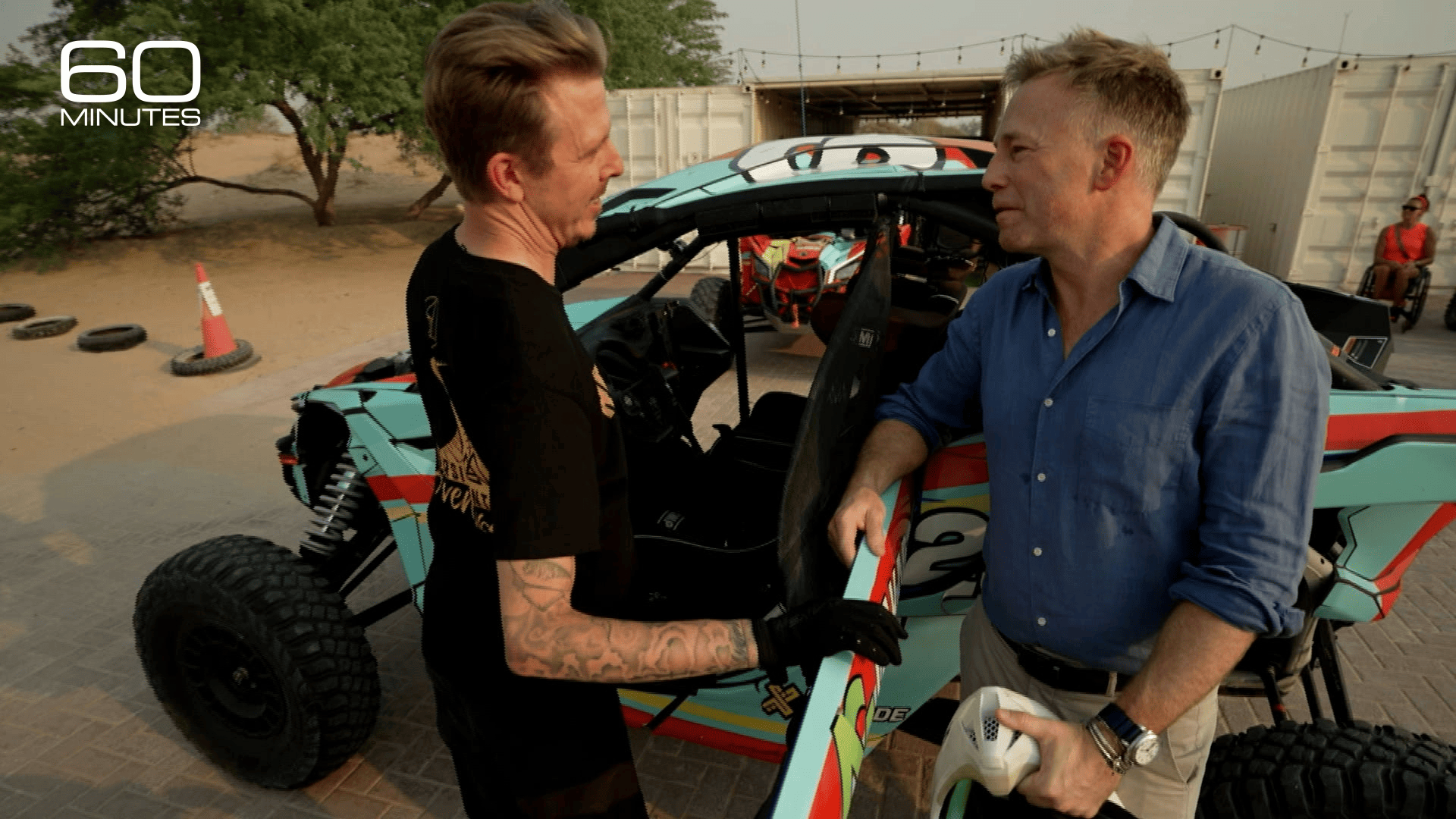
In “One in a Million,” CBS News correspondent Seth Doane explores Baker’s nearly three-decade-long journey through physical rehabilitation, consistent training and cutting-edge medical treatments.
The report, airing on Sunday, November 29, 2026, follows Baker from the suburbs of Los Angeles to the deserts of Dubai, examining his determination to challenge expectations about what might be possible following a severe spinal cord injury.
His story also provides insight into the evolving field of spinal cord rehabilitation and the medical advances offering new possibilities for people living with paralysis.
- 60 Minutes Reports on “Ukraine’s Stolen Children” & “One in a Million” November 29 2026
- Ukraine’s Stolen Children: 60 Minutes Investigates Russia’s Campaign to Erase Ukrainian Children’s Identities
Who Is Aaron Baker? From Professional Motocross Racer to Spinal Cord Injury Survivor
Before his accident, Aaron Baker was a professional motocross racer from California whose life revolved around motorcycles and competitive sports.
On May 26, 1999, Baker suffered a serious accident during a training session. He fractured three cervical vertebrae in his neck, sustaining a spinal cord injury that left him unable to move his body from the neck down.
The accident ended his professional motocross career and fundamentally changed his life.
Doctors gave Baker a one-in-a-million chance of ever being able to feed himself independently, a prognosis that provides the inspiration for the title of the 60 Minutes segment.
With the support of his family, particularly his mother, Baker began a lengthy rehabilitation process that would eventually see him achieve milestones once considered highly unlikely.
Aaron Baker’s Extraordinary Journey to Regain Movement
Baker’s recovery was not an overnight transformation. It involved years of restorative exercise, physical rehabilitation and repeated attempts to regain control over individual movements.
Small improvements gradually allowed him to undertake increasingly challenging physical activities. Over time, he regained the ability to feed himself and take steps independently.
His progress eventually extended beyond everyday activities. Baker participated in cycling events, completed two cross-country cycling journeys and pursued competitive para-cycling.
In 2011, he won a national para-cycling championship, an achievement that demonstrated how far he had progressed since his accident.
However, Baker continues to live with the effects of his spinal cord injury. Maintaining his physical abilities requires ongoing effort, and his experience demonstrates that rehabilitation can be a lifelong process rather than a journey with a clearly defined endpoint.
Understanding Spinal Cord Injuries and the Challenges of Recovery
The spinal cord carries signals between the brain and the rest of the body. Damage to this vital structure can affect movement, sensation and other bodily functions.
Injuries involving the cervical spinal cord can result in tetraplegia, also known as quadriplegia, affecting both the arms and legs.
The extent of paralysis and the potential for recovery depend on several factors, including the location and severity of the injury and the degree of preserved neurological function.
Rehabilitation typically focuses on helping individuals maximize their independence, strengthen available physical functions and adapt to changes in mobility.
Although some people regain movement following a spinal cord injury, recovery outcomes vary considerably. There is currently no proven universal treatment capable of fully restoring neurological function after such an injury.
Baker’s achievements are particularly remarkable given his initial prognosis, but his experience should not be interpreted as evidence that determination and exercise alone can reverse paralysis in every patient.
Coming to My Senses and The Rebellious Recovery
Baker has shared his experiences through documentary filmmaking, public speaking and writing.
His story is featured in the documentary Coming to My Senses, which chronicles his recovery and personal challenges, including an ambitious journey through the California desert.
He also published a memoir, The Rebellious Recovery, in July 2022, documenting his life before and after the motorcycle accident.
The book explores his experiences with rehabilitation, competitive cycling, entrepreneurship and building a family following his injury.
Rather than focusing exclusively on physical recovery, Baker examines how his accident changed his understanding of independence, achievement and personal fulfillment.
Helping Others Through Spinal Cord Injury Rehabilitation
Baker has also dedicated much of his life to helping other people living with spinal cord injuries and disabilities.
In 2011, he co-founded the Center of Restorative Exercise, commonly known as C.O.R.E., alongside exercise specialist Taylor-Kevin Isaacs.
The California-based initiative was established to help bridge the gap between traditional rehabilitation and longer-term physical exercise.
Baker has also become an ambassador for Wings for Life, a nonprofit organization supporting scientific research into spinal cord injuries.
His involvement reflects a commitment to improving opportunities for people living with paralysis while supporting research into future treatments.
From Los Angeles to Dubai: Aaron Baker’s Global Adventure
The 60 Minutes report follows Baker from California to Dubai as he continues pursuing an active life while exploring advanced medical treatments.
In June 2024, Baker, his wife Katelyn and their daughter Cayla embarked on an international journey called the Adversity Into Adventure World Tour.
The initiative aims to raise awareness and funds for disability-related causes, including rehabilitation, accessibility, recreation and neurological research.
The family combines different forms of adaptive transportation and physical activity throughout the journey, highlighting opportunities for people living with disabilities to participate in travel and adventure.
Seth Doane’s report examines Baker’s continuing physical and mental journey, including his pursuit of cutting-edge medical treatments that could help him regain further movement.
Advances in Spinal Cord Injury Treatment
Spinal cord injury research has expanded significantly in recent decades, with scientists investigating new approaches to restoring movement and improving independence.
Areas of research include electrical stimulation of the spinal cord, robotic-assisted rehabilitation, regenerative medicine and brain-computer interfaces.
These approaches address different aspects of spinal cord injuries, ranging from improving communication between the nervous system and muscles to helping patients perform movements through assistive technology.
While some experimental treatments have demonstrated encouraging results, their effectiveness varies, and many remain under clinical investigation.
Baker’s story provides a personal perspective on why continued medical research matters to people living with spinal cord injuries.
His determination to maintain his physical health while exploring new treatment opportunities forms an important part of the upcoming 60 Minutes profile.
When to Watch One in a Million on 60 Minutes
“One in a Million” airs Sunday, November 29, 2026, as part of a new edition of 60 Minutes on CBS.
Correspondent Seth Doane follows Aaron Baker’s nearly three-decade journey to regain movement after a motorcycle accident left him paralyzed from the neck down at age 20.
The report examines his commitment to physical training, advanced medical treatments and determination to challenge his original prognosis.
Nicole Young is the producer.
The episode airs 7:00–8:00 PM ET/PT on CBS and is available to stream on Paramount+.
The November 29 broadcast also features Bill Whitaker’s double-length investigation, “Ukraine’s Stolen Children.”
Through Baker’s extraordinary experiences, “One in a Million” explores the possibilities of long-term rehabilitation, the importance of medical innovation and how an individual can rebuild a meaningful life following a devastating injury.
More 60 Minutes November 29 2026
- 60 Minutes Reports on “Ukraine’s Stolen Children” & “One in a Million” November 29 2026
- Ukraine’s Stolen Children: 60 Minutes Investigates Russia’s Campaign to Erase Ukrainian Children’s Identities
- One in a Million: 60 Minutes Reports on Aaron Baker’s Extraordinary Recovery After Being Paralyzed From the Neck Down
More Feature Articles
- 20/20 Pre-Empted November 27 2026 for College Football
- Dateline NBC Pre-Empted November 27 2026 for College Football
- “Sarah Mattered”: 48 Hours Reports on Sarah Hunter Homicide and the 39-Year Investigation That Brought David Morrison to Justice November 28 2026
- “Jade Colvin Is Missing”: 48 Hours Reports on The Murder of an Iowa Teenager and the Conviction of James Bachmurski Sr. November 28 2026
- 60 Minutes Reports on “Ukraine’s Stolen Children” & “One in a Million” November 29 2026