


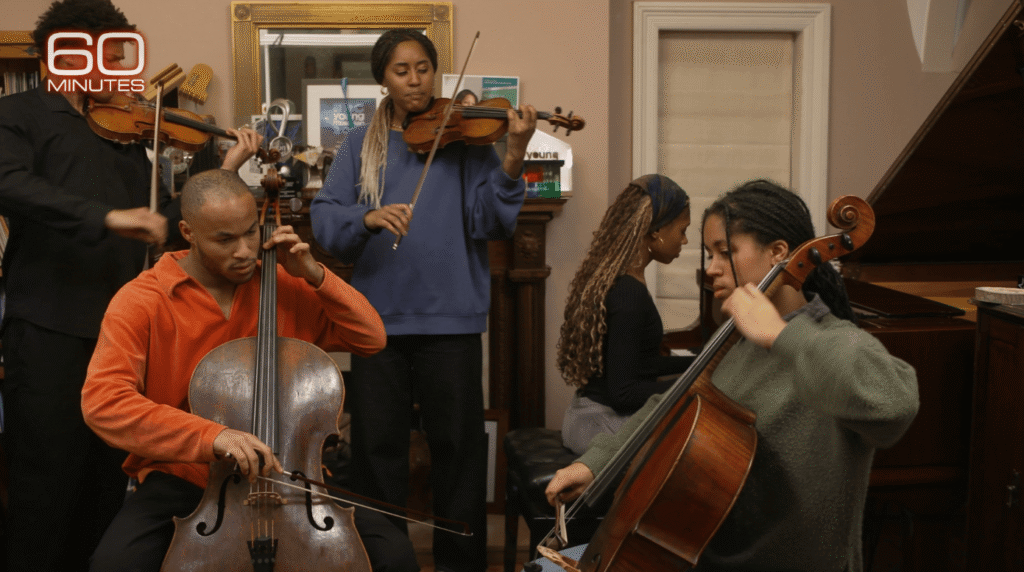
60 Minutes turns its attention to one of classical music’s most remarkable families on Sunday, August 30, 2026, when correspondent Jon Wertheim travels to Nottingham, England, to meet the Kanneh-Masons, seven siblings who have transformed a childhood filled with music into international careers.
In “Presenting the Kanneh-Masons,” Wertheim explores a family whose achievements extend far beyond the success of one celebrated musician. Isata, Braimah, Sheku, Konya, Jeneba, Aminata and Mariatu Kanneh-Mason all grew up playing classical music, often performing together while developing their own instruments and identities.
Sheku Kanneh-Mason may be the sibling most familiar to audiences around the world, particularly after his performance at the 2018 wedding of Prince Harry and Meghan Markle. The family’s story, however, begins years before that global television appearance, inside a Nottingham home where instruments, rehearsals, competitions and ensemble performances became part of everyday life.
- 60 Minutes Reports on “The Cap Arcona” & “Presenting the Kanneh-Masons” on August 30 2026
- The Cap Arcona: 60 Minutes Investigates One of World War II’s Final Tragedies on August 30 2026
Who Are the Kanneh-Masons?
The Kanneh-Masons are a British family from Nottingham consisting of parents Stuart Mason and Kadiatu Kanneh-Mason and their seven children: Isata, Braimah, Sheku, Konya, Jeneba, Aminata and Mariatu.
Each of the seven children developed substantial musical ability. Piano became a foundation for much of the family, while several siblings also specialised in string instruments. Collectively, they have pursued careers and studies involving piano, cello and violin while regularly performing in different combinations.
Their emergence attracted attention because having one musician reach an elite level requires years of training and commitment. Having seven children from the same household demonstrate serious classical ability is far more unusual.
Their achievements also challenge assumptions about what a classical music family looks like. As a prominent Black British family performing repertoire associated with a field that has historically lacked racial diversity, the Kanneh-Masons have become visible figures for a new generation of musicians and audiences.
Music Began at Home
The foundation of the Kanneh-Mason story was established long before international concerts and recording contracts.
Music occupied a central place in the children’s Nottingham upbringing. Their parents were not professional musicians, but both had musical backgrounds and placed considerable value on music as part of their children’s education.
Their mother, Kadiatu Kanneh-Mason, was born in Sierra Leone and later grew up in Britain. Their father, Stuart Mason, is from Antigua. Kadiatu studied at the University of Birmingham before attending the Royal Veterinary College, while Stuart worked in business.
Both played instruments themselves. More important was their decision to make music accessible to their children and to create a household in which practising was treated as a normal part of daily life.
With seven children learning instruments, that required considerable organisation. Lessons, practice sessions, school, rehearsals, performances and competitions had to coexist inside the routine of a large family.
Rather than producing seven identical musicians, that environment allowed the siblings to influence one another while pursuing individual strengths.
Isata Kanneh-Mason Led the Way
Isata Kanneh-Mason, the eldest of the seven siblings, became an important musical example for those who followed her.
A pianist, Isata studied at the Royal Academy of Music in London and developed an international career as a soloist and recording artist. Her emergence also meant the younger Kanneh-Masons grew up seeing an older sibling progress through advanced musical education and professional performance.
Isata has performed with major orchestras and at prominent venues while developing a recording catalogue that has helped bring attention to composers and repertoire beyond the most frequently performed classical works.
Her debut album, Romance, released by Decca Classics in 2019, focused on the music of Clara Schumann, whose work as a composer had historically been overshadowed by that of her husband, Robert Schumann. The project demonstrated Isata’s interest not only in performance but in broadening the repertoire presented to modern audiences.
She has subsequently established an identity independent of the family ensemble. That distinction is important to understanding the Kanneh-Masons: their collective story attracts attention, but their careers are not interchangeable.
Sheku Kanneh-Mason’s Historic Breakthrough
The family’s international profile changed dramatically with the emergence of cellist Sheku Kanneh-Mason.
Born in 1999, Sheku began learning the cello as a child and progressed through Britain’s youth music system. His breakthrough came in 2016 when, at 17, he won BBC Young Musician, one of Britain’s most prestigious competitions for young classical performers.
The victory was historic. Sheku became the first Black musician to win the competition since it began in 1978.
Winning BBC Young Musician established him as one of Britain’s leading young classical prospects. His career soon expanded through recordings, orchestral appearances and solo performances.
Then came an invitation that exposed his playing to an audience far larger than the conventional classical concert world.
The Royal Wedding Made Sheku a Global Name
On May 19, 2018, Prince Harry married Meghan Markle at St George’s Chapel at Windsor Castle. Hundreds of millions of people around the world followed coverage of the royal wedding.
Among the musicians performing during the ceremony was 19-year-old Sheku Kanneh-Mason.
Sheku performed three pieces during the signing of the register, accompanied by an orchestra. His appearance became one of the musical highlights of the ceremony and brought the young cellist to international attention.
The invitation reportedly followed a previous encounter with the Duke and Duchess of Sussex. Prince Harry had seen Sheku perform at an event in London and Meghan later personally contacted him about playing at their wedding.
For a teenager who had won BBC Young Musician only two years earlier, it represented an extraordinary leap in visibility.
Yet the royal wedding did not become the defining endpoint of his career. Sheku continued performing internationally and recording classical repertoire, including Elgar’s Cello Concerto, while studying at London’s Royal Academy of Music.
Sheku’s Cello Has a Special History
One of the interesting elements of Sheku’s career is the instrument on which he performs.
Professional string players at the highest level often use instruments that are centuries old and worth sums far beyond what a young musician could reasonably purchase. These instruments can be provided through trusts, foundations or private owners.
Sheku has performed on historic cellos loaned to him for his career, connecting a musician of the 21st century with instruments created generations earlier.
The relationship between performer and instrument is particularly significant for cellists. Differences in construction, age and character can affect how musicians approach tone and repertoire.
For audiences introduced to Sheku through a modern event such as the royal wedding, it is another reminder that his career operates within a musical tradition stretching back centuries.
Braimah Kanneh-Mason Chose the Violin
Braimah Kanneh-Mason, the second eldest sibling, established himself primarily as a violinist.
Like his brothers and sisters, Braimah began with music at a young age and later pursued advanced training. His work has included solo, chamber and ensemble performances, including appearances alongside his siblings.
The violin gives Braimah a natural role in many of the family’s ensemble configurations. A household containing pianists, violinists and cellists can form numerous chamber combinations without bringing in outside performers.
That ability to play together has been one of the family’s defining characteristics. Their shared experience extends beyond being siblings who happen to have the same profession. They spent their formative years rehearsing and making music with one another.
For chamber music, where performers must listen closely and respond to subtle changes from other musicians, years of familiarity can create a distinctive dynamic.
Konya Kanneh-Mason Developed as a Pianist
Konya Kanneh-Mason followed a path centred on the piano.
Like her siblings, she participated in music from childhood and progressed through formal training while also performing with members of the family.
The piano has a special place within the Kanneh-Mason household because several of the siblings learned it. It provided a shared musical language even when they later concentrated on different instruments.
Konya’s development also demonstrates how the family’s musical achievements were spread across the sibling group rather than concentrated exclusively on Isata and Sheku.
Public attention naturally gravitates toward the siblings with the largest international solo careers, but the 60 Minutes profile examines the Kanneh-Masons as a seven-person family. Their collective story depends on the musicianship and relationships of all seven.
Jeneba Kanneh-Mason Emerged as Another Major Pianist
Jeneba Kanneh-Mason has built her own reputation as a pianist, extending another branch of the family’s professional musical careers.
Her development included study at the Royal Academy of Music and performances as both a soloist and ensemble musician. Like Isata, Jeneba has been able to build a distinct identity around the piano despite growing up alongside siblings playing the same instrument.
That raises an interesting aspect of life inside the Kanneh-Mason household: comparison would have been almost unavoidable.
Seven talented siblings participating in auditions, lessons and performances could easily have created a fiercely competitive environment. The family instead frequently describes music as something shared, with siblings helping, listening to and learning from one another.
Competition and individual ambition still exist, but they operate alongside collaboration.
That relationship is central to Wertheim’s 60 Minutes report.
Aminata and Mariatu Complete the Seven Siblings
The two youngest members of the family, Aminata and Mariatu Kanneh-Mason, grew up in a household in which serious music was already firmly established by the time they began learning.
They had an unusual collection of examples immediately around them. Instead of looking only to professional musicians or teachers, they could watch older brothers and sisters practise, prepare for competitions, attend conservatoires, record albums and perform before major audiences.
At the same time, being one of the younger Kanneh-Masons came with a unique challenge. By then, the family name carried expectations.
Their musical development therefore illustrates another stage of the family story: what happens when younger children begin finding their own identities after older siblings have already achieved international recognition.
The 60 Minutes profile captures the seven siblings at different stages of that process, from established international careers to younger musicians continuing their development.
Britain’s Got Talent Introduced the Family to a Wider Audience
The family’s connection to television predates Sheku’s royal wedding performance.
In 2015, six of the siblings appeared together on Britain’s Got Talent as the Kanneh-Masons. Their appearance brought the family to a mainstream television audience at a time when several of the children were still young.
They progressed through the competition but did not ultimately reach the final.
In retrospect, the appearance is striking because it came shortly before Sheku’s BBC Young Musician victory and the rapid expansion of the family’s public profile.
Rather than representing a conventional reality television act that disappeared after the competition, the Kanneh-Masons continued through classical training and built careers within the professional music world.
It was an early glimpse of something that would become much larger.
The Role of Kadiatu Kanneh-Mason
Behind seven musical careers was an enormous amount of family organisation, much of it overseen by Kadiatu Kanneh-Mason.
Raising seven children would present logistical demands under any circumstances. Coordinating the education of seven serious young musicians added lessons, rehearsals, examinations, competitions, concerts and travel.
Kadiatu has since written about the experience, providing an account of family life behind the performances.
Her memoir, House of Music: Raising the Kanneh-Masons, describes the realities of raising seven children in a household where music was central. The story includes not only success but the practical work required to provide opportunities for each child.
The family’s rise was therefore not the product of a single discovery or television appearance. It developed through years of lessons, practice and parental commitment before most of the public knew the Kanneh-Mason name.
Seven Siblings Who Can Perform Together
One of the most distinctive qualities of the Kanneh-Masons is their ability to transform from a family into an ensemble.
The siblings perform separately, but different combinations can also appear together in chamber works and family concerts. Their instruments allow them to move between solo, duo and larger ensemble formats.
There is an obvious novelty in seeing seven siblings on the same stage, but their appeal extends beyond that.
Chamber music depends on communication. Musicians must understand when to lead, when to follow and how to respond to one another without words. The Kanneh-Masons bring years of family interaction into that process.
That is the idea at the heart of 60 Minutes’ description of them as an orchestra “greater than the sum of its parts.”
Their individual achievements are substantial, but placing them together reveals something different: a musical relationship formed long before recording contracts and international concert halls entered their lives.
The Kanneh-Masons and Representation in Classical Music
The family’s prominence also carries significance beyond performance.
Classical music institutions in Britain, the United States and elsewhere have spent years confronting questions about representation, participation and who feels that classical music belongs to them.
The Kanneh-Masons are a highly visible Black British family occupying some of the most traditional spaces in classical music: conservatoires, recital halls, orchestras, recording labels and major cultural events.
Sheku’s BBC Young Musician victory was particularly important because he was the first Black winner in the competition’s history.
The siblings have spoken about the importance of young people being able to see musicians with backgrounds similar to their own performing classical music at the highest level.
Their visibility does not mean that barriers within classical music have disappeared. It does, however, give audiences and aspiring musicians examples that were less common on Britain’s classical stages in previous generations.
Nottingham Remains Central to Their Story
Despite international careers, Nottingham remains fundamental to the Kanneh-Mason identity.
It was there that the siblings learned to play, attended school, rehearsed and developed as musicians. Their association with the city has remained strong even as their careers have taken them across Britain and around the world.
That is why Nottingham provides an important setting for Jon Wertheim’s 60 Minutes profile.
A concert hall can show what the Kanneh-Masons became. Their home city helps explain where it began.
The story is ultimately not one of seven musical prodigies appearing independently in the same family. It is about an environment in which music became normal: someone practising piano, another working on a cello passage, siblings rehearsing together and younger children watching what the older ones were doing.
More Than the Family of the Royal Wedding Cellist
For many people outside classical music, the name Kanneh-Mason remains most closely associated with Sheku and the royal wedding.
That moment deserves its place in the family’s history. A teenage cellist from Nottingham performing before a global audience at one of the decade’s most watched events was an extraordinary achievement.
But reducing the Kanneh-Masons to that performance misses the larger story.
Isata has developed an acclaimed career as a pianist. Braimah has pursued the violin. Konya and Jeneba have developed as pianists. Aminata and Mariatu have continued the musical tradition established by their older siblings. Together, the seven have performed as a family while following separate paths.
What makes them unusual is therefore not simply the level of talent inside one household.
It is that the success became sustainable.
Years after their first national television appearances, the Kanneh-Masons remain part of the international classical music landscape.
60 Minutes Goes Inside the Kanneh-Mason Family
In “Presenting the Kanneh-Masons,” Jon Wertheim travels to Nottingham to look beyond the concert programmes and individual accomplishments to examine the relationships connecting the seven musicians.
It provides a contrast to the first, double-length story in the August 30 broadcast, Bill Whitaker’s investigation of the Cap Arcona disaster. After an examination of one of the darkest events of the closing days of World War II, 60 Minutes ends its hour with a family whose story centres on music, opportunity and the power of performing together.
For the Kanneh-Masons, the most remarkable statistic may still be the simplest one.
Seven children grew up in the same Nottingham home.
All seven became accomplished classical musicians.
Yet their story is less about producing seven individual success stories than about the environment that connected them. Long before the Royal Academy of Music, recording contracts, BBC Young Musician, the royal wedding and international concert stages, they were brothers and sisters learning how to play together.
That shared foundation remains at the heart of the family that 60 Minutes introduces to its audience.
60 Minutes presents “Presenting the Kanneh-Masons” on Sunday, August 30, 2026, at 7:00 p.m. ET/PT on CBS and Paramount+. Jon Wertheim reports the segment, produced by David M. Levine.
More 60 Minutes on August 30 2026
- 60 Minutes Reports on “The Cap Arcona” & “Presenting the Kanneh-Masons” on August 30 2026
- The Cap Arcona: 60 Minutes Investigates One of World War II’s Final Tragedies on August 30 2026
- Presenting the Kanneh-Masons: 60 Minutes Meets the Extraordinary Family of Seven Classical Musicians on August 30 2026
Feature Articles
- “Evil in Eden”: 20/20 Reports on Cary Stayner, the Yosemite Murders and the Stayner Family’s Story of Horror and Heroism August 28 2026
- “The Other Side of Paradise”: Dateline NBC Revisits Sandra Galas Homicide August 28 2026
- “A Death in the Stairwell”: 48 Hours Reports on Kevin Davis & Alison Davis Case August 29 2026
- 60 Minutes Reports on “The Cap Arcona” & “Presenting the Kanneh-Masons” on August 30 2026