Sealand: 60 Minutes Visits the World’s Smallest Self-Proclaimed Nation on July 12 2026
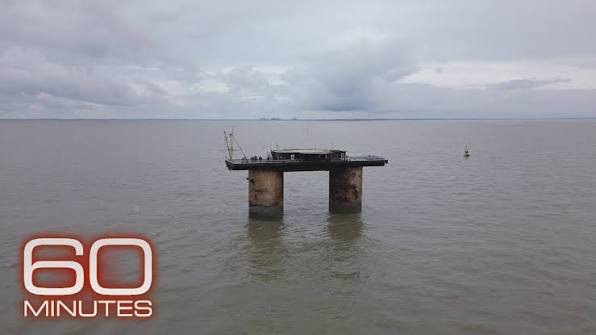
60 Minutes travels to one of the world’s most unusual destinations in “Sealand,” an updated encore report airing on Sunday, July 12, 2026. Correspondent Jon Wertheim ventures into the North Sea to visit the Principality of Sealand, a self-declared micronation located on a former World War II sea fort just off England’s eastern coast.
Accessible only by boat and a winch that lifts visitors onto the platform, Sealand occupies an area of roughly two tennis courts and has a permanent population of just one resident. Despite its tiny size, the fortress has become famous for its extraordinary history, which includes pirate radio, attempted coups, legal battles and decades of claims of sovereignty by the Bates family.
A Wartime Fortress in the North Sea
Sealand began life as HM Fort Roughs, one of several Maunsell Sea Forts constructed by Britain during World War II. Completed in 1942, the structure was built to defend shipping lanes and the Thames Estuary against German aircraft and naval attacks.
Unlike traditional forts, HM Fort Roughs stood on two reinforced concrete towers anchored to the seabed and connected by a steel platform. The isolated location allowed military personnel to monitor enemy movements while operating anti-aircraft guns far from the English coastline.
Following the end of the war, Britain’s military gradually abandoned many of the offshore forts. By the late 1950s, HM Fort Roughs had been left empty, seemingly destined to become little more than a forgotten relic of the conflict.
Its isolation, however, would soon make it attractive for an entirely different purpose.
The Rise of Pirate Radio
During the 1960s, Britain tightly regulated commercial radio broadcasting, leaving listeners with limited entertainment options. Entrepreneurs began establishing unlicensed “pirate radio” stations aboard ships and offshore platforms positioned outside Britain’s territorial waters.
The abandoned sea forts proved ideal for these operations. Their distance from land made enforcement difficult while allowing broadcasters to beam popular music into millions of homes across England.
HM Fort Roughs briefly became associated with pirate broadcasting during this period, helping cement its reputation as an outpost operating beyond conventional government control.
The pirate radio movement ultimately influenced British broadcasting policy by demonstrating public demand for commercial radio programming. While most offshore stations eventually closed, the era gave HM Fort Roughs a new identity that extended far beyond its military origins.
Roy Bates and the Birth of Sealand
The modern story of Sealand began in 1967 when Paddy Roy Bates, a former British Army major and pirate radio operator, occupied HM Fort Roughs with his family.
Claiming that the abandoned platform lay outside Britain’s territorial waters at the time, Bates declared it the independent Principality of Sealand on September 2, 1967. He proclaimed himself Prince Roy, while his wife Joan became Princess Joan, establishing what the family described as a sovereign constitutional monarchy.
The Bates family created many of the symbols commonly associated with nationhood. Sealand adopted its own flag, national motto, passports, stamps and currency, while drafting a constitution and issuing noble titles to supporters.
Although no United Nations member state has formally recognized Sealand as an independent country, the micronation has attracted worldwide attention as one of the longest-running sovereignty experiments in modern history.
A History Filled with Coups and Conflict
Sealand’s colorful history includes events more commonly associated with full-sized nations than a tiny offshore platform.
One of the most dramatic incidents occurred in 1978 when a group of German and Dutch businessmen attempted what has often been described as a coup. While Prince Roy was away, the group seized control of the platform and briefly held his son, Michael Bates, captive.
Michael later regained control with assistance from his father, reclaiming Sealand after what supporters describe as a counter-coup. The incident became internationally famous when one of the captured participants was a German citizen, prompting diplomatic discussions involving German officials.
The Bates family has long cited the episode as evidence of Sealand’s independent status, arguing that Germany’s involvement amounted to unofficial recognition. Legal scholars generally reject that interpretation, but the incident remains one of the micronation’s most celebrated chapters.
Does Sealand Really Qualify as a Country?
Whether Sealand can legitimately claim to be an independent nation remains the subject of ongoing legal debate.
Under international law, statehood is generally assessed using criteria outlined in the Montevideo Convention, including a permanent population, defined territory, government and the capacity to conduct international relations.
Sealand possesses some characteristics associated with nationhood. It has a governing family, constitutional documents and a distinct identity that has endured for decades. However, it lacks formal diplomatic recognition from established sovereign states, which remains a major obstacle to international acceptance.
Most governments and legal experts continue to regard Sealand as a privately occupied offshore platform rather than an independent country. Nevertheless, its unique circumstances have made it a frequent topic of discussion among constitutional scholars, historians and enthusiasts of international law.
A Global Curiosity
Despite its tiny footprint, Sealand has developed an outsized cultural presence.
Over the years, documentaries, books and news reports have introduced audiences to the platform’s remarkable story. The Bates family has welcomed journalists, historians and curious visitors eager to experience what is arguably the world’s most unusual self-declared nation.
The principality has also attracted attention from technology companies, internet entrepreneurs and collectors. At various points, Sealand promoted itself as a secure offshore location for digital data storage and has continued selling commemorative titles, coins and memorabilia to supporters around the world.
Its combination of military history, legal ambiguity and eccentric nation-building has transformed Sealand into one of Britain’s most distinctive tourist curiosities, even if relatively few people ever set foot on the platform itself.
Why Sealand Continues to Fascinate
More than half a century after its declaration of independence, Sealand remains a symbol of unconventional ambition and the enduring appeal of challenging established ideas about sovereignty.
Its story blends wartime history, pirate radio culture, family determination and international legal questions into a narrative unlike any other. While few expect Sealand to receive formal recognition as an independent state, its survival over decades has ensured its place as one of the world’s best-known micronations.
In 60 Minutes, Jon Wertheim explores not only the platform itself but also the remarkable people who continue to maintain it. Through firsthand access to the isolated fortress and interviews with those preserving its legacy, the report offers viewers an inside look at a place where history, law and imagination intersect in the middle of the North Sea.
More 60 Minutes July 12 2026
- 60 Minutes Reports on “The Vatican’s Orphans”, “Sealand” & “Christopher Nolan” on July 12 2026
- The Vatican’s Orphans: 60 Minutes Investigates the Secret Adoption Program That Separated Thousands of Families on July 12 2026
- Sealand: 60 Minutes Visits the World’s Smallest Self-Proclaimed Nation on July 12 2026
- Christopher Nolan: 60 Minutes Profiles the Visionary Director Behind The Odyssey on July 12 2026
More Feature Articles
- “The Bluegrass Mystery”: Dateline NBC Reports on Ella Jackson Homicide July 10 2026
- “House of Cards”: 20/20 Reports on Angel Goyena & Vonda Goyena Homicides July 10 2026
- “Chameleon”: Dateline NBC Examines the Two Missing Wives of Convicted Killer John Smith July 11 2026
- “My Mother’s Murder Trials”: 48 Hours Investigates the Dana Chandler Case on July 11 2026
- 60 Minutes Reports on “The Vatican’s Orphans”, “Sealand” & “Christopher Nolan” on July 12 2026