


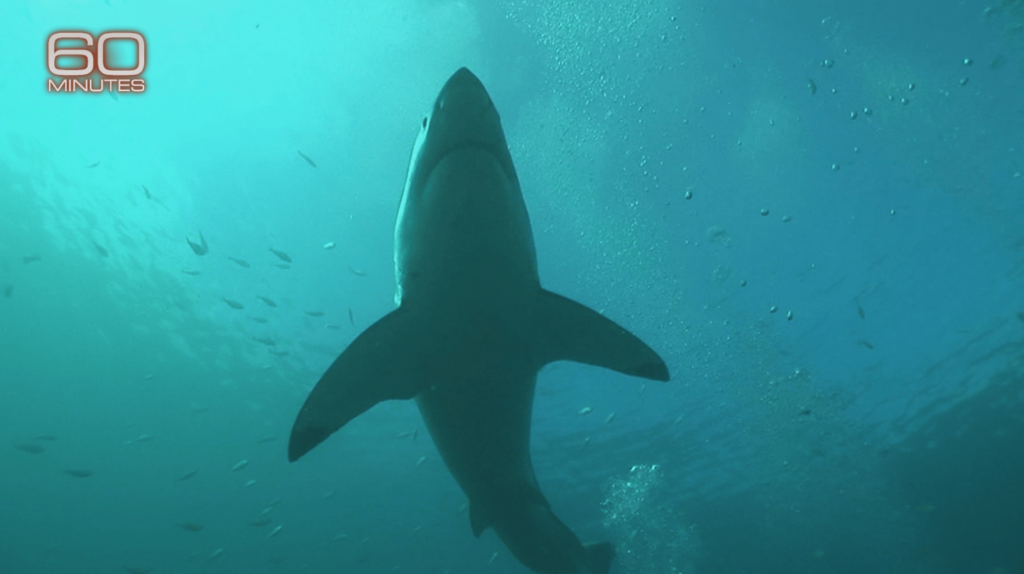
CBS’s 60 Minutes travels to South Africa for a gripping and unusual investigation in the segment titled What Happened to the Great White Sharks? Correspondent Anderson Cooper examines a decade-long mystery that has transformed one of the world’s most famous shark habitats into a site of uncertainty and debate. Once a global hotspot for great white shark sightings, the waters around Cape Town have seen a dramatic and troubling shift.
The report centers on a series of strange and unsettling discoveries: great white sharks washing ashore with their livers missing. The pattern has sparked intense scientific interest and disagreement, with competing theories and growing tension among researchers trying to explain what is happening beneath the surface.
- 60 Minutes Reports on “Pope Leo’s Church”, “Risk on the Road” & “What Happened to the Great White Sharks?” on April 12 2026
- Pope Leo’s Church: 60 Minutes Explores a New American Papacy and Its Global Impact
- Risk on the Road: 60 Minutes Investigates the Hidden Dangers of Chameleon Carriers
A Disappearance That Shocked a Global Hotspot
For years, Cape Town’s coastal waters, particularly around areas like False Bay, were known for reliable great white shark activity. Tourists and researchers alike were drawn to the region, where cage diving became a major attraction and a key part of the local economy. The sudden decline in sightings disrupted not only scientific observation but also an entire industry built around these apex predators.
The segment explores how quickly the change occurred. Within a relatively short period, sightings dropped off, and the once-predictable presence of great whites became increasingly rare. This disappearance raised alarm among marine biologists, who recognized that such a shift could signal deeper ecological changes.
The Disturbing Discovery of Missing Livers
Central to the mystery are the carcasses of great white sharks found along the coastline with a specific and unusual injury: the precise removal of their livers. This detail has become a focal point for investigators, as the liver of a shark is rich in nutrients and energy, making it a valuable target for predators.
The consistency of these findings suggests a deliberate and highly efficient process. Researchers have noted that the bodies often show minimal additional damage, indicating that whatever is responsible is capable of targeting the liver with precision. This has narrowed the range of possible explanations, while also intensifying the debate over what predator or mechanism could be responsible.
Orcas, Predators, and Competing Theories
One of the leading theories explored in the segment points to orcas, also known as killer whales, as the likely culprits. Evidence has emerged of specific orcas exhibiting hunting behavior that targets great white sharks, including documented cases where sharks were killed and their livers consumed. Some scientists believe that the presence of these orcas has driven great whites away from their traditional habitats.
However, not all experts agree with this conclusion. The segment highlights a divide within the scientific community, with some researchers questioning whether orcas alone can account for the scale of the disappearance. Alternative theories consider environmental changes, shifts in prey availability, and human activity as contributing factors. This lack of consensus has fueled ongoing debate and underscores the complexity of marine ecosystems.
Ecosystem Impact and the Role of Apex Predators
The disappearance of great white sharks has broader implications beyond the mystery itself. As apex predators, great whites play a critical role in maintaining the balance of marine ecosystems. Their absence can lead to changes in the behavior and population of other species, potentially triggering cascading effects throughout the food chain.
The segment examines how these ecological shifts are being observed and studied. Changes in seal populations and the behavior of other marine animals are among the indicators scientists are monitoring. The report emphasizes that understanding the fate of the great whites is essential not only for solving the mystery but also for protecting the health of the ocean environment.
A Scientific Feud in the Search for Answers
In addition to the environmental questions, 60 Minutes delves into the human side of the story, highlighting the disagreements among scientists and conservationists. Differing interpretations of data and evidence have led to a visible divide, with researchers advocating for competing explanations and approaches.
This tension reflects the challenges of studying complex and evolving natural systems. The segment presents these differing viewpoints, offering insight into how scientific debates unfold in real time. While the mystery remains unresolved, the ongoing investigation continues to drive research and collaboration, even amid disagreement.
Through on-location reporting and expert interviews, Anderson Cooper’s report captures both the intrigue of the mystery and the urgency of finding answers. What Happened to the Great White Sharks? stands as a compelling exploration of nature, science, and the unanswered questions that still lie beneath the ocean’s surface.
More 60 Minutes April 12 2026
- 60 Minutes Reports on “Pope Leo’s Church”, “Risk on the Road” & “What Happened to the Great White Sharks?” on April 12 2026
- Pope Leo’s Church: 60 Minutes Explores a New American Papacy and Its Global Impact
- Risk on the Road: 60 Minutes Investigates the Hidden Dangers of Chameleon Carriers
- What Happened to the Great White Sharks?: 60 Minutes Explores a Coastal Mystery and a Battle Within Science
More Feature Articles
- “One Last Call”: 20/20 Reports on Robbie Doerr Homicide April 10 2026
- “The Gorge”: Dateline Examines the Alice Ku Herchen Disappearance April 10 2026
- “The Pin at Apartment 210”: Dateline Investigates Jasmine “Jazzy” Pace Homicide April 11 2026
- “Kimberly Langwell’s Hidden Grave”: 48 Hours Reports April 11 2026
- 60 Minutes Reports on “Pope Leo’s Church”, “Risk on the Road” & “What Happened to the Great White Sharks?” on April 12 2026