A Psychedelic Journey: 60 Minutes Follows Veterans Searching for Relief From PTSD on August 16 2026
The August 16, 2026, edition of 60 Minutes revisits a deeply personal report about U.S. military veterans who traveled thousands of miles in search of relief from post-traumatic stress disorder. In “A Psychedelic Journey,” correspondent Anderson Cooper follows nine veterans to the west coast of Mexico, where they participate in psychedelic ceremonies after conventional approaches failed to provide the relief they were seeking.
The segment, produced by Katie Brennan, comes at a time when psychedelic-assisted therapy is moving from the fringes of mental health research toward more serious scientific investigation. The Department of Veterans Affairs has increasingly supported research into psychedelics, but these substances have not become standard VA treatments for PTSD. That gap between scientific interest and clinical availability is at the heart of the 60 Minutes report.
- 60 Minutes Reports on “A Psychedelic Journey”, “The Mardi Gras Indians” & “The Indomitable Margaret Atwood” on August 16 2026
- The Mardi Gras Indians: 60 Minutes Explores the History, Art and Resilience of a New Orleans Tradition on August 16 2026
- The Indomitable Margaret Atwood: 60 Minutes Profiles the Author Who Refuses to Be Silenced on August 16 2026
Nine Veterans Travel to Mexico Looking for a Different Approach
The veterans featured by 60 Minutes came from different parts of the United States but shared the experience of living with psychological wounds that remained long after their military service. CBS originally followed the nine veterans as they attended a week-long retreat in Mexico organized by the nonprofit Heroic Hearts Project.
For some members of the group, PTSD had affected nearly every part of their lives. Marine veteran and firefighter Ed Glover told 60 Minutes that after returning from Afghanistan, he struggled with anger, anxiety, hypervigilance and suicidal thoughts. Randy Weaver also struggled with suicidal ideation and memories associated with losing fellow service members.
Their decision to travel to Mexico illustrates one of the central issues explored in the report. Research into psychedelic-assisted treatment has generated considerable interest, but veterans who want to pursue these approaches cannot simply make an appointment at their local VA facility and receive psilocybin or MDMA as routine treatment.
Instead, some veterans have traveled outside the United States to retreats where particular psychedelics can be used under different legal and cultural frameworks. That has created an unusual situation in which veterans suffering from serious mental health conditions may seek experiences abroad that American researchers are still carefully evaluating in controlled clinical settings.
The Heroic Hearts Project and Jesse Gould
The retreat featured by 60 Minutes was organized by the Heroic Hearts Project. The organization was founded in 2017 by former Army Ranger Jesse Gould, who had his own experience with psychedelics after leaving the military. Gould traveled to Peru and participated in an ayahuasca retreat, an experience that eventually contributed to his decision to establish Heroic Hearts.
Gould believes psychedelic experiences can allow veterans to confront memories and emotions that may otherwise remain difficult to access. The idea is not simply that a psychedelic substance makes traumatic memories disappear. Rather, advocates believe that under appropriate circumstances, altered states may allow some people to revisit painful experiences from a different psychological perspective.
Gould also raised a more difficult question during Cooper’s reporting: why are veterans reaching the point where they feel they must leave their own country to find what they consider a final option?
That question gives “A Psychedelic Journey” a broader significance. The report is not simply about psychedelic drugs. It is also about what happens when veterans believe existing treatments have not been enough and begin searching for alternatives on their own.
What Happened at the Psychedelic Retreat
The veterans did not simply arrive in Mexico and immediately take psychedelic substances. CBS reported that participants underwent medical screening before the retreat. They also had to work with their doctors to discontinue certain antidepressant or anxiety medications because of possible interactions. People with a family history of psychosis or schizophrenia were excluded.
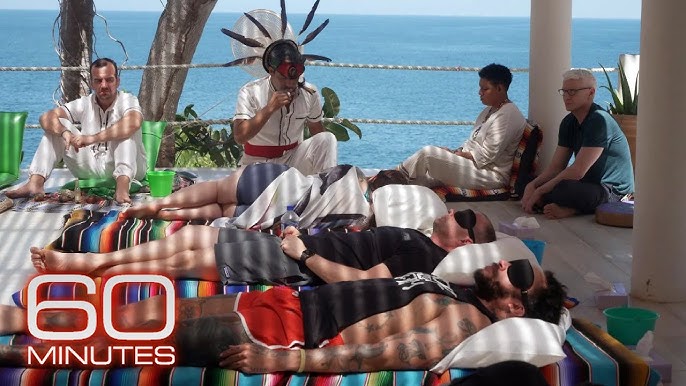
During the retreat documented by 60 Minutes, a local doctor was present, although CBS reported there were no mental health professionals on site during the ceremonies themselves. Traditional healers conducted three psychedelic ceremonies. The first two involved psilocybin, the psychoactive compound found in certain mushrooms.
The mushrooms were ground and prepared as tea. After drinking it, the veterans put on eye coverings to reduce outside distractions and lay down while waiting for the effects.
Their reactions varied considerably, which is an important part of the story. Psychedelic experiences are not uniform, and 60 Minutes did not portray every participant as having the same transformative response.
Michael Giardina Confronts Painful Memories
One of the most physically dramatic experiences captured by the cameras involved Navy veteran Michael Giardina. As the psilocybin began taking effect, Giardina’s foot started shaking before the movement spread through his body. He later described the experience as frightening and extremely intense.
For Giardina, the experience also brought up trauma extending beyond his military service. In follow-up reporting, CBS explained that his psychedelic journey confronted him with childhood trauma. He described entering an extremely dark psychological place while simultaneously feeling that he was finally able to address experiences he had carried with him.
His story highlights an important complication in discussions about PTSD among veterans. Trauma experienced during military service does not necessarily exist in isolation. A person can enter the military carrying earlier experiences and then encounter additional traumatic events during deployment or service.
Psychedelic experiences may therefore bring up memories that participants were not necessarily expecting to confront. That unpredictability is one reason researchers emphasize the importance of screening, controlled environments and professional support when studying psychedelic-assisted therapies.
Ed Glover Relives Years of Loss
Ed Glover’s experience was different but equally intense. His life had exposed him to trauma both as a Marine and later as a firefighter. During his psychedelic experience, he described feeling connected to the deaths of victims, patients and friends he had lost over the years.
The experience appeared to bring years of accumulated grief to the surface at once. For someone who had spent much of his adult life in environments where death and serious injury were possible, the psychological burden was not tied to one single event.
Glover subsequently told Cooper that before the retreat he had thought about suicide almost every day and had experienced a dangerously close call. When 60 Minutes checked in with him nearly a year after the retreat, he said those thoughts had stopped.
However, an important update complicates that initial outcome. When CBS revisited the story in June 2025, it reported that Glover had suffered a setback in his long struggle with PTSD and had subsequently sought conventional mental health care.
That update is particularly important because it prevents the story from being interpreted as evidence of a simple cure. A powerful psychedelic experience and short-term improvement do not necessarily mean that PTSD has permanently disappeared.
Randy Weaver Revisits the Loss of Fellow Service Members
Randy Weaver’s psychedelic experience brought him back to memories involving service members he had lost. He described visualizing fallen friends returning on medical evacuation helicopters and feeling as though he was able to revisit moments that had previously remained psychologically unresolved.
Weaver explained to Cooper that combat can create abrupt psychological breaks. A service member can be talking to a friend one moment and dealing with that person’s death shortly afterward. There may be little opportunity to process what has happened before the demands of military service continue.
Nearly a year after the Mexico retreat, Weaver told 60 Minutes that his suicidal thoughts had stopped. He believed revisiting those memories had brought him a degree of peace.
His experience helps explain why researchers are interested in combining certain psychoactive substances with psychotherapy. One hypothesis is that some drugs may temporarily change how fear, emotional openness and traumatic memories are processed, potentially allowing patients to engage with material that would otherwise be overwhelming.
Not Every Veteran Had the Same Experience
One of the most significant aspects of the 60 Minutes report is that it does not present psychedelic experiences as universally positive.
Veteran TJ Duff had a much less immersive response than several of the other participants. Rather than describing the experience as immediately liberating, he found aspects of it unsettling and frightening. He eventually left the retreat before completing the entire program.
The contrast matters. Psychedelics can produce powerful alterations in perception, emotion and thought, and those experiences can be unpredictable. An intense experience that one person interprets as therapeutic may be disturbing to another.
That uncertainty is also one reason personal stories, however compelling, cannot replace controlled clinical trials. Researchers need to determine not only whether treatments work on average, but which patients are most likely to benefit, what doses and therapeutic structures are appropriate, what adverse effects can occur and who should not receive them.
The Final Ceremony Involved 5-MeO-DMT
The retreat’s final ceremony involved 5-MeO-DMT, a potent and fast-acting psychedelic. CBS described the substance used at the retreat as originating from secretions associated with a toad.
5-MeO-DMT differs substantially from psilocybin in the duration and character of its effects. The inclusion of multiple psychedelic substances also makes the retreat fundamentally different from the tightly controlled clinical trials being conducted by medical researchers.
In a clinical trial, researchers typically investigate a particular drug, dose, treatment protocol and patient population. Participants are carefully monitored, outcomes are measured using established criteria and adverse events are documented.
The retreat featured by 60 Minutes represents a different model, one that combines psychedelics with traditional ceremonies and post-retreat support. After returning home, the veterans participated in virtual meetings with a Heroic Hearts Project counselor.
Why Scientists Are Interested in Psychedelic-Assisted Therapy
Interest in psychedelics as psychiatric treatments has grown substantially after decades in which research was severely limited.
Two substances have attracted particular attention: MDMA and psilocybin. Although they are often discussed together under the broad psychedelic label, they work differently. MDMA is generally described as an entactogen or empathogen rather than a classic psychedelic, while psilocybin is a classic psychedelic that acts primarily through serotonin receptors.
The VA’s National Center for PTSD says randomized controlled trials involving MDMA have produced promising findings, but emphasizes that research remains ongoing. Research involving psilocybin specifically for PTSD is at an earlier stage, although trials involving psilocybin for depression have also generated promising results.
Importantly, neither enthusiasm surrounding the research nor individual success stories mean psychedelic drugs are established replacements for current PTSD treatments. The VA continues to emphasize evidence-based psychotherapies and other established approaches while researchers investigate whether psychedelic-assisted therapy can eventually become another option.
The VA Has Returned to Psychedelic Research
The federal government’s changing position toward psychedelic research provides crucial background to the 60 Minutes story.
In January 2024, the Department of Veterans Affairs announced that it would seek research proposals examining psychedelic compounds including MDMA and psilocybin for PTSD and depression. It marked the VA’s return to funding research involving these compounds after decades away from the field.
In December 2024, the VA announced funding for a study of MDMA-assisted therapy involving veterans with both PTSD and alcohol use disorder. Researchers affiliated with Brown University and Yale University were selected to evaluate the treatment at VA medical centers in Providence, Rhode Island, and West Haven, Connecticut. The approximately $1.5 million project represented the first VA-funded psychedelic-assisted therapy study since the 1960s.
The research is carefully controlled. Participants receive psychotherapy, with some receiving a therapeutic dose of MDMA and others receiving an active placebo involving a lower dose. Pharmaceutical-grade MDMA is used, and participants are monitored under federal research and safety requirements.
VA Psychedelic Research Has Continued to Expand
The landscape has continued changing since 60 Minutes first reported the veterans’ story.
In May 2026, the VA announced a new randomized controlled clinical trial examining MDMA-assisted therapy for PTSD and alcohol use disorder. The trial is designed to enroll approximately 80 veterans and compare MDMA-assisted therapy with the same psychotherapy accompanied by an active placebo.
That development gives the August 2026 encore presentation additional context. What viewers are seeing began as a report about veterans traveling outside the United States because psychedelic therapy was not available to them through ordinary VA care. Meanwhile, the institutional research effort inside the VA has continued moving forward.
Still, research and routine treatment are very different things. The VA’s own National Center for PTSD continues to describe psychedelic-assisted therapy as an area under investigation rather than an established clinical treatment available to veterans generally.
The Evidence Remains More Complicated Than the Personal Stories
The emotional experiences documented by 60 Minutes are powerful, but the scientific picture requires more caution.
The VA and Department of Defense PTSD clinical practice guideline concluded that there was insufficient evidence to recommend either for or against substances including psilocybin, ayahuasca and DMT for treating PTSD. The guideline noted that qualifying evidence was lacking and that potential adverse effects and risks remain areas of concern.
The VA’s National Center for PTSD similarly notes that while MDMA trials have produced promising results, more research is required to understand both benefits and risks. Evidence involving psilocybin specifically for PTSD remains less developed.
That distinction is essential when interpreting “A Psychedelic Journey.” The segment documents the experiences of nine individuals. Their stories can help researchers, policymakers and viewers understand why veterans are interested in these treatments, but they cannot establish that the treatments are safe or effective for everyone with PTSD.
Eight Veterans Initially Reported Improvement
When 60 Minutes contacted the participants nearly a year after their trip to Mexico, eight of the nine veterans reported that their symptoms had improved and described the psychedelic experience as life-changing.
Those accounts provide the emotional conclusion to much of Cooper’s reporting. For veterans who had spent years dealing with traumatic memories, anxiety, anger and suicidal thoughts, even the possibility of meaningful improvement was significant.
But Glover’s later setback reinforces an equally important lesson: PTSD can be chronic and complicated. Improvement after one intervention does not guarantee permanent recovery. People may still require psychotherapy, medication or other conventional mental health care later.
Rather than weakening the story, that update adds important context. It illustrates why psychedelic-assisted therapy is being investigated as a possible component of mental health treatment rather than a simple one-time solution.
A Story About PTSD as Much as Psychedelics
Ultimately, “A Psychedelic Journey” is about more than controversial drugs.
It is a story about veterans living with trauma long after returning home and the lengths some are willing to go to find relief. Their decision to travel to Mexico reflects both their hope in an emerging field of mental health research and their frustration with the options they felt were available to them.
It is also a story unfolding while American medicine tries to determine whether substances once largely associated with illicit recreational use could have legitimate therapeutic roles when administered within carefully designed treatment programs.
The distinction between a retreat and a clinical treatment remains critical. The ceremonies documented by 60 Minutes should not be confused with the highly controlled psychedelic-assisted psychotherapy being studied by the VA and academic researchers.
For Cooper and 60 Minutes, the veterans themselves provide the human side of that scientific debate. Their experiences show why psychedelic research has attracted so much attention while also demonstrating why extraordinary individual experiences need to be followed by rigorous evidence.
“A Psychedelic Journey,” reported by Anderson Cooper and produced by Katie Brennan, airs as part of the 60 Minutes encore presentation on Sunday, August 16, 2026, from 7:00 to 8:00 PM ET/PT on CBS and Paramount+.
More 60 Minutes on August 16 2026
- 60 Minutes Reports on “A Psychedelic Journey”, “The Mardi Gras Indians” & “The Indomitable Margaret Atwood” on August 16 2026
- A Psychedelic Journey: 60 Minutes Follows Veterans Searching for Relief From PTSD on August 16 2026
- The Mardi Gras Indians: 60 Minutes Explores the History, Art and Resilience of a New Orleans Tradition on August 16 2026
- The Indomitable Margaret Atwood: 60 Minutes Profiles the Author Who Refuses to Be Silenced on August 16 2026
Feature Articles
- “Noises in the Night”: Dateline NBC Revisits the Homicide of Cassy Farrington August 14 2026
- “I’m Going to Get You”: 20/20 Reports on Debbie Dorian Homicide August 14 2026
- “Murder in the Parking Garage”: 48 Hours Investigates the Kenny Fandrich Homicide on August 15 2026
- 60 Minutes Reports on “A Psychedelic Journey”, “The Mardi Gras Indians” & “The Indomitable Margaret Atwood” on August 16 2026