
The Pardon Economy: 60 Minutes Goes Undercover Inside the Business of Seeking a Trump Pardon
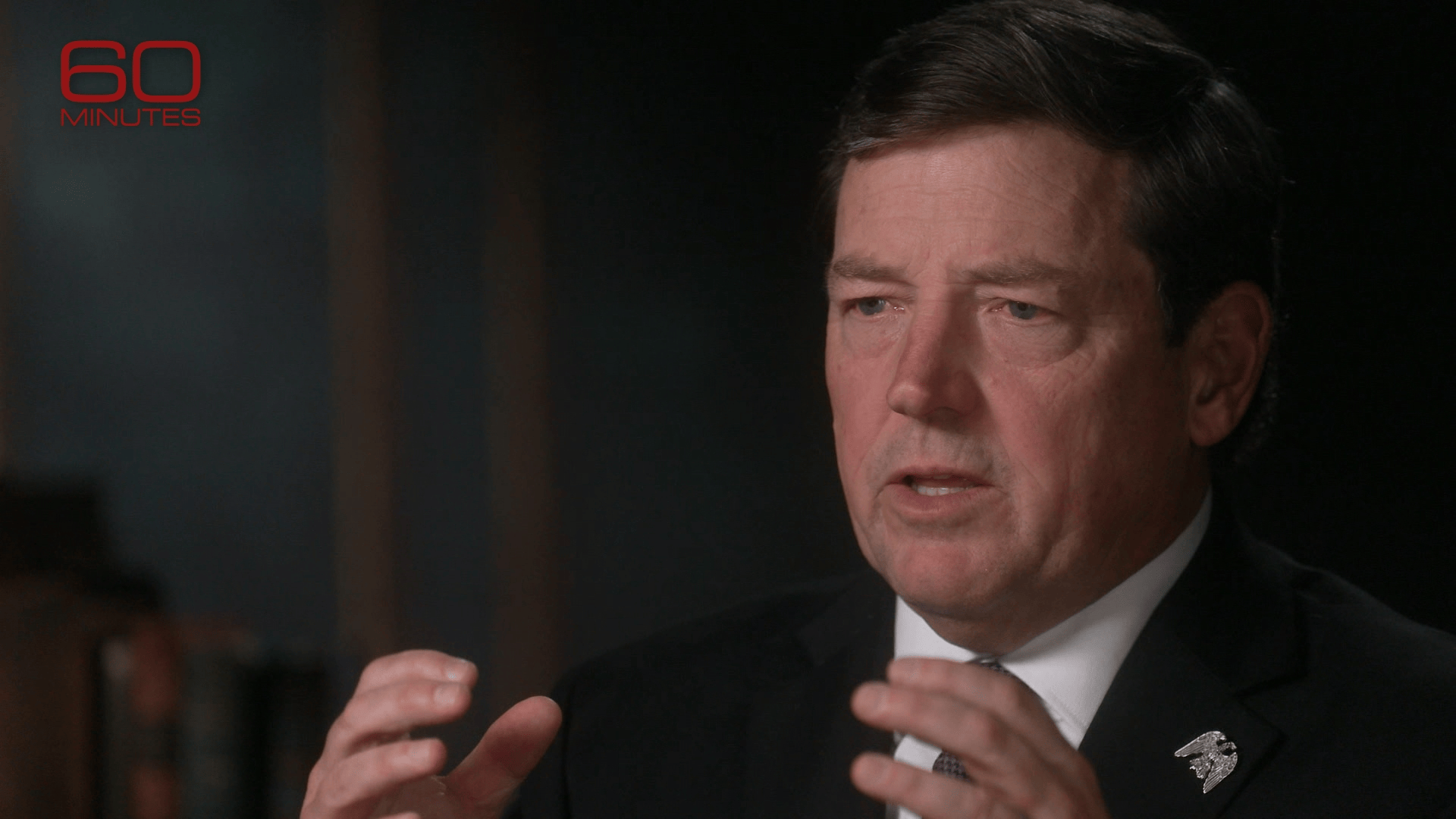
When 60 Minutes returns for its 59th season on Sunday, September 13, Lesley Stahl will investigate an unusual Washington industry in which access to the president could be extraordinarily valuable: the business of helping convicted criminals seek presidential pardons.
In “The Pardon Economy,” Stahl examines lawyers, lobbyists and other intermediaries offering to help people pursue clemency from President Donald Trump. CBS has revealed that the report includes a hidden-camera investigation into the business of brokering pardons, with prospective clients being offered a possible route toward clemency for a price — but without any guarantee that the president will ultimately grant their request.
The investigation arrives as reporting from several news organizations has documented a booming market for people who claim they can help put a clemency case in front of Trump or influential members of his circle. In some cases, the sums involved have reached hundreds of thousands of dollars or more.
That makes the central question behind Stahl’s investigation considerably larger than whether charging someone to advocate for a pardon is legal. It is about what happens to a constitutional power intended to provide mercy when access to the person holding that power itself becomes something extremely valuable.
What Is the Pardon Economy?
A presidential pardon cannot simply be purchased. The decision belongs to the president, and an attorney, lobbyist or political intermediary cannot guarantee that a client will receive one.
What can be sold, however, is advocacy and access.
People seeking clemency can hire lawyers to prepare their cases, lobbyists to advocate for them and politically connected intermediaries who may know people close to the administration.
That distinction is central to understanding what has become known as the “pardon economy.”
Recent reporting illustrates just how valuable such services have become. Bloomberg reported in 2025 that lawyers and pardon hopefuls described potential costs ranging from tens of thousands of dollars to more than $1 million to assemble a campaign and attempt to get a case before the White House.
Reuters subsequently conducted a much broader examination of Trump’s second-term clemency decisions. It identified 290 advocates or influencers who helped obtain clemency for 197 recipients, with some intermediaries appearing repeatedly. Six people familiar with the process told Reuters that intermediaries with demonstrated access to Trump’s circle could charge as much as $2 million for their services.
The important qualification is that these are payments for representation or advocacy, not a fee paid to the government in exchange for a pardon. There is no guarantee of success.
That uncertainty is precisely what makes the business examined by 60 Minutes so intriguing.
60 Minutes Goes Undercover
CBS says Stahl and the 60 Minutes team have gone beyond interviewing experts about the growth of pardon lobbying.
The investigation uses hidden cameras to examine people offering to broker pardons for convicted felons, allowing viewers to see how the opportunity is pitched to potential clients.
The distinction between promising access and promising an outcome could prove particularly important. A politically connected advocate might legitimately offer to present someone’s case to influential officials. That is very different from being able to guarantee what the president will do.
CBS’s preview indicates that the people encountered by 60 Minutes offer a chance at clemency for a price, rather than a guaranteed pardon.
The report therefore enters a murky intersection of law, lobbying, political connections and enormous financial incentives.
Presidential Pardons Are an Extraordinary Constitutional Power
The reason such access can become so valuable lies in the extraordinary breadth of the presidential pardon power.
Article II of the U.S. Constitution gives the president the power to grant reprieves and pardons for offenses against the United States, with an exception for impeachment. The Supreme Court has historically interpreted that authority very broadly.
It applies to federal offenses, rather than ordinary state crimes. A president therefore cannot simply pardon someone convicted solely under a state’s criminal laws.
A pardon can also have profound consequences. A full pardon can eliminate punishment associated with the pardoned federal crime and remove various legal disabilities flowing from the conviction.
Most importantly for the emerging pardon industry, the ultimate constitutional decision belongs to one person: the president.
Congress does not vote to approve an ordinary presidential pardon, and a court does not need to sign off on the president’s decision.
That concentration of authority makes presidential clemency fundamentally different from many other parts of the criminal justice system — and makes reaching the president potentially extremely valuable.
There Is Already an Official Way to Ask for Clemency
There is a formal system for people seeking presidential clemency that does not depend upon finding a politically connected lobbyist.
The Justice Department’s Office of the Pardon Attorney receives and reviews applications, investigates cases and provides recommendations to the president and senior Justice Department officials. The office traces its history back more than 130 years.
People who have completed sentences for federal convictions can submit pardon applications, while people still serving federal sentences can seek commutations. The Justice Department publishes the application process publicly.
The president, however, is not constitutionally required to follow that process.
That creates an important distinction between the formal clemency system and the more informal world being examined by 60 Minutes.
A person can submit an application through established government channels. But someone with sufficient resources may also decide to employ attorneys, lobbyists or other advocates who believe they can get the case noticed more quickly or place it before people closer to the president.
Trump’s Second Presidency Has Changed the Equation
Although controversial pardons long predate Donald Trump, his approach to clemency has intensified attention on the role of personal access.
Reuters examined thousands of records relating to clemency during Trump’s second term and reported that 96% of his second-term clemency grants had gone to recipients who did not meet longstanding Justice Department guidelines for such requests. Reuters contrasted that with fewer than 1% under the Biden administration and 14% during Trump’s first presidency.
The news organization also identified at least 110 Trump allies among the network of influencers it found advocating for clemency recipients. Some advocates had been involved in multiple successful cases.
That does not establish that money purchased those pardons. Nor does bypassing the Justice Department process make a pardon constitutionally invalid.
But it changes the incentives facing someone desperate to receive clemency.
If an applicant believes that getting a case directly before the president or someone close to him improves the chances of success, then a person who can credibly promise that access suddenly possesses something extremely valuable.
A $500,000 Pardon Lobbying Contract
CBS News itself uncovered a striking example earlier this year.
In June, CBS reported that Mo Strategies, a lobbying operation associated with former Trump campaign and administration officials, had expanded into pardon-related lobbying.
Federal lobbying disclosures showed the firm had been retained by Northern Virginia’s Blessinger Legal for “immigration and pardon-related discussions.”
The reported value of the engagement was already $500,000, according to CBS News.
It is an illustration of the scale the clemency business can reach.
For a wealthy defendant, hundreds of thousands of dollars could potentially be viewed as a rational expenditure if the alternative is years in federal prison, continuing restrictions caused by a conviction or other substantial consequences.
For the lawyers and lobbyists involved, meanwhile, the extraordinary value of a successful pardon can support extraordinary fees.
Some Pardon Campaigns Have Cost Even More
Reuters found examples illustrating an even larger market.
Its investigation identified only two successful recipients who had disclosed hiring registered lobbyists to seek clemency. Those lobbying efforts cost a combined $2.7 million.
But unsuccessful applicants were spending heavily as well.
Reuters found another 26 people who spent a combined nearly $1.9 million on lobbyists without obtaining clemency.
That last figure is especially important when considering the 60 Minutes hidden-camera investigation.
Hiring someone with political connections is not the same thing as buying a pardon. Even substantial expenditure may produce nothing.
When $600,000 Doesn’t Produce a Pardon
One of the clearest examples emerged publicly this summer involving rapper Boosie Badazz, whose legal name is Torence Hatch.
Hatch sought clemency following a federal gun conviction and reportedly paid lobbyists $600,000 in connection with efforts to obtain a Trump pardon.
The pardon did not materialize.
Hatch subsequently sought the return of $300,000, leading to a dispute over the arrangement and drawing considerably more attention to the pardon-brokering industry.
The episode illustrates the central risk for anyone entering this market.
A client can potentially spend an enormous amount of money hiring people who claim they know how to get a request noticed, yet the final decision remains outside their control.
Why Connections Can Be Worth So Much
Traditional lobbying usually involves trying to influence institutions.
Pardon lobbying is unusual because the ultimate decision cannot be delegated away from the president’s constitutional authority.
Reuters found that personal connections had become particularly important in Trump’s second-term clemency system. Its investigation identified figures ranging from lawyers and political operatives to longtime Trump allies who had advocated for applicants.
That creates an unusual marketplace.
The most valuable service may not necessarily be writing the strongest legal petition. It may be knowing who can get that petition read by someone who matters.
One advocate interviewed by Reuters described the value she provided in straightforward terms: access and relationships that could prevent an application from simply remaining unnoticed in a large pile.
It is this transformation of political proximity into a marketable service that helps explain the phrase “pardon economy.”
Why Supporters Say the Traditional System Needed to Change
There is another side to the debate.
Critics of the conventional Justice Department process have long argued that federal clemency became overly bureaucratic, slow and difficult to navigate.
Thousands of applications can remain pending, while people seeking mercy may wait years without receiving the outcome they want.
Trump administration officials and supporters of its approach have argued that disrupting that system can allow deserving cases to reach the president rather than becoming trapped in bureaucracy.
The administration’s pardon czar, Alice Johnson, has publicly rejected the suggestion that political connections determine which cases she considers, saying her focus is on the individual applicant, what that person has done and whether they are ready to reenter society.
There is also nothing historically unusual about presidents ignoring recommendations or making controversial clemency decisions.
The pardon power was deliberately placed in the executive branch, and presidents have enormous discretion over how they exercise it.
The Bigger Question: Who Gets Heard?
The strongest issue raised by the pardon economy may therefore be less about whether a particular lobbying arrangement is permissible and more about equality of access.
Two federal prisoners could theoretically have equally compelling cases for clemency.
One might complete the standard government application and wait.
The other might have the resources to spend hundreds of thousands of dollars hiring lawyers, lobbyists and political intermediaries who know people in the president’s orbit.
Both are ultimately asking the same person for the same constitutional act of mercy.
But they may have dramatically different opportunities to get their stories heard.
That tension between merit and access is what turns the business surrounding pardons from an obscure Washington lobbying story into a much broader question about the American justice system.
What to Expect From The Pardon Economy on 60 Minutes
Lesley Stahl’s report appears positioned to examine that system from the inside rather than simply debating the merits of Trump’s individual pardons.
The hidden-camera component should show viewers how pardon assistance is marketed to people who want clemency and what intermediaries say they can potentially accomplish.
Just as importantly, 60 Minutes will be examining an industry in which the product being offered is unusual: not necessarily a pardon, but a better chance of reaching the people who might help make one happen.
With reports of six- and seven-figure fees, a growing network of professional advocates and a president willing to exercise his clemency authority outside the traditional Justice Department process, the market surrounding pardons has become a story in its own right.
“The Pardon Economy” airs as part of the 60 Minutes Season 59 premiere Sunday, September 13, 2026, on CBS. Lesley Stahl is the correspondent, with Shachar Bar-On and Michael Kaplan producing the report.
More 60 Minutes September 13 2026
- 60 Minutes Reports on “Shot Down Over Iran”, “The Pardon Economy” & “Battering Ram” on September 13 2026
- Shot Down Over Iran: 60 Minutes Reports on a Dramatic Rescue Behind Enemy Lines
- The Pardon Economy: 60 Minutes Goes Undercover Inside the Business of Seeking a Trump Pardon
- Battering Ram: 60 Minutes Goes Inside the Los Angeles Rams’ Super Bowl Quest







Grey text on a white background is a poor choice for readability.